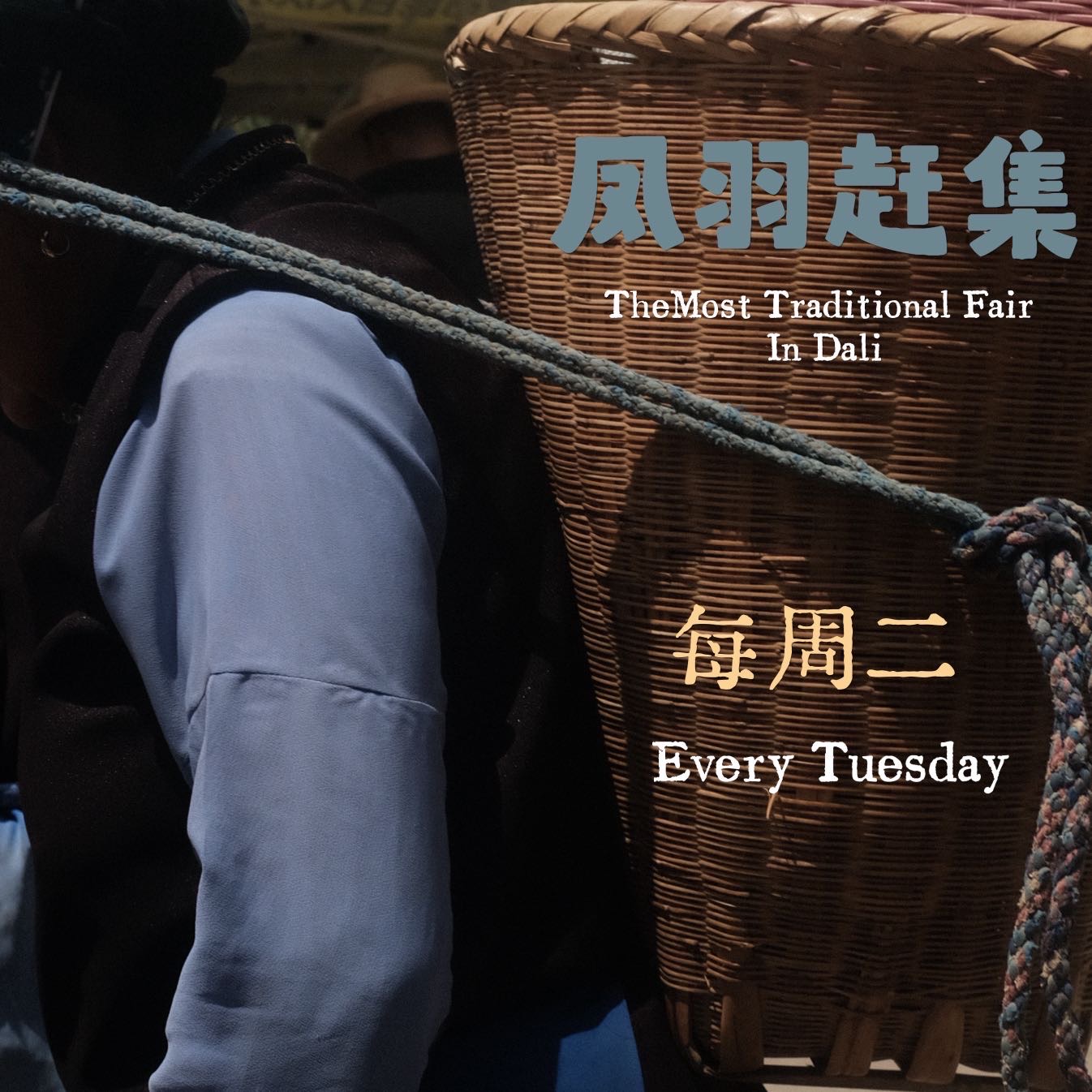
Itinerary:
Destination: Miaojie, Weishan (60 km from the old town, 1-hour drive)
Departure: 10:00 AM, meet at Pushí Baking, opposite Dali University
After the market, we'll have lunch at the livestock trading area within the market, enjoying local braised snacks and street food (cost shared, affordable, order as you like)
Return to Dali Old Town: 5:00 PM
Possible discomfort:
Most of our guides' vehicles are ordinary minivans.
On one hand, we are quite frugal; on the other hand, we often carry outdoor gear to the mountains and village dirt roads, and minivans are the most suitable transport partners. However, there are often children who especially enjoy the bumpy ride and call it the 'rocking car'.
I've long wanted to properly document the days of going to market in Yunnan, because it's rich, interesting, and like a window into a place, its people, and life through the market. In various trips across Yunnan, they all revolve around routes from village markets to forests. What locals eat and wear, what grows in the local forests.
But every time I go to market, I get excited, and when excited, I have no mind to record; when calm, I don't know where to start, because the daily details are both trivial and complex. We have two market activities: one in Fengyu and one in Shangguan, each with its own characteristics and temperament. Miaojie is not the first time either, but today felt especially different, and on the way back I thought I could try to record it. Write a long account of a short trip.
The first time I went to Miaojie market was before the New Year, still winter. Wangwang and I each bought a 20-yuan cotton vest, and I quite like mine. Miaojie is famous for its fermented black beans, and chili is one of the main ingredients for making them. It happened to be chili season, so the whole market was filled with the sound of pounding chilies, 'dong dong dong', like a unique rural market symphony in Miaojie. The people and scenes at the market were like a stage play.
The chili-pounding machine in Weishan
Going again today felt different. Besides the liveliness of the market, there was more gentleness and cuteness. From the live animal trading area to the daily necessities area, from the lively bustling area to a stroll in the quaint abandoned village, walking through the village along the pond, you can overlook the entire century-old village. Then rest in the shade by the pond, as if slowly crossing through time.
About the market
Actually, I've been to quite a few markets in Yunnan. The livestock trading area mostly has cows, sheep, pigs, chickens, ducks, cats, dogs, pigeons, rabbits, hamsters, etc. Once in Fengyu market, I saw a man leading a camel to sell. Haha, it's rare to see camels sold at rural markets in Yunnan, but it was my first time seeing so many donkeys and mules at a town market. Sellers are calling out, and buyers of livestock all look joyful, as adding a live animal to the family feels like a happy occasion.
A stubborn little sheep just bought, refusing to walk (like my stubborn self)
A mother cow and calf for sale, led by their owner to a possibly better-selling spot.
A mule stuck by branches
The most orderly and professional dog-selling area: several rows of regular iron poles, a dog parking lot, a dog parking area. A row of local dogs of various breeds tied up, mixed with some purebreds.
Encountered a group of high school students from Guangzhou on a sketching trip and their drawings, beside the cow shed and along the market road.
The lady will definitely take a chick home today
At a market where outsiders are rarely seen, shoes and clothes may not be nicely displayed; they might be piled on a cloth on the ground, on a makeshift wooden board, or in the back of a small truck. Even if some stalls are neatly arranged, they never look as glamorous as goods in the city, yet customers keep coming.
Village markets are mostly like this too. All goods seem less like commodities and more like a practical 'household item' one might need at home. In the rural areas of my childhood, every household had furniture for eating, clothing, and daily use: from door panels, wardrobes, and chairs, to pots and pans in the kitchen, down to pliers and wires for repairing furniture, threads and needles for mending. Nothing had a spare replacement. The miscellaneous goods at this market are like those 'household items' that always appear at home, indispensable, practical but not pretty.
A lady's half-tied tie-dye cloth
15 yuan for two pairs of holey shoes; we lingered at this stall for a long time.
The uncle selling hats
Cherry wood cutting boards—I really like such boards; they feel solid and steady, like they could last most of a lifetime. In March, we traveled from southeast to southwest Guizhou, going to markets along the way, and brought back a camphor wood cutting board from a market. We were happy for a long time, as if life had become more grounded and stable. This is just some strange emotional attachment I have to objects, haha. Maybe it's another reason I like going to markets, besides the difference and fun.
A lady's self-woven cushions and shoes
A mini local 'Panjiayuan'—although most things are the same, I can't help but look for oddities.
2 yuan per set of Jiama (paper charms), four or five sheets per set, pick your own; I picked a few.
The mending lady. After living in the city for a long time, I almost forgot that in childhood everything was mended and used for years. If something broke—buy; if you didn't like it—buy. We forgot about mending. After moving to Dali, I kept that habit, until Yanzi moved next door to the studio, and I realized mending is quite fun. It reminded me to first think about repairing things when they break.
The lady selling incense. Locals burn incense at their doorsteps on the 1st and 15th of each lunar month. Many elderly people make their own incense from pine, cypress, and mugwort; those who don't want to make it buy it at the market.
Wangwang and the 'magic broom' he encountered
Going to market is physical work; it takes a whole day, but you won't go hungry at the market. Everyone who comes to market solves lunch there. Besides food stalls, there are various snacks and fruits. It's also my main shopping battleground. After visiting many markets, I know what the land here grows, how to eat wild vegetables and herbs, what's in season, and what things I haven't seen before.
Fresh Aralia elata shoots and Chinese toon are the representatives of spring.
Yunnan produces plums and prunes, so almost every market has pickled plums, prunes, and pears.
The lady's stall doesn't have much: two or three kinds of greens she grew herself, and the rest are wild grasses and flowers, including jasmine for herbal tea, Erigeron annuus (I read in a book that Erigeron annuus can be medicinal; it was my first time seeing locals sell it as medicine), and picked green prickly ash shoots.
Unripe green plum babies; Wangwang says he likes to eat them because they're sour and astringent. I think it's similar to Americano; if you really eat them, a little chili powder would make them taste better.
Bundles of tobacco leaves are not hard to find at various markets in Yunnan, and they are part of daily life.
We ate at a food stall in the livestock area. We discussed before that these stalls aren't like proper restaurants, but the food is good. Eating a meal at a local market after shopping is also a special experience.
The food hall at the market
I find this scene very cute: the stall owners sit inside in a row, while流动 diners sit outside in waves. Wangwang calls it 'liangfen omakase'.
The grandparent and grandchild selling candy
At the market, there's all Luoboke tea. Luoboke is a place name, located in the Wuliang Mountains. At first hearing, Luoboke sounds foreign, like a foreigner's name, but it's actually a Yi name. In the Yi language, Luoboke means 'place where fierce tigers roam'. The Yi people revere tigers; along the way, we passed many Yi villages, and every household has tiger head patterns painted on the gable walls. Luoboke produces tea; there are ten thousand mu of tea gardens there, famous for green tea.
The man buying baba (flatbread) at the stall said that what they Hui people make is clean and delicious, and we Han people love to eat it, so he told me to buy some too. Actually, since we've lived in Dali for a long time, we often go to Hui restaurants; they're clean, tasty, generous in portion, and fair in price. I also bought some baba to take back. What we can't finish goes in the fridge; reheated in the morning, it's a fragrant breakfast.
Came across some sophora rice tea and bought some.
The lady sells tu jian (earth alkali). At first I thought it was ciba (glutinous rice cake), but looking closely, the texture was different, like cakes made of sandstone powder. The aunties and uncles at the stall generally don't speak Mandarin well; for common things you can guess, but for something completely unknown, it's hard to understand. Xiao He looked it up and found it's tu jian, an intangible cultural heritage of Nanjian, used medicinally by locals. This thing is troublesome to make and troublesome to eat. As a man at the market said, 'You outsiders don't know how to eat it,' meaning we don't know how to prepare it.
The market activity is a complete rural trip, I think. From the lively, bustling market to the quiet village, you'll enjoy that moment of tranquility even more. So our market activities always go from the market to a quiet village, just like locals returning home after the market.
Like Village is the next stop after the market. From Miaojie market to Like Village is not far; along the way, spring is green with rapeseed flowers and broad beans, mixed with warm wheat, making people feel warm.
Now the villagers of Like Village have moved to the periphery of the original site and built new houses, while the ancient village from the Ming and Qing dynasties has been preserved. Over thirty courtyards are clustered together, close to the mountain. The independent courtyards gathered together look like a complete, solid, large fortress. The murals, eaves, and door frames of each house have completely retained their quaint appearance. No modern buildings are mixed in the entire village. A few households still live inside, but I hardly ever meet anyone when I visit, occasionally an elderly person going to the old house to fetch well water.
Behind the village is a pond, where you can always see one or two fishing rods set up, but I've never met anyone. Walking along the embankment, resting in the shade by the pond with tea, cars passing on the highway on the opposite mountain, the village quiet on the left, birds singing by the pond, and a puppy running happily around your feet. It gives the illusion of being in a hometown village in Yunnan.
Walking back from the pond to the village entrance, overlooking the entire old Like Village
On the way to Like Village, we pass the Xi River. Who could guess that this is an important international river that flows through 12 provinces, with a total length of 1,280 km, the only major international river originating in Yunnan, and also the largest river in northern Vietnam, the Red River? Tracing back to its source, it turns out to be such a delicate little stream by the village.
The green waves of rapeseed flowers along the riverbank
The stone bridge and huge Pistacia chinensis at the entrance of Like Village
Strolling in the deserted ancient village
Walking through the village and climbing up the pond embankment
On the embankment, looking at the quiet abandoned village, the quiet pond behind the houses, and vehicles speeding on the highway in the distance, there's a sense of crossing time and space.
On the way back, take another look at the complete village