Life in Dali
Handicrafts and Architecture of Dali (Dali): A Complete System Left by an Independent Kingdom
Aug 15, 2026
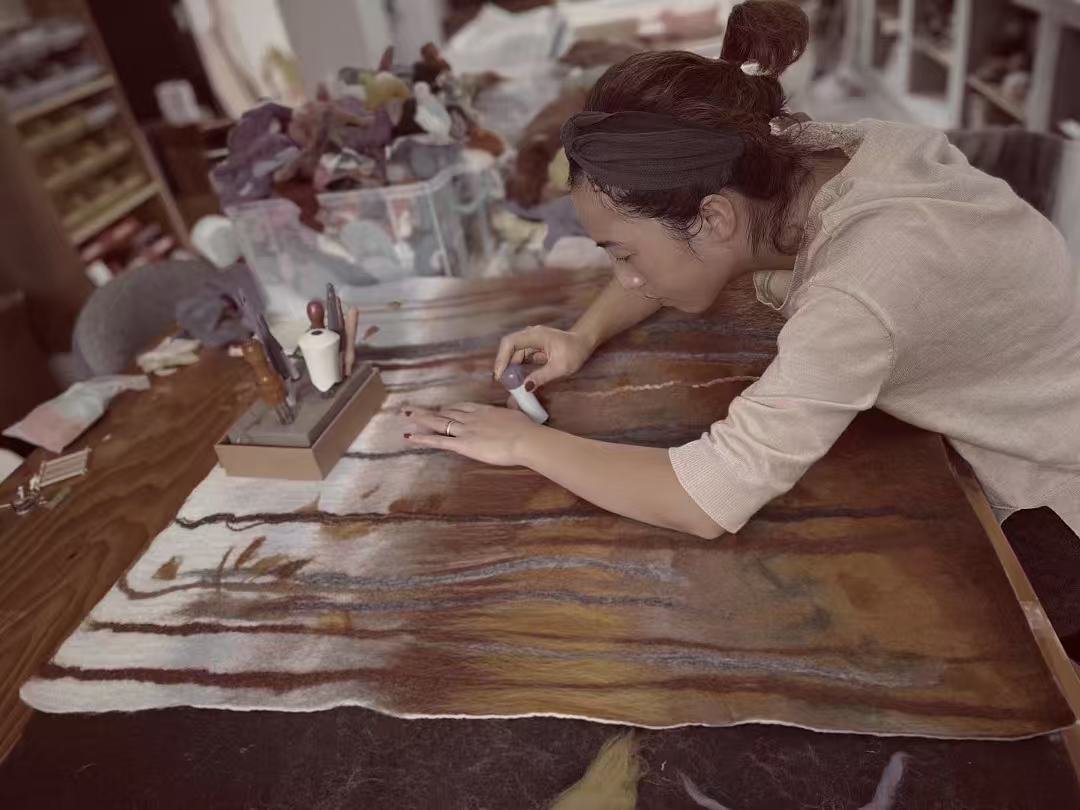
The craftsmanship of a place is often more honest than official history. It does not speak of emperors and generals, only of specific days: cloth soaking beside dye vats, silver being hammered on workbenches, ceramic beasts crouching on roof ridges. Why has Dali been able to form such a complete craft system? A major reason is that it was once an independent kingdom—over nearly five hundred years of the Nanzhao and Dali Kingdom, artisans on the land beside Erhai Lake slowly blended Buddhist, indigenous, and South and Southeast Asian techniques into their own style, passing it down from generation to generation.
Saying that "the history of Dali is the history of Yunnan" is no exaggeration. Nanzhao rose in the eighth century and established its capital between Cangshan and Erhai; the ruins of Taihe City and Yangjumie City still exist today. The Dali Kingdom followed, with Buddhism as the state religion, and its capital was in the area of present-day Dali Ancient City, known in history as the "Kingdom of Fragrant Buddhism." What does five hundred years of an independent kingdom mean? It means that craftsmen did not have to change with every shift in the wind; on their own land, they could calmly build a complete system of making things: faith produced jiama paper prints and grottoes, daily life produced tie-dye and vernacular dwellings, and trade produced silverware and wooden objects. Buddhist art brought solemnity, local aesthetics brought innocence, and the location at the intersection of the Southern Silk Road and the Tea Horse Road allowed techniques from India, Myanmar, and Southeast Asia to enter at any time and be absorbed into "Dali's own style."
The Bai people are the main ethnic group of this land and the primary creators of this set of crafts. The Bai people have not put "art" on a pedestal; crafts are part of everyday life: cloth must be dyed, houses must be built, gods must be honored, and objects must be forged—each craft corresponds to a real, tangible aspect of life. This is also why Dali's crafts are so "complete as a set": tie-dye comes from daily clothing and weddings, jiama (paper horse prints) come from religious belief, wa mao (roof cat figurines) come from residential architecture, and woodcarving and silverware come from architecture and rituals. To understand Dali's crafts is, in fact, to understand how the Bai people live their lives.
This system was not static; it traveled with the footsteps of craftsmen across all of western Yunnan. There is an old saying in Yunnan: "Lijiang baba, Heqing wine, and Jianchuan carpenters everywhere." Carpenters from Jianchuan carried their toolboxes along the ancient roads, going from village to village and stockade to stockade. From temple beams and pillars to the doors and windows of homes, almost all architecture in western Yunnan bears their chisel marks. The silversmiths of Heqing traveled even farther; they "went to the Yi regions," taking their silverwork to markets in Myanmar and Thailand. The movement of craftsmen made Dali the center of Yunnan's handicrafts and drew this craft map wider than administrative boundaries. The wood carvings of Jianchuan and the Shibao Mountain grottoes, the silverwork of Xinhua Village in Heqing, the tie-dye of Zhoucheng Village, the marble of Diancang Mountain, and the grand residences of Xizhou all belong to one system and echo one another.
The key to understanding Dali's crafts: Jiangzhiji Folk Art Center
If you want to systematically understand Dali's handicrafts in the shortest time, it is recommended to first visit the Craftsman Chronicle Folk Art Center in Xizhou. It is like a "Dali crafts museum," or more accurately, like a "showcase of skills" by Dali's craftspeople: from tie-dye, Jiama prints, and silverware to papermaking and woodworking, the exhibits are organized by craft lineage, and there are also hands-on workshops. This is one of the places with the richest collection of Jiama woodblock prints—those rough yet spirited woodcut prints, hung one by one, are like an illustrated compendium of Bai folk beliefs. Many of the craftspeople repeatedly mentioned in our local guide can be matched to corresponding traditions through the threads it presents.
Particularly noteworthy is the curatorial approach of Jiangzhiji (Jiangzhi Collection)—it does not present things with an "antique" air, but organizes them around "how a craft is made step by step": the process of a piece of cloth from weaving to dyeing, and the process of a Jiama (paper horse print) from carving the block to printing, are all taken apart for you to see. Once you understand the process, you will look at any object with an extra layer of respect. Jiangzhiji's location in Xizhou is itself a reminder: this is not a specimen museum behind glass cases, but a living space where displays and workshops intertwine. After seeing Jiangzhiji and then walking into the streets and alleys of Xizhou, you will suddenly recognize many things—the inscribed characters on the screen walls, the lattice doors under the eaves, the marble screens on the desks—all turn out to be members of the same system. The ancient town of Xizhou, where Jiangzhiji is located, is itself a Bai dwelling museum without walls—the old streets, the grand residences, and the screen walls are all its extended exhibition areas.
Zhoucheng tie-dye: Bai aesthetics steeped in a vat of indigo
Tie-dyeing in Zhoucheng is the Bai people's most famous indigo dyeing craft. In Zhoucheng village at the foot of the Cangshan mountains, every household hangs out indigo-blue cloth to dry—it's best to visit Zhoucheng on a sunny day, when rows of wooden drying racks stand on the open ground at the village entrance, the indigo cloth billowing into waves in the wind, blues of every shade filling half the village; this is Zhoucheng's most iconic sight. Inside the dye workshops the light is dim, with large vats lined up along the walls, fine indigo foam floating on the water's surface, and the faintly bitter, grassy smell peculiar to plant dyes in the air.
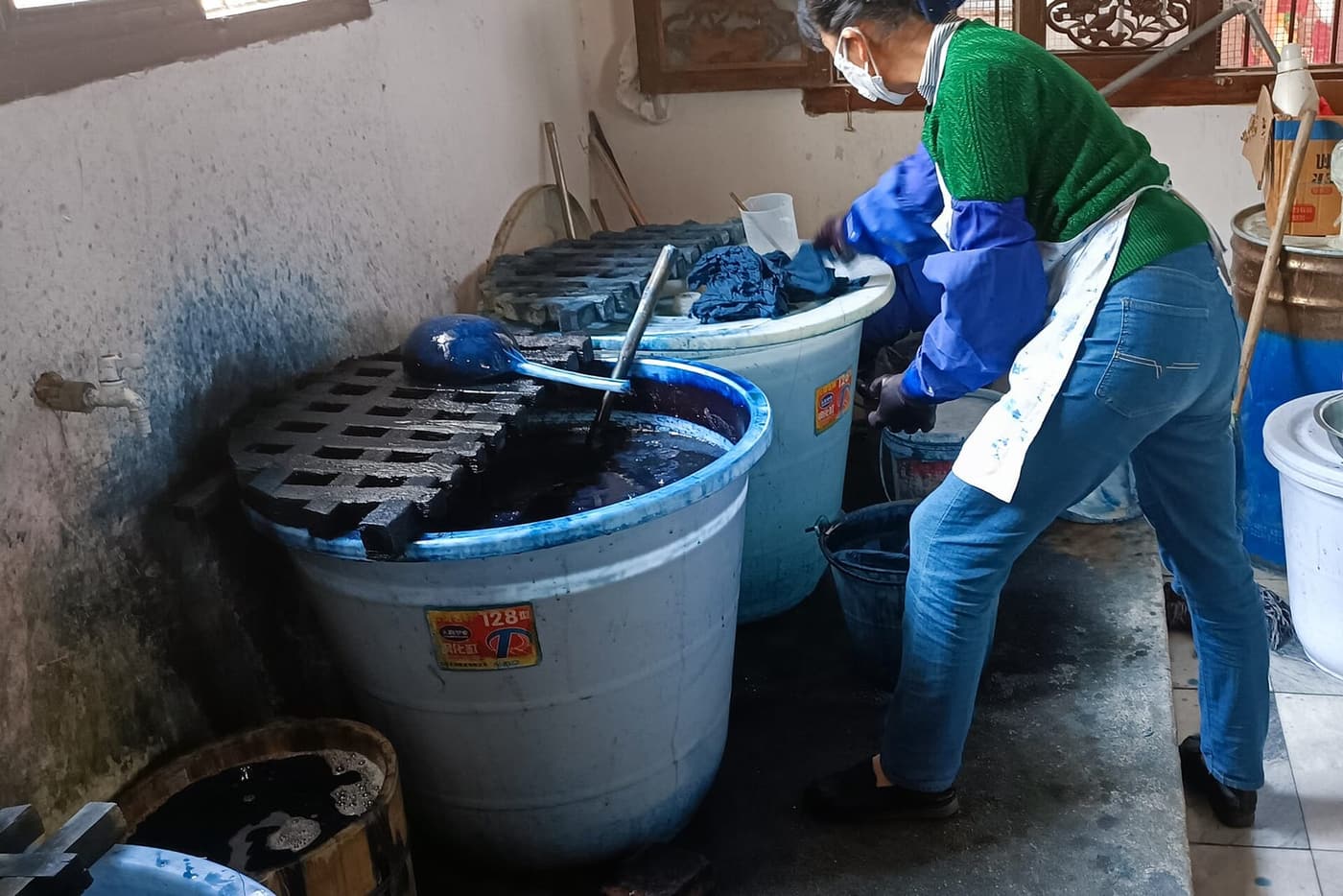
Xizhou tie-dyeing process. Image: Kcx36 / Wikimedia Commons, CC BY-SA 4.0
It is worth explaining separately how this "blue" comes about. The dye comes from banlangen—more precisely, from one type of banlangen, locally often called malan, of which a large patch is grown at the foot of Cangshan. The leaves are picked and soaked in a large vat so that the water draws out the chlorophyll; the residue is skimmed off, lime is added, and the mixture is stirred vigorously. Indigo then gradually separates out from the water and settles at the bottom of the vat. This vat of "indigo" is the base color of tie-dye. The dye vat is not something established once and for all; it is like a vat of living things and must be "raised": stirred every day, with indigo, liquor, and plant ash added at regular intervals to keep the microbial community in the vat active. The dye-works master says that whether a vat of indigo is raised well or not makes a complete difference to the blue that is dyed—good indigo blue becomes deeper and more steady the more it is washed, with the distinctive layering that comes from plants.
The patterns are "tied" out. Tie-dye was called "jiaoxie" in ancient times, and the method is to tie the cloth according to the desired pattern: sewing the pattern with needle and thread and then pulling it tight is called sewn binding; pinching the cloth into small tufts and binding them tightly with thread is called bundled binding; clamping the cloth between two wooden boards is called clamped binding—the places that are tied tight or clamped cannot take up dye, and after they are untied, white patterns remain on the blue ground. The most moving moment is when the threads are removed: once the dyed cloth is dry, a pair of scissors picks open the thread ends and slowly pulls them out, and the white sealed off by the thread is revealed bit by bit, like an image developing from a negative. With the same tying method, different hand strength and tightness produce different patterns—so every piece of tie-dye is one of a kind.
The patterns of Zhoucheng are inseparable from the daily life of the Bai people. The butterfly is the most classic: near Zhoucheng lies Butterfly Spring, and in Bai legend the butterfly is the embodiment of faithful love, so butterfly patterns are the most common, whether flying alone, in pairs, or framed together with flowers; flowers and birds, fish and insects, and geometric patterns are also common, and some even tie the characters for "fortune" and "longevity" directly into the cloth. The flowers of tie-dye are not drawn but "tied" out, their lines carrying the clumsy strength of handwork, the blue deep and the white bright, with a liveliness that machine printing and dyeing cannot give.
In the daily life of the Bai people, tie-dye has never been merely "decoration." In the past, girls in Zhoucheng learned to tie flowers from their mothers from a young age; the bedding, headscarves, and aprons in their dowries all had to be dyed by their own hands—the blue-ground, white-flower patterns were the bride's "calling card" of craftsmanship and proof of her family's heartfelt intentions. Today, the elderly A-niang in the village can still rattle off the names of dozens of patterns in one breath: Phoenix Through Peonies, Magpie on Plum Branch, Fish Playing Among Lotus... They may not be literate, but they carry the genealogy of these patterns in their hands. This "memory in the hands" is what makes tie-dye most precious.
Zhoucheng is the main inheritor of the national-level intangible cultural heritage "Bai tie-dyeing craft." After this craft entered the first batch of the national intangible cultural heritage list, the dye houses in Zhoucheng actually became busier—the old craft was seen again, and young people came back as well. Today, in addition to the old dye houses that have dyed cloth for generations, the village also has new brands such as "Lanxu" (Blue Continuation) and "Zhibai" (Planting White): founded by young Bai people who have returned home, they use traditional indigo methods to make modern designs—scarves, tablecloths, canvas bags—bringing the old craft into new life scenarios. If you want to try it yourself, just walk into any dye house; with a square scarf and a little over an hour, you can take away a piece of blue that is the only one of its kind in the world.
Diancang Mountain marble paintings: a piece of stone is like a painting
The marble of Diancang Mountain is a word Dali gave to China—the name "marble" (dali shi) comes from the fact that this stone is produced in Dali. Among the nineteen peaks of Cangshan, the mines halfway up the slopes hold a peculiar stone: on a blue-white base, minerals seep through in layers, naturally forming patterns like ink wash spreading—some resemble distant mountains, some seas of clouds, some dry-brush landscapes—hence the term "stone paintings": a single stone is a painting.
This stone was prized very early on. During the Ming and Qing dynasties, the marble of Diancang Mountain was a famous tribute item sent to the imperial court, and when Xu Xiake traveled through Yunnan he recorded the scene of quarrying on Cangshan. Extraction was extremely difficult: the stone lies hidden in cliff faces, and quarrymen chiseled along the mineral veins, often having to dig very deep to obtain a complete piece; only when the extracted slabs were cut and polished did the patterns appear. So connoisseurs say marble is "cut" into being—one wrong cut, and the painting is gone.
Looking at stone paintings, everyone has their own way of reading them. By vein patterns, the trade distinguishes categories such as "colorful flower" and "ink-wash flower": colorful flower stone veins carry color, like blue-green landscapes; ink-wash flower stone is sharply black and white, most resembling splashed ink. By pictorial intent, they are further divided into landscape, bird-and-flower, and figure subjects—for landscapes, one looks at whether the layered peaks convey distance and nearness; for birds and flowers, whether the branches and leaves are vivid; figures are the hardest, and only "resembling" makes them interesting. A good stone painting is naturally a piece of freehand brushwork: set in a wooden frame on a desk, it is a table screen; inlaid at the center of the screen wall of a Bai dwelling, it becomes the focal point of an entire wall. Bai families like marble not only because it is beautiful—the mountains hidden within the stone amount to inviting Cangshan (the Cang Mountains) into the home.
It is said that many of the stones used in the Forbidden City and the imperial gardens in Beijing came from Diancang Mountain—the history of marble being offered as tribute turned this local specialty into a material of "national stone" status. Even today, the people of Dali still understand it best: when a Bai family marries off a daughter, they make a point of including a fine stone painting in the dowry; when moving into a new home, the first thing they do is choose a "focal piece" for the screen wall. Stone paintings are not industrial products—the veins of each piece are the result of geological ages slowly taking shape, unique and impossible to replicate—this is probably the plainest meaning of "a stone like a painting."
To buy a stone painting, you need not go to an expensive gift shop. My friend Yilang's recommendation is: small roadside workshops, where you can buy a very distinctive piece for just a few hundred yuan, with more character than a gift shop. Watching the craftsman cut and polish a rough stone, the veins gradually emerging, that sense of anticipation is far more interesting than buying a finished piece.
Jianchuan wood carving: a whole western Yunnan carved out with a single chisel
There is an old saying in Yunnan: "Jianchuan carpenters are found everywhere." This is no exaggeration: from Dali to Lijiang, from temples to private homes, the architecture of western Yunnan is filled with beams, pillars, doors, windows, and plaques carved by people from Jianchuan. Jianchuan lies between Dali and Lijiang, a place with more mountains than farmland, and woodworking has been a livelihood there since ancient times. Boys learned to use chisels and planes from their fathers from an early age, and once trained they would set out with their toolboxes to find work. The skills of Jianchuan carpenters traveled along the ancient roads, reaching as far as Diqing, Lijiang, and even farther afield—it could be said that half of the wooden houses in western Yunnan were built and carved by people from Jianchuan.
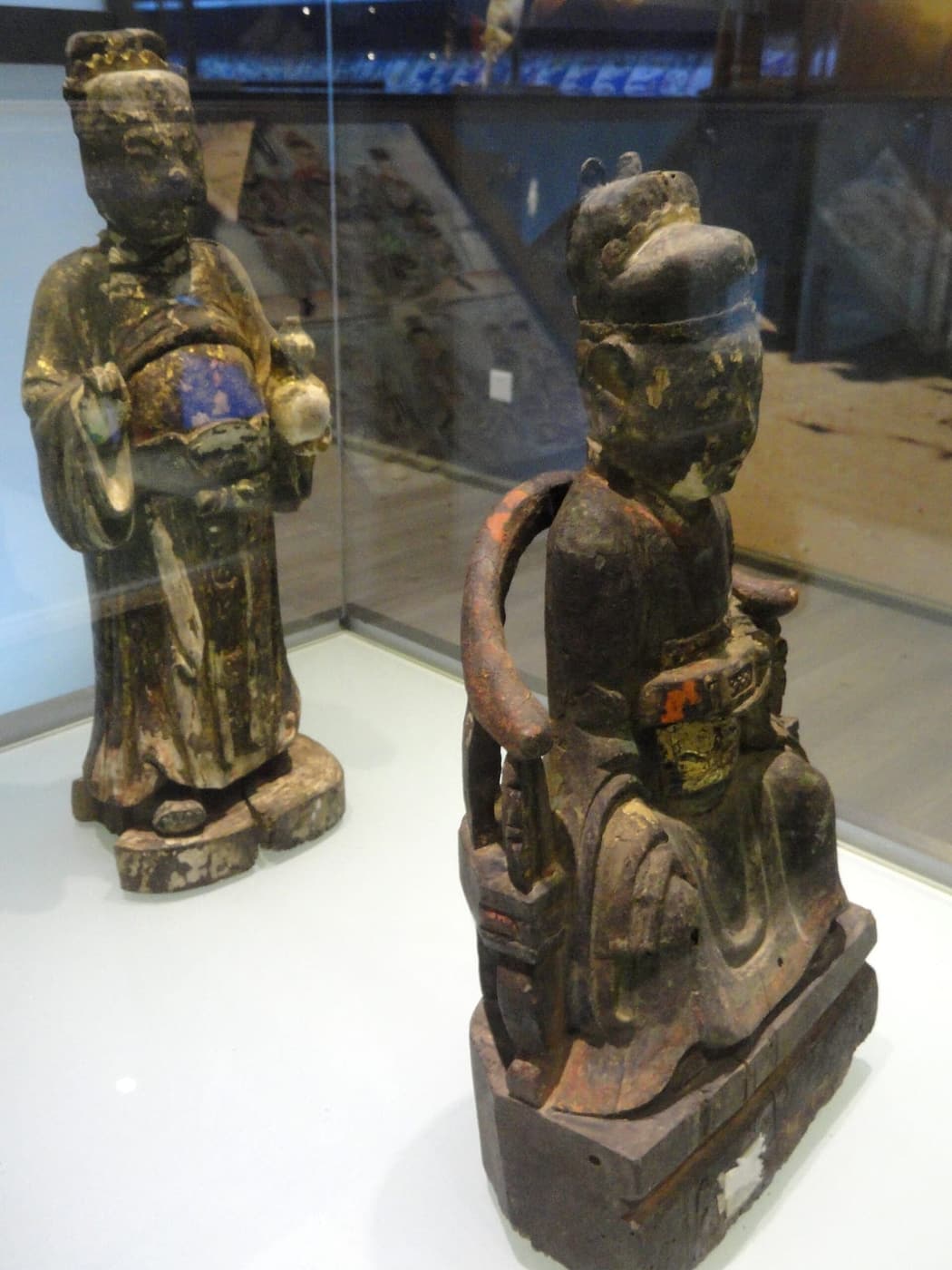
Bai ethnic woodcarving. Image: Daderot / Wikimedia Commons, public domain
The most skilled woodcarving is seen in the lattice doors of Bai ethnic houses. A lattice door is divided into upper and lower sections: the upper part is openwork, carved with flowers, birds, and figure stories, with light filtering through in shifting shadows; the lower part is a solid panel with relief carvings of landscapes or auspicious patterns. Technically, it emphasizes "relief carving, openwork carving, and pierced carving": relief carving makes patterns stand out from the flat surface, openwork carving cuts through the backing, and pierced carving is layered one upon another, with the finest areas able to be carved in several layers, figure garments and sashes, flower and leaf veins, each layer pressing over the next. On a good lattice door, the knife work is so fine it makes one hold one's breath—when old craftsmen carve figures, the eyebrows and eyes are picked out one cut at a time, and one bad cut means the whole piece must be started over. Bai families reserve the best woodcarving for the doors and windows of the main hall, because that is the family's face and also what is shown to the ancestors.
The Bai people's sacred spaces are another main arena for Jianchuan carpenters. The beams, columns, coffered ceilings, and shrines of Buddhist temples are often more intricate than those of homes—three layers of openwork carving and gilded polychrome painting carve the word "solemnity" out of wood. The craftsmen of Jianchuan are both carpenters and, in part, master builders: from setting out the layout to raising the ridge beam, the skeleton of a temple is often assembled by them.
The craftsmanship of Jianchuan has an even older root, located in Shibao Mountain (Shibaoshan) south of the county seat. The Shibao Mountain Grottoes were carved during the Nanzhao and Dali Kingdom periods and are among the first batch of Major Historical and Cultural Sites Protected at the National Level, hailed as a "treasure of the southern heavens." The statues in the grottoes include processions of Nanzhao kings, Buddhist bodhisattvas, and guardian deities. Among them, the "Acharya Avalokitesvara" statue unique to the Dali Kingdom—with a slender waist, bare feet, and a serene expression—is the most typical representative of Nanzhao-Dali Buddhist art. Standing before the grottoes, you will understand that Jianchuan's woodcarving did not emerge from nowhere—over a thousand years ago, craftsmen here learned to use blades to tell of faith in stone; later, the blade moved from stone to wood, telling the same story. Today, Jianchuan woodcarving has been inscribed on the national list of intangible cultural heritage, and in Jianchuan town there are still whole streets of woodcarving workshops, with the sound of chisels ringing from morning till night.
The reputation of the Jianchuan carpenters even spread to the snowy plateau. Legend has it that when the Potala Palace in Lhasa was being renovated, Jianchuan carpenters were invited as well—since ancient times, the Tea Horse Road has connected western Yunnan with Tibet, and horse caravans carrying tea into Tibet also brought Jianchuan chisels up to the plateau. Such claims may not be verifiable one by one, but records of carpenters from western Yunnan leaving carved work in Tibetan temples are not uncommon. Wood cannot speak, but temple after temple and lattice door after lattice door speak for them.
Heqing silverware: tapped by small hammers for a thousand years
Xinhua Village in Heqing County is called "Shizhaizi" in the Bai language, a place where "the small hammer has struck for a thousand years." This saying is widely circulated, but Xinhua Village's silverware history is indeed very long: legend has it that from the Nanzhao period onward, craftsmen here began making silverware; by the Ming and Qing dynasties, Xinhua Village's silversmiths were already carrying their bellows and hammers across the land. Yunnan is mountainous, and silversmiths traveled along the ancient roads from village to village and stockade to stockade; wherever a family had a happy occasion or wanted silver ornaments made, they would set up a forge and stay there to work, sometimes for ten days to half a month. Those going farther would "walk to the Yi regions"—following the horse caravans down into Myanmar and Thailand, setting up stalls in foreign marketplaces. Amid the bells of the Tea Horse Ancient Road, Heqing's silver flowed along with the caravans, trading back for tea and salt, and also bringing back knowledge and experience gained along the way.
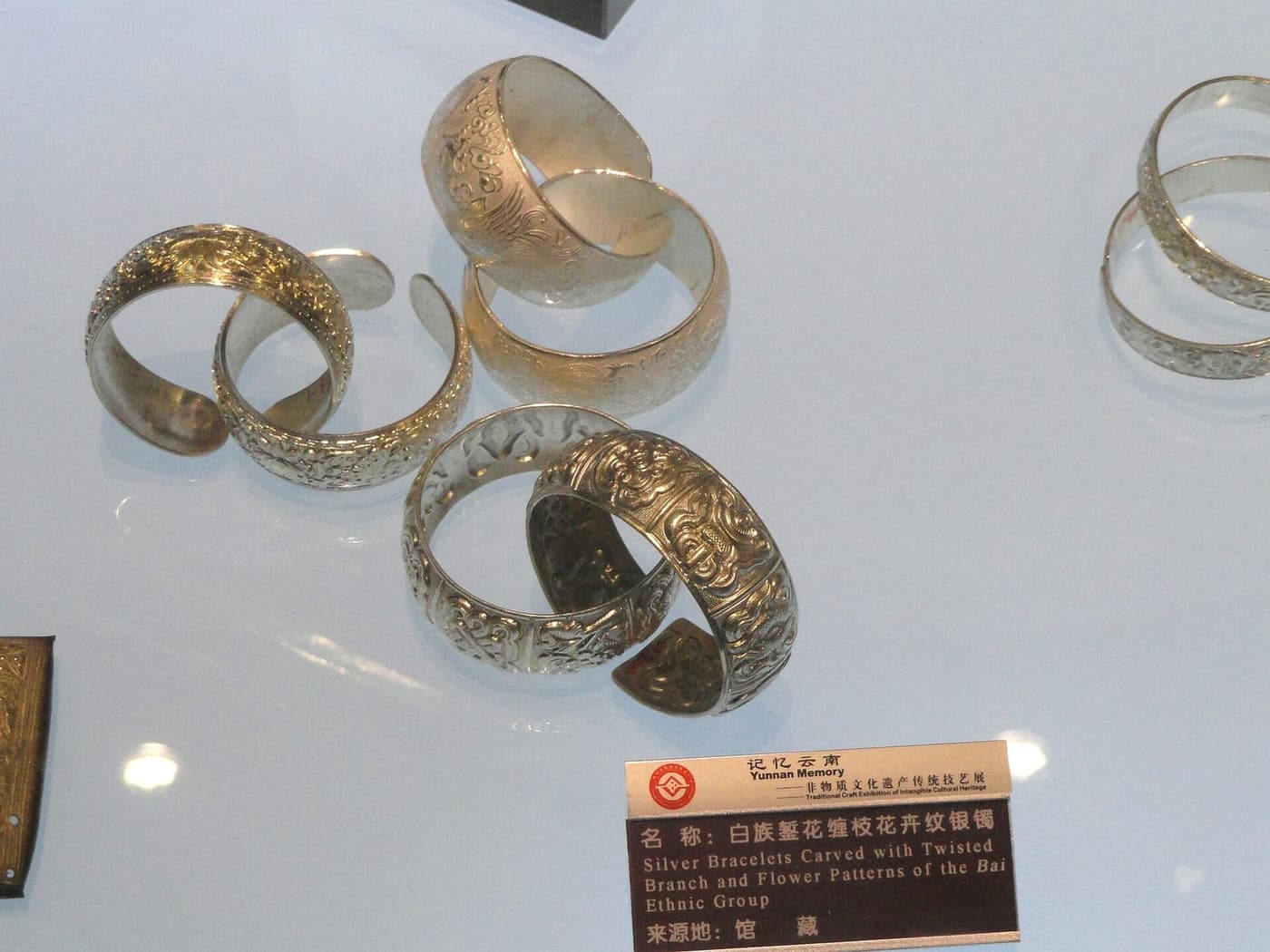
Bai-style chased silver bracelet. Image: Daderot / Wikimedia Commons, public domain
The silverware of Xinhua Village is made entirely with a small hammer. Melting the silver, forging, drawing wire, engraving, and welding—a single silver pot goes through dozens of steps from silver ingot to finished product: the silver ingot is melted in the furnace fire and repeatedly forged to shape the vessel; the body of the pot is engraved with patterns, struck blow by blow with a chisel, and if the force is slightly off, the pattern goes crooked; the silver wire, fine as a hair, is drawn out and then welded on bit by bit. The old craftsmen say silver is soft, but the heart must be hard and the hand steady. Xinhua Village still preserves the tradition of "one family, one workshop; shop in front, factory behind." When you go to the village, the clanging and tapping of hammers runs from morning to night without stopping—that is the heartbeat of this village.
The silverware of Heqing still lives on the bodies of the Bai people. In the traditional dress of Bai women, silver is indispensable: silver hairpins on the head, silver earrings on the ears, silver chains on the chest, and silver bracelets on the wrists—a whole outfit jingles as they walk. When a child turns one month old or an elderly person celebrates a birthday, relatives mostly give silver locks and silver bracelets—among the people, silver is seen as something that "calms fright" and "wards off evil," worn on the body for the sake of peace. So what the silversmiths of Heqing forge is not mere objects, but the Bai people's hopes for a good life.
The Heqing silverware forging technique has been inscribed on the national list of intangible cultural heritage. Today's silverware includes not only traditional silver bracelets, silver locks, and head ornaments, but also handcrafted silver teapots and silver cups for tea—in the teahouses of Dali, boiling water in a Heqing silver teapot is a matter of great face. Pick a piece of silverware to take home; it need not be expensive—a small silver bracelet or a silver spoon is a souvenir whose warmth you can feel.
Wamao (roof cat): the grinning, glaring guardian deity on the rooftops
In Dali, you will see a crouching ceramic beast on the roof ridges of many Bai ethnic houses: its mouth is wide open, its round eyes glare, and its teeth are bared, making it look both fierce and endearing. It is called a tile cat (wamao), the guardian deity on Bai rooftops. The tile cat's wide-open mouth has a special meaning—legend says it can devour the "wind evil" and swallow unlucky things into its belly; its glaring eyes watch ahead day and night, guarding the home and courtyard for its owner. The elders say the tile cat is "installed" on the roof ridge to suppress evil, and on the day it is placed there, a "consecration" ceremony is held to formally put it on duty.
Those who make tile cats are mainly traditional kiln villages like Jingtian Village (Jingtian Cun). Jingtian Village is in Fengyi Town (Fengyi Zhen), Dali City (Dali Shi). The village has fired pottery for generations; besides roof tiles and flower pots, their specialty is the tile cat. Once the kiln fire is lit, the tile cat comes from earth and takes shape in fire; when it leaves the kiln it is dusty gray, yet it already has that fierce energy. In the past, tile cats were a household rooftop faith, and no one cared whether they looked good; today, tile cats have come down from the roofs—shops in the old town and Xizhou (Xizhou) are full of tile cats large and small, making them one of Dali’s most distinctive souvenirs. Small tile cats are shaped round and cute, while large ones still bare their teeth and glare; placed at home, they are both decoration and a continuation of the old saying: invite a tile cat home to guard the house and add blessings.
Wamao (roof cat figurines) come in many styles, and every village and kiln has its own "facial design": some grin with a silly smile, some bare their teeth and glare, and some hold a small wamao in their front paws—legend has it that this is "summoning wealth," so that once wealth enters the door, it never leaves. The master craftsmen of Jingtian Village shape wamao entirely by hand: no sketches, no molds—the clay turns a few times in their hands, and a cat takes on its spirit. That is why every wamao is one of a kind.
Jiama (paper horse prints): Dali's folk pop art
Jiama is a woodblock print of the Bai people, printed on paper and used to pray for blessings and avert disasters. Deities or symbols are carved into wooden blocks, ink is applied, rubbings are taken, and sheet by sheet they are cut apart—these are the "tickets" of folk belief that communicate with the divine. Throughout the life of a Bai person, jiama is used at almost every turn: when ill, one is printed to ward off sickness; when setting out on a long journey, one is printed for safety; and it is indispensable in sacrifices to Benzhu and ancestors. The imagery of jiama is a catalogue of Bai folk belief—Benzhu deities, ancestors, the Kitchen God, the Mountain God, the Dragon King, the God of Joy… each carved into wooden blocks, rough and unrefined, yet possessed of an indescribable spirituality. The carvers do not pursue refinement; their knife work is crisp and decisive, their lines exaggerated and distorted, like folk pop art—recognizable at a glance.
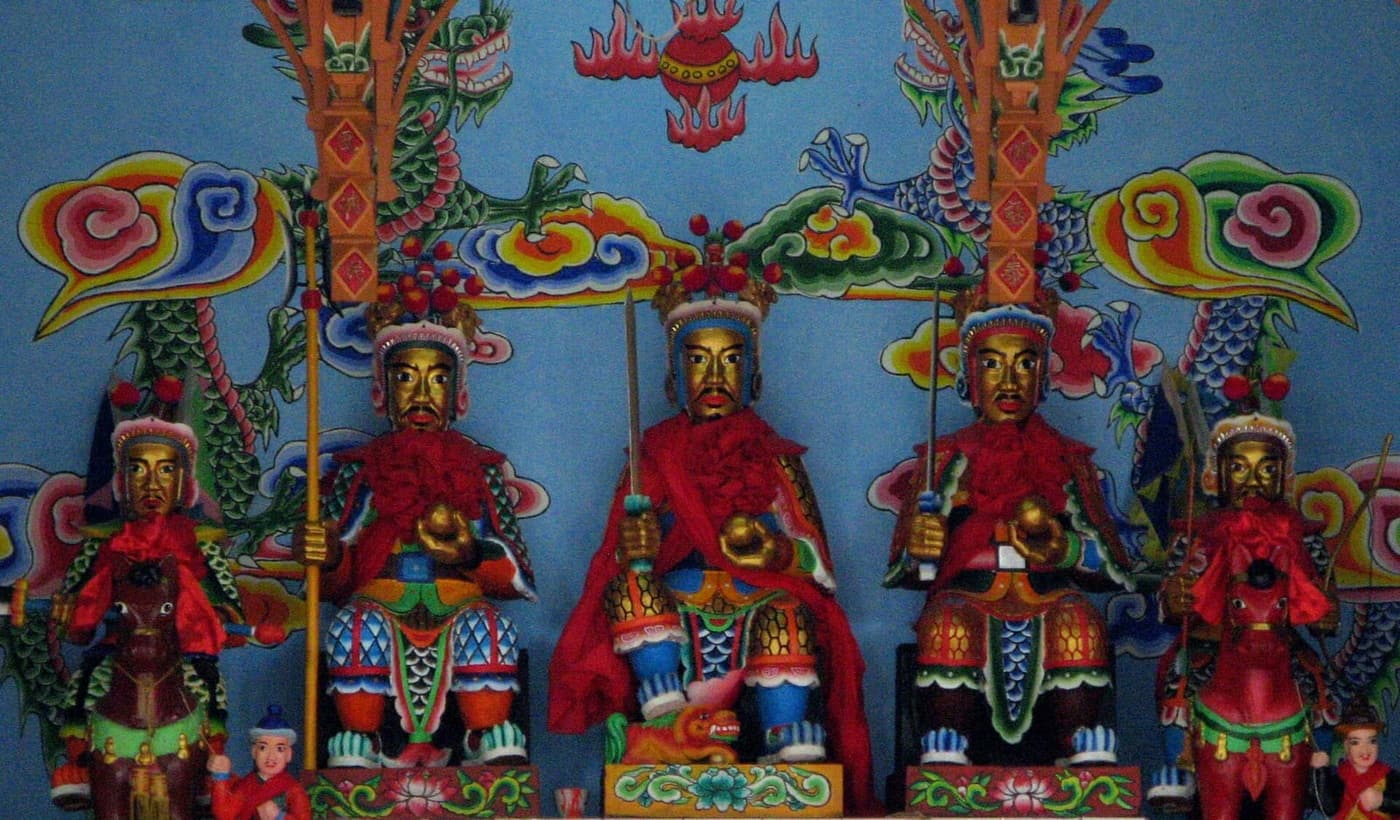
Dali Benzhu deity image. Image: G41rn8 / Wikimedia Commons, CC BY-SA 4.0
The uses of Jiama each follow their own rules: some are printed and then burned, so that the "tickets" are delivered into the hands of the deities; some are pasted on the lintel or above the stove, so that the gods "stand guard" in the home; some are buried with the dead, so that the departed can take them along. When the Bai people obtain Jiama, they do not call it "buying" but "inviting"—a thin sheet of paper carries weight in their faith. Today there are fewer and fewer old artisans making Jiama, but every old printing block is still being used, and the printers say: as long as there are still people who invite them, this craft will not die out.
Today, Jiama appears more often as an art form. Bai ethnic Jiama has been listed in the Yunnan Provincial Intangible Cultural Heritage Directory, old printing blocks are becoming increasingly precious, and some veteran artisans are still carving new blocks—carving today's life into the blocks as well, so that this craft can keep growing. The Jiama prints collected by Jiangzhiji Folk Art Center are widely recognized in the field as the richest batch; hung on the wall, they form a pictorial compendium of Bai folk beliefs. At places such as Shuli Library and Jiangzhiji, visitors can personally try drawing and printing—choose an old block, roll on ink, lay down paper, press and lift, and a "divine horse" bearing the scent of ink emerges. Printing ten thousand copies by machine and printing this one copy by hand feel completely different.
Bai architecture: three wings and one screen wall, four courtyards and five skylights
The architecture of Dali is the Bai people's way of building feng shui, family, and aesthetics into their walls. The typical layout is "three wings and one screen wall, four courtyards and five skylights": three wings and one screen wall means three sides of houses enclosing a courtyard, facing a screen wall directly—the screen wall serves a very practical purpose, as the white wall reflects light, bouncing sunlight into the main hall, making the room bright and warm in winter; in feng shui terms, it also "gathers qi and blocks evil," keeping good fortune within the courtyard. Four courtyards and five skylights means four wings enclosing a courtyard, with a large central skylight and a small skylight at each of the four corners, so that even the leaky corners are planned as space.
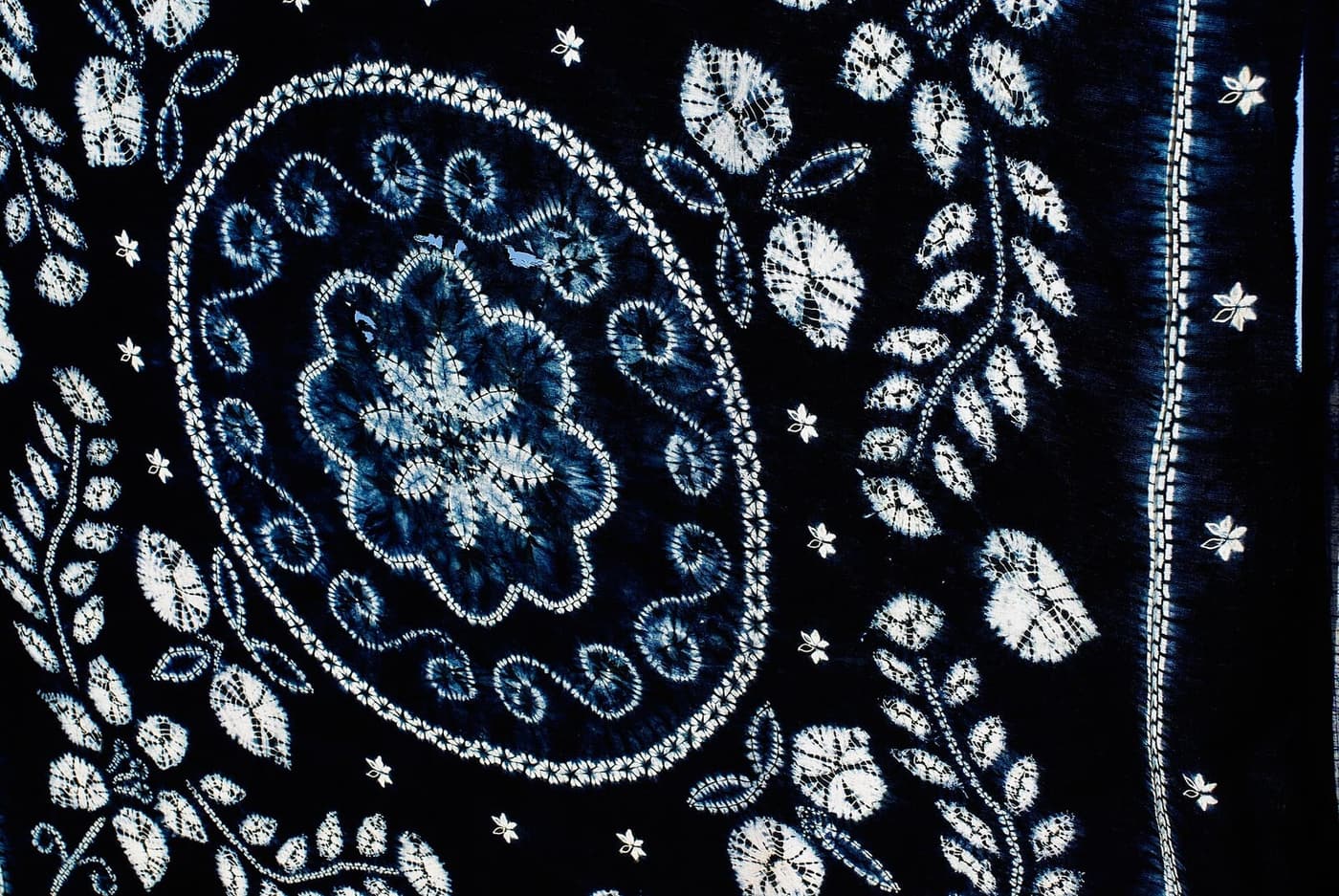
Bai blue-and-white tie-dye fabric pattern. Image: Cogburn CC / Wikimedia Commons, CC BY-SA 2.0
The roofs of Bai ethnic houses emphasize "blue tiles and white walls, with flying eaves and upturned corners." The tiles are blue tiles fired in local kilns, and both ends of the eaves curve slightly upward like a bird spreading its wings, called "flying eaves"; the walls are screen walls and gable walls whitewashed with lime. In Bai aesthetic taste, the white wall is the ground, the blue tiles are the ink, and the wood carvings are the painting—the entire courtyard is a three-dimensional ink wash painting. Sunlight casts the shadow of the screen wall into the courtyard, and this is the everyday aesthetics of Bai households.
The gatehouse of a Bai ethnic house is another place for showing off skill. In more particular households, the gatehouse is made in the "three-drip" style—three tiers of flying eaves descending level by level, beneath which are layer upon layer of wooden bracket sets and painted decoration, with marble inlaid on the door lintel and brick carvings on both sides. A gatehouse is a family's face: before guests even enter the door, this is the first thing they see. In the grand courtyards of Xizhou, such gatehouses are more elaborate one after another, and walking through the alleys, you are almost viewing an exhibition of gatehouses.
A screen wall is not just a wall; it is also a billboard for family values. Bai ethnic screen walls almost always bear inscriptions, and each surname has its own particular emphasis: the Yang surname inscribes "Passing Down an Incorruptible Legacy," drawing on the story of Yang Zhen of the Eastern Han dynasty, who refused gold with his "Four Knows" principle; the Zhang surname inscribes "The Family Tradition of a Hundred Endurances," taken from the story of Zhang Gongyi of the Tang dynasty, whose nine generations lived under one roof and governed the household through "endurance"; the Li surname inscribes "The Legacy of the Blue Lotus," because Li Bai was known as the Layman of the Blue Lotus; the Zhao surname inscribes "The Reputation of the Lute and Crane," referring to Zhao Bian of the Northern Song dynasty, who had only a lute and a crane and served as an official with integrity. Each phrase is a family precept, reflected every day in the household courtyard and also recited for passersby to hear—Bai families write the words "family tradition" directly on their front facades.
To see the most concentrated collection of grand Bai-style mansions in one go, head to Xizhou. Xizhou was once the wealthiest commercial town of the merchant groups in western Yunnan. In the late Qing dynasty and early Republic of China era, the Xizhou merchants did business across all of Yunnan, and Yan Zizhen's Yongchangxiang (Yongchangxiang) even sold tea as far as Southeast Asia. Having made their fortunes, the merchants returned to Xizhou and embarked on extensive construction, building one deep courtyard mansion after another. Today, the Xizhou Bai folk house architectural complex is a nationally protected key cultural heritage site. The Yan Family Mansion (Yan Family Mansion) and the Yang Family Mansion (Yang Family Mansion) are representative works among them: multiple courtyards laid out one after another, with gate towers, screen walls, and lattice doors unfolding in layers, while wood carvings, stone carvings, and painted decorations cover every detail. Many courtyards still have families living in them, while others have been converted into museums, guesthouses, and cafes where you can go in and look around at your leisure. Visiting the Yan Family Mansion, you will understand what "the dignity of a merchant group" really means.
The grand residences of Xizhou also housed a remarkable chapter of history. During the War of Resistance Against Japan, Huazhong University (one of the predecessors of today's Central China Normal University) relocated westward from Wuhan, eventually making its way to Xizhou to continue operating, and it stayed for eight years. The Xizhou merchant guild vacated courtyard homes and donated funds, allowing a university to settle in a small town in western Yunnan. Many of the old residences you see in Xizhou today still bear traces from those years above their door lintels—the merchants' wealth ultimately became a memory of education in this way. This is the most moving page in Xizhou's story.
The ancient city of Dali itself is another lesson in architecture. During the Ming Hongwu era, the imperial court established a prefecture and built a city wall in Dali, and the ancient city was constructed according to the regulations for a square-walled city, with four gates and a north-south central axis, a layout that has continued to this day. The plaque reading "Wenxian Mingbang" (Land of Literature and Famous Scholars) on the south gate is an inscription left from the Qing dynasty, speaking to the flourishing of education and culture in Dali. The streets and alleys in the ancient city still preserve the scale of a Ming-Qing prefectural city: Wuhua Tower stands at the center of the street, with Bai ethnic residences lined up one after another on both sides—carved wooden windows, stone-built walls, and gray-tiled roofs—filled with tourists, small shops, and the bustle of everyday life. Walking through it, you can still feel the street-and-alley scale inherited from the Ming prefectural city of more than five hundred years ago.
The "Wawa Street" (Doll Street) on the fifth day of the first lunar month, formerly called "Yinyang Street" (Yin-Yang Street)
In the Jianchuan area, on the fifth day of the first lunar month during Spring Festival, there is a very special street fair, now called "Wawa Street" (Doll Street), though the older generation is more used to calling it "Yinyang Street." On this day, the market is filled with handmade dolls and toys: paper effigies, clay figurines, cloth dolls, as well as masks, rattles, and small woodcarvings—the liveliest flavor of the New Year in the memories of the older generation. Jianchuan has produced craftsmen since ancient times, and Wawa Street is precisely the craftsmen's "showcase"—paper effigy makers, clay figurine makers, and carpenters all bring out their finest craftsmanship during these few days. Children clutch their New Year's lucky money and are dazzled choosing among the stalls, while adults also stand before the stalls for a long time, examining whether the paper dolls are finely crafted and whether the clay lions are vividly molded. There is also a particular custom when buying dolls: the elders say that buying dolls for children is for the good omen of "adding children and bringing in wealth"—the more dolls, the more prosperous the family line. So on this day, stallholders always make their dolls as festive as possible, and children always linger in front of the stalls for ages, picking the one that best catches their eye.
The name "Yin-Yang Street" comes from a belief passed down for a long time: people believe that on the fifth day of the Lunar New Year, deceased loved ones also return to the market to bring New Year money to the children. If the money they pay—spirit money—falls into water, it floats up from the surface instead of sinking; the elders say that means the deceased have "received" the gesture of affection. So this street is half the liveliness of children and half a commemoration of the departed; people from the worlds of the living and the dead seem to meet on the same street on this day. Every doll the craftspeople make is the simplest possible expression of "reunion." Such legends have echoes in many parts of China, but places like Doll Street, which writes "yin and yang" directly into the street name and also places it in the hands of a group of craftspeople, are rare.
To clarify, Wawa Street is a Spring Festival custom in Jianchuan during the first lunar month, not a ghost festival, nor a festival in the seventh lunar month—it falls on the most festive days of the year, yet in the gentlest way, it brings remembrance along with it. If you are in Xizhou and want to hear the fuller story of this street, the Jiangzhiji Folk Art Center preserves displays and records of Wawa Street (Yinyang Street)—it is also the best starting point for getting to know Dali's crafts.
Want to try it yourself
· Zhoucheng tie-dye: most dye workshops offer hands-on experiences; make your own indigo-dyed bandana, about 1 hour.
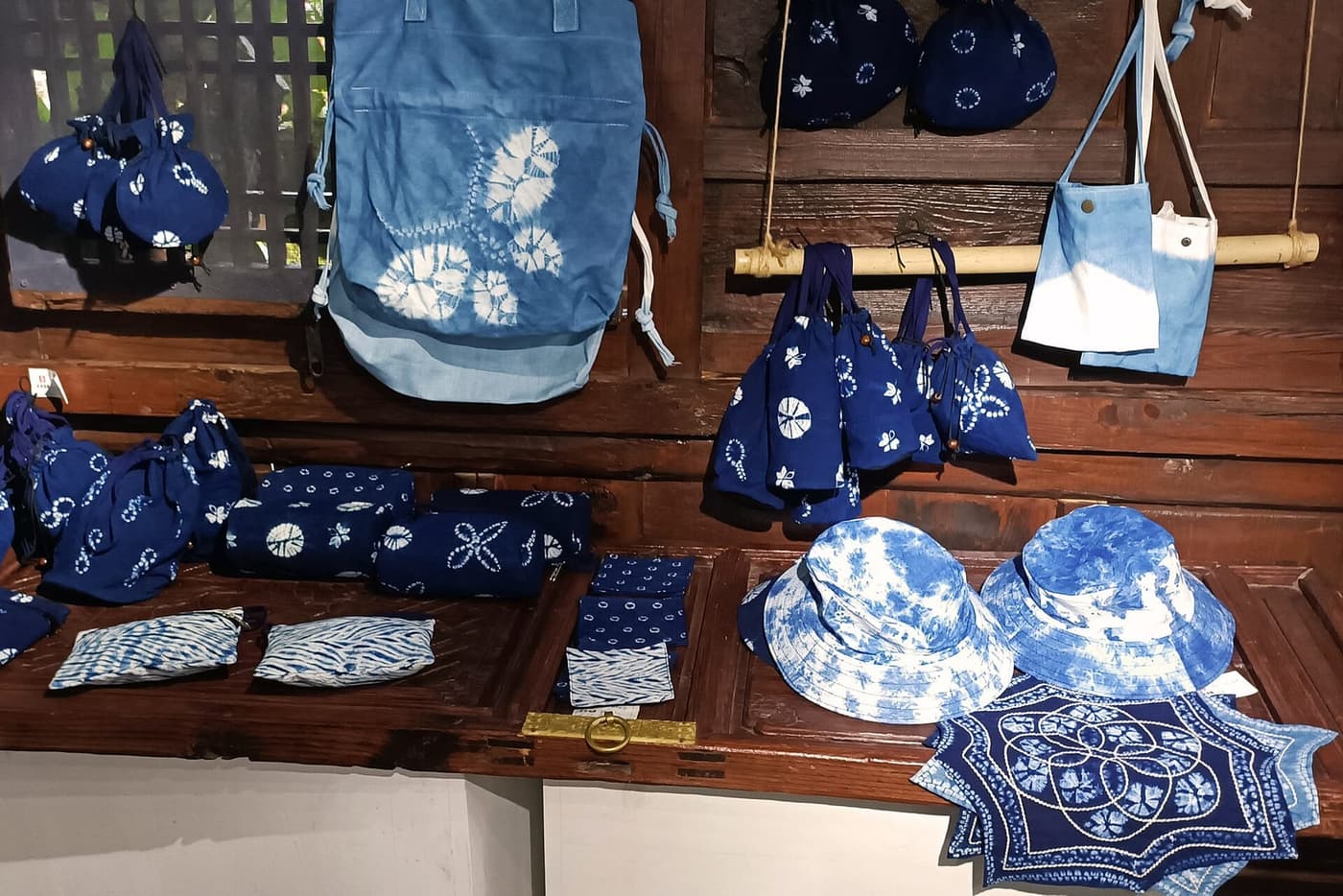
Xizhou tie-dye handicrafts. Image: Kcx36 / Wikimedia Commons, CC BY-SA 4.0
· Jiangzhiji Folk Art Center (Xizhou): experiences in jiama woodblock prints, tie-dye, silverwork, and more.
· Xingmu Workshop / Muye Woodworking Camp: woodworking experiences, suitable for adults and children.
· Zhibai Indigo Dyeing and Lanxu Indigo Dyeing (Zhoucheng/Old Town): deeper indigo dyeing study.
· Jingtian Kiln Fire (Old Town): tile cats and Jiama print painting.
Dali's crafts are a gift left to today by that kingdom of a thousand years ago. They are not only in museums, but also beside the dye vats of Zhoucheng, under the eaves of Xizhou, at the paper-effigy stalls on Jianchuan Wawa Street, and on the workbenches where artisans hammer and tap. Pick one and make it yourself once, and you will come closer to the inner essence of this city than any tourist—because craft is that kind of thing: only after you have used your hands do you truly know it. On the way back, put the things you made today together and look at them: a square indigo-dyed scarf, a Jiama print, a small tile cat—they come from different villages and different workshops, yet they all share the same "face of Dali."
References and Notes
Jiangzhiji Folk Art Center: Located in Xizhou, this is a centralized exhibition and hands-on experience space for Dali's folk crafts, with a rich collection of Jiama woodblock prints; for related reports, see "The People Who Built a Museum in an Ancient Town" and "Not a Museum in a 'Glass Case,' but a 'Showcase of Skills' by Dali's Artisans."
Zhoucheng Tie-Dye: See the relevant local gazetteers and intangible cultural heritage materials on "Dali Zhoucheng Bai Tie-Dye." Zhoucheng is the main transmission site of the national-level intangible cultural heritage "Bai Tie-Dye Technique"; tie-dye was called "jiaoxie" in ancient times, and the tie-dye methods of stitch-tying, bundle-tying, and clamp-board tying, as well as the indigo production process using banlangen (malan, Baphicacanthus cusia), are the commonly used technical descriptions of Bai tie-dye.
Diancang Mountain Marble: Marble is named after Dali, where it is produced; the records of it being presented as tribute to the imperial court during the Ming and Qing dynasties and of Xu Xiake collecting stones while traveling in Yunnan can be found in "Xu Xiake's Travels: Diary of Travels in Yunnan" and Dali local gazetteer materials; categories such as "colorful patterned stone" and "ink-wash patterned stone," as well as the classification by pictorial themes of landscapes, flowers and birds, and figures, are commonly accepted industry descriptions.
· Shibao Mountain Grottoes: Located in Jianchuan County, carved during the Nanzhao and Dali Kingdom periods, they are among the first batch of Major Historical and Cultural Sites Protected at the National Level and are known as the "Treasure of the Southern Sky." The site contains statues depicting Nanzhao kings on procession as well as Dali Kingdom Buddhist statues such as the Acuoye Guanyin.
· Jianchuan Woodcarving: Jianchuan woodcarving has been inscribed on the National Intangible Cultural Heritage List; "Jianchuan carpenters are found everywhere" is a folk saying in western Yunnan (the old saying goes, "Lijiang baba, Heqing wine, Jianchuan carpenters everywhere").
· Heqing Xinhua Village Silverware: See the intangible cultural heritage materials of Heqing County; "struck by small hammers for a thousand years" is a saying associated with it; Heqing silverware forging techniques have been inscribed on the National Intangible Cultural Heritage List; "zou yifang" refers to the tradition of Yunnan craftsmen traveling far to places such as Myanmar and Thailand to work.
· Wama (roof cat figurines) and Jiama (paper horse prints): see research on Dali Bai folk crafts and materials on traditional villages such as Jingtian Village; Bai Jiama has been included in the Yunnan Provincial Intangible Cultural Heritage List, and its patterns are related to Bai Benzhu (local deity) worship.
· Bai dwellings and Xizhou: the "sanfang yi zhaobi" (three wings and one screen wall) and "sihe wu tianjing" (four courtyards and five skylights) are common layouts of Bai dwellings; the inscriptions on screen walls are derived from classical allusions according to family surnames, see monographs such as "Bai Vernacular Architecture"; the Xizhou Bai vernacular building complex is a Major Historical and Cultural Site Protected at the National Level; Huazhong University moved west to Xizhou to run its school in 1939 and moved back to Wuhan in 1946; for relevant historical facts, see the school history materials of Central China Normal University.
· Dali Ancient City: built during the Hongwu period of the Ming Dynasty, and served as the seat of Dali Prefecture during the Ming and Qing dynasties; the plaque "Wenxian Mingbang" (A Land of Literature and Famous Scholars) was inscribed in the Qing Dynasty; for related information, see Dali local gazetteer materials.
Jianchuan's "Doll Street" on the fifth day of the Lunar New Year: This is a folk market custom in the Jianchuan area held on the fifth day of the Lunar New Year, formerly known as "Yin-Yang Street." It is based on local oral accounts; the description here is synthesized from folk memory, and details may vary slightly by year and locality.
Keep exploring Dali
 Dali Wild Mushrooms: Mushroom Season, Table Recipes, and Two Thousand Years of Mushroom-Eating HistoryEvery June, when the rainy season arrives in Yunnan, mushrooms start to pop up. Yunnan has 2,753 known wild mushroom species, accounting for more than half of China's total. This article covers the dried beef mushroom (ganba jun), termite mushroom (jizong), green-headed mushroom (qingtou jun), matsutake, and jianshouqing on Dali people's tables, how locals stir-fry them and preserve them in oil until next year, and also records from Zhuangzi, Bencao Gangmu, and Xu Xiake of Yunnan people eating mushrooms for over two thousand years—as well as the safety bottom line that must be upheld when foraging and eating mushrooms.→
 Scripts, Songs, and Wine in the Valleys: The Spread of Christianity in Yunnan's BorderlandsFrom James O. Fraser's early encounters with the Lisu people in Tengchong, explore the scripts, songs, churches, and wine of Yunnan's borderlands.→
 The Hump Route and the Burma Road: Two Lifelines of the War of Resistance Through YunnanOne leads through the mountains west of Xiaguan to Myanmar, the other flies over the mountains from Yunnanyi in Xiangyun. How did the Burma Road and the Hump Route maintain China's connection with the world during the most difficult phase of the War of Resistance? Why did Dali become an important node on both lifelines simultaneously?→
 The Nujiang, Lancang, and Jinsha Rivers: the unique nature and culture of the Three Parallel RiversStarting from Dali and heading north, crossing over the Cangshan Mountains, you will enter a massive fold split open by three great rivers. The Nujiang (Salween), Lancang (Mekong), and Jinsha (Yangtze) rivers—three great rivers originating from the Qinghai-Tibet Plateau—cut through the land of northwestern Yunnan from north to south like three parallel knives. They run so close together—at their nearest point, the straight-line distance is less than seventy kilometers; and they flow side by side for over one hundred seventy kilometers before each turns and heads toward a different destination. This is the "Three Parallel Rivers," inscribed as a UNESCO World Natural Heritage site in 2003, and it is also a key to understanding Yunnan. Many people think the beauty of Yunnan is simply the wind, flowers, snow, and moon by Erhai Lake→
 The history of Yunnan coffee: from Zhukula (a village in Yunnan) to a cup at the foot of Cangshan (a mountain in Yunnan)If you walk into the ancient town of Dali today, sit down at any café, and order a latte made with Yunnan beans, chances are you won't find it anything special. Coffee is far too common here—on Renmin Road there's one every few steps, the aroma of roasting drifts from the courtyards on Yeyu Road, and the terraces of the Chuangdancang Art District are full of people with their laptops. You might not realize that this ordinary cup of coffee is actually the end of a history spanning more than a century: its source lies in the mountains not far from the ancient town of Dali; its story begins with a French missionary and a small village almost completely cut off from the world. The story of Yunnan coffee is almost→
Comments
Comments
…