Life in Dali
How to Get to Dali and Local Transportation
Aug 15, 2026
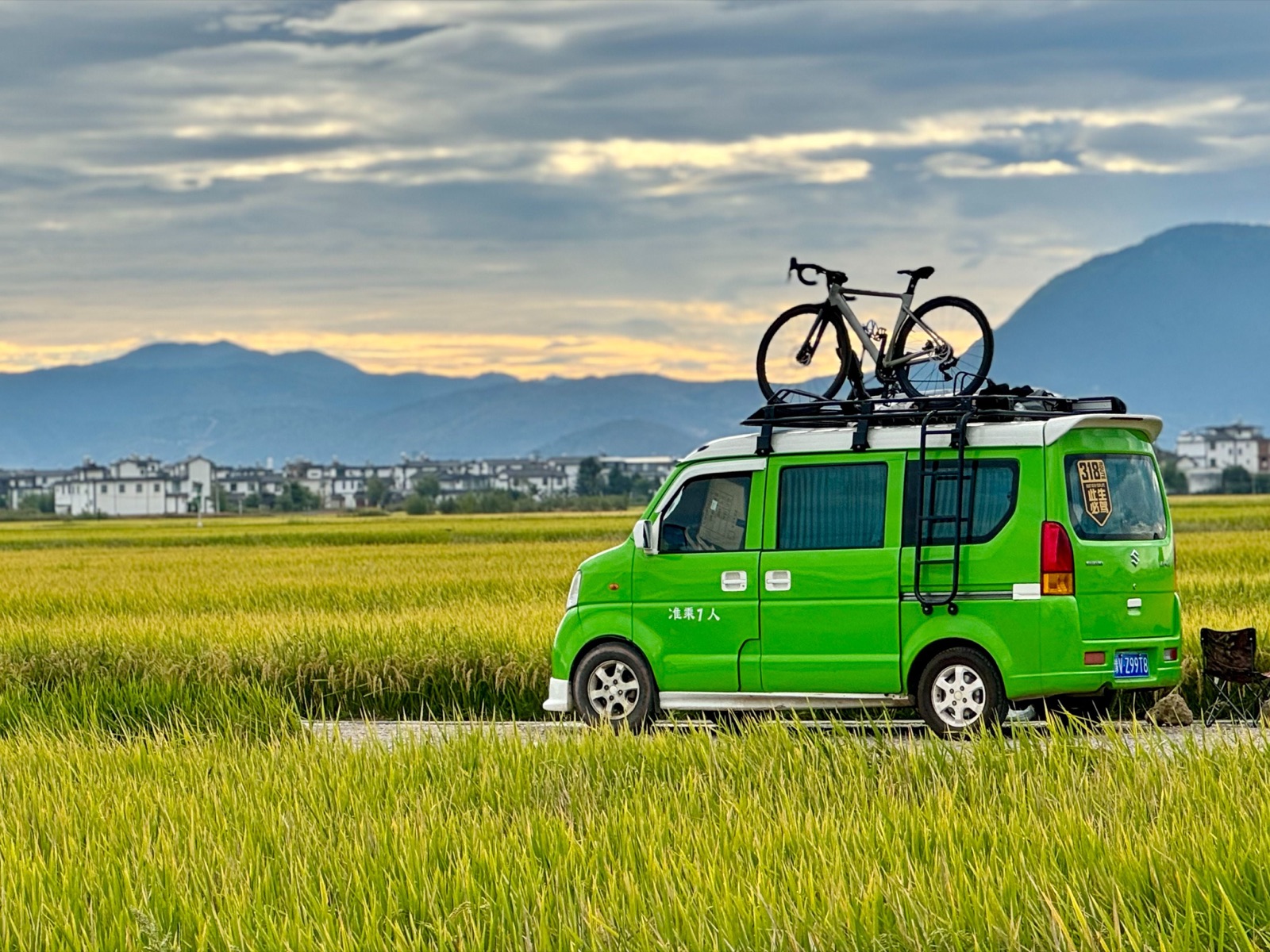
Transportation: How to get to Dali and how to get around Dali
How is it most convenient to get to Dali? And once you're here, how do you get around? This guide compiles practical information on several ways to reach Dali and local transportation (chartered cars, car rentals, intercity buses, bicycles, electric scooters).
Getting to Dali:
Lijiang is a cheap and relatively convenient option for reaching Dali (127km). Shared rides (cost 80-90 per person) can take you directly to Dali Old Town in under 2 hours, and this is the choice of many long-term Dali residents. In contrast, landing in Kunming requires transferring to an airport bus to the high-speed rail station, taking the high-speed train to Dali, and then getting from Dali Station to the old town; the total time is over four hours, and the cost is at least 200+ per person (high-speed rail 145, airport bus 25, Dali Station to old town 40). Landing at Dali Airport has few flights and high costs, and during the windy season there can be landing difficulties and return flights (December-April, not currently). The airport to the old town also takes about 1 hour.
Kunming is also a good option: Kunming is a transportation hub with many affordable flights and trains. From Kunming Airport, without leaving the terminal, there is a direct bus to Kunming Railway Station (20 yuan), taking generally less than 1 hour. Then take the high-speed train from Kunming Railway Station to Dali (about 145 yuan). Then take a hotel pickup car or a ride-hailing car (please try not to take illegal taxis, as you will mainly face annoying sales pitches and easily encounter high prices or disputes).
Dali Airport (30km from the old town): Dali has "Fengyi Airport". The advantage is direct access, but the disadvantages are few flights and high prices. Transportation generally takes 45 minutes to 1 hour; the time is due to passing through Dali city area. In addition, during the windy season (December-April), there are very rare cases of landing difficulties, with the possibility of returning to Kunming.
Shared rides: To get from (Lijiang or Kunming) to Dali, book a shared ride on a platform in advance (preferred). If you really can't book on the platform, you can contact 18987085657 (WeChat phone) Liu Sanqi, or 15125176744 (another sister). When I leave or return to Dali, I sometimes use them. Each has their own group and can arrange the earliest available car for you. Currently, Lijiang Airport to Dali is 80-100 per person, fluctuating within a normal range due to oil prices and other reasons, and generally reliable. Because this kind of shared ride involves different drivers, there will be service differences, and common shared-ride issues will occur; it won't be very attentive (I have also encountered situations where they didn't pick up on time and service attitudes varied). Expectations for this kind of service should not be too high; as long as there are no major problems, it's fine. In addition, at the arrival area of Lijiang Airport, there are also drivers waiting for passengers to share rides (generally shared-ride drivers returning to Dali after dropping off passengers). If the price is similar, they can also be an option.
Local transportation:
Chartered cars (better models): Recommended Master Ma: 13170759527 (same on WeChat), a car fleet. I came into contact with them when a guest used their car, and was impressed. Many guests have used them since, and I have not received any negative feedback. But note that there will be differences between drivers, especially during peak season. If there is poor service, please give feedback to him promptly. I can't guarantee perfect chartered cars, but I recommend them for reference, at least to avoid outrageous situations, or to have problems resolved.
Another chartered car service, Master Fan: 13987202000, is a fleet we also use when we need it, and is basically reliable.
Car rental: Please try to use regular platforms and avoid roadside car rental shops. Roadside shops that rent trendy cars for photo ops (like Beetles, usually the main business of irregular shops) often have malicious damage extortion disputes, and many cars have problems (e.g., nearly scrapped and refurbished).
Intercity transportation: Dianyue Chuxing (WeChat mini-program)
This is a reliable intercity travel method, for example, to and from Kunming, Lijiang, Baoshan, Tengchong, Yunlong (Nuodeng). It's affordable and has many schedules. It's very suitable for traveling to some farther areas on your own. For Shaxi transportation, please refer to the "Shaxi section" later.
Bicycle rental:
Shengkai Bike Shop (Yuer Road, Old Town, WeChat: S15331687170)
Initially recommended by guest ejing. The bike models and prices, store information can be found on Dianping. They provide suitable child seats, children's bikes, and good service. They have professional cycling bicycles (mountain, road) for rent and provide breakdown rescue. There is a Xizhou branch where you can return the bike at a different location. Below is their official account's guide to cycling around Erhai Lake: Shengkai Bikes | Guide to Cycling Around Erhai Lake
The diary of Randy, manager of the Xizhou branch, has a lively and human touch, and you can see some admirable states of their work: Shengkai Diary
Now we have jointly opened a cycling route to visit Dali Cangshan, villages, and Erhai Lake.
214 Cycling Station: A professional cycling bike shop in Caicun. One of our guests, Heiyuan, borrowed a Specialized bike and crashed, damaging some parts. He thought he would have to pay several hundred (the actual replacement value). Teacher Wu said he would fix it himself and told him to treat his scrapes first, and only charged a few dozen yuan, which moved him very much. WeChat: xiaoheizi54999. He has a guesthouse upstairs and also organizes some cycling activities.
Daily transportation:
Taxis for daily travel: Use ride-hailing apps for taxis, try not to take illegal taxis. It's very convenient and fast, with faster pickups and cheaper fares than in big cities. For locations sent by businesses (like us), it's better to use the map to hail a ride directly, because many rural locations don't have a definite house number or name, and there are more vehicle options.
Electric scooters: The most convenient and free way to get around Dali is by electric scooter, especially during winter and summer vacations and peak holiday seasons, as you are not affected by traffic jams. In and around the old town, there are shared electric bikes "Didi Qingju". If you want to go to places far from the old town like Xizhou, you can rent a scooter. The most reliable is "Hello Electric Bike", which has many pickup points and, crucially, insurance and guarantees, so there won't be disputes if something goes wrong. You can open the mini-program to see the nearest pickup point. For going around the lake, it's also fine, as there are battery swap stations along the way.
For other private rentals, just find one nearby; they are about the same. If you want a recommendation, try: Qiqiche Bike Shop: at the intersection of Hongsheng Road and Xuefu Road near Dali University, the owner is quiet and nice. The convenience store right next to Pushi Bakery also rents bikes. They should all be fairly reliable.
Another one at March Street: "Youyijia Car Rental". A friend of mine used it and thought it was good. Ordinary scooter (60km range) is about 40/day, monthly rental available (off-season 400+, peak season prices vary). WeChat: j166176686, phone: 18987074030. Location near March Street.
Peak season transportation advice:
Based on experience, during peak season (winter vacation, Spring Festival) there will be difficulty getting taxis. Rent a car or electric scooter (shared electric bike or private shop, recommendations above). If you stay in a residential area near Dali University (like Shanshuijian Phases 1, 2, 3) near Dali Shanshuijian, not only can you walk to restaurants, coffee, brunch, but taxis are relatively easy, and traffic is basically not congested. Our activity meeting point is also convenient from here. The South District of Dali's Xiaoyuanzi is not too congested, and taxis are okay, but dining options within walking distance are very insufficient. Most of the old town is easily congested. If you stay in a guesthouse in a remote village, arrange vehicles in advance: rent a car, electric scooter, or charter a car.
Meeting points for our activities:
Most hiking and craft activities are within 5 km of the old town, so staying near the old town, including the Erhai lakeside near the old town, is convenient. Shuanglang and Haidong are not recommended to join, as the meeting journey is too far (50km), except for "Huoshan Sunset", "Eryuan Countryside Trip", "West Lake Paddleboarding", and "Stargazing by Boat". See attached map (drawn by Xiaojing):
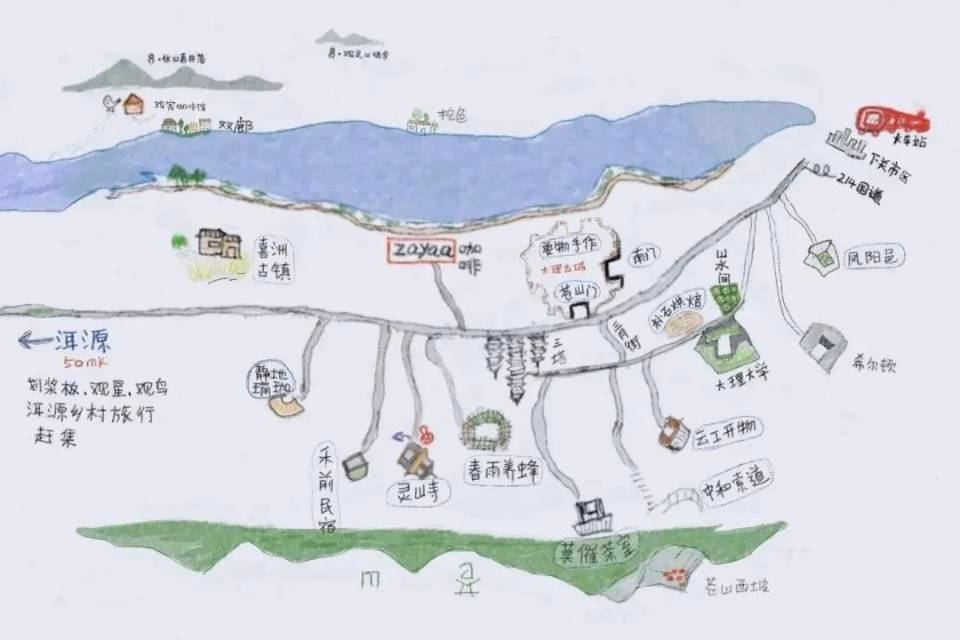
Some activities go to 50km away, such as "Eryuan Countryside Trip", "West Lake Paddleboarding", "Fengyu Market Day", "Huoshan Sunset", which will meet at "Pushi Bakery" near Dali University, and can pick up along the way on National Highway 214 via Xizhou (sometimes guests stay there).
← Return to "Dali Travel Information" overview
Places mentioned · Chinese names
盛开车行 · 盛开日记 · 骑行线路 · 214 骑行驿站 · 骑骑车行 · 朴石烘焙 · 伙山日落 · 洱源乡村旅行 · 西湖桨板 · 坐船观星 · 小景
Places and experiences in this story


Dali in depth
 Dali Wild Mushrooms: Mushroom Season, Table Recipes, and Two Thousand Years of Mushroom-Eating HistoryEvery June, when the rainy season arrives in Yunnan, mushrooms start to pop up. Yunnan has 2,753 known wild mushroom species, accounting for more than half of China's total. This article covers the dried beef mushroom (ganba jun), termite mushroom (jizong), green-headed mushroom (qingtou jun), matsutake, and jianshouqing on Dali people's tables, how locals stir-fry them and preserve them in oil until next year, and also records from Zhuangzi, Bencao Gangmu, and Xu Xiake of Yunnan people eating mushrooms for over two thousand years—as well as the safety bottom line that must be upheld when foraging and eating mushrooms.→
 Scripts, Songs, and Wine in the Valleys: The Spread of Christianity in Yunnan's BorderlandsFrom James O. Fraser's early encounters with the Lisu people in Tengchong, explore the scripts, songs, churches, and wine of Yunnan's borderlands.→
 The Hump Route and the Burma Road: Two Lifelines of the War of Resistance Through YunnanOne leads through the mountains west of Xiaguan to Myanmar, the other flies over the mountains from Yunnanyi in Xiangyun. How did the Burma Road and the Hump Route maintain China's connection with the world during the most difficult phase of the War of Resistance? Why did Dali become an important node on both lifelines simultaneously?→
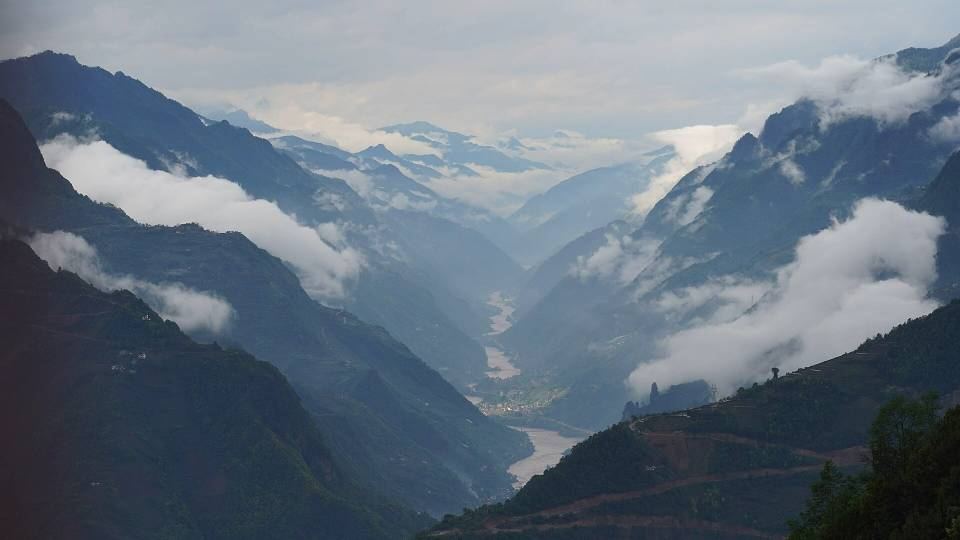 The Nujiang, Lancang, and Jinsha Rivers: the unique nature and culture of the Three Parallel RiversStarting from Dali and heading north, crossing over the Cangshan Mountains, you will enter a massive fold split open by three great rivers. The Nujiang (Salween), Lancang (Mekong), and Jinsha (Yangtze) rivers—three great rivers originating from the Qinghai-Tibet Plateau—cut through the land of northwestern Yunnan from north to south like three parallel knives. They run so close together—at their nearest point, the straight-line distance is less than seventy kilometers; and they flow side by side for over one hundred seventy kilometers before each turns and heads toward a different destination. This is the "Three Parallel Rivers," inscribed as a UNESCO World Natural Heritage site in 2003, and it is also a key to understanding Yunnan. Many people think the beauty of Yunnan is simply the wind, flowers, snow, and moon by Erhai Lake→
 The history of Yunnan coffee: from Zhukula (a village in Yunnan) to a cup at the foot of Cangshan (a mountain in Yunnan)If you walk into the ancient town of Dali today, sit down at any café, and order a latte made with Yunnan beans, chances are you won't find it anything special. Coffee is far too common here—on Renmin Road there's one every few steps, the aroma of roasting drifts from the courtyards on Yeyu Road, and the terraces of the Chuangdancang Art District are full of people with their laptops. You might not realize that this ordinary cup of coffee is actually the end of a history spanning more than a century: its source lies in the mountains not far from the ancient town of Dali; its story begins with a French missionary and a small village almost completely cut off from the world. The story of Yunnan coffee is almost→
Comments
Comments
…