Life in Dali
The History of Dali (Dali): The Story of an Independent Kingdom
Aug 15, 2026
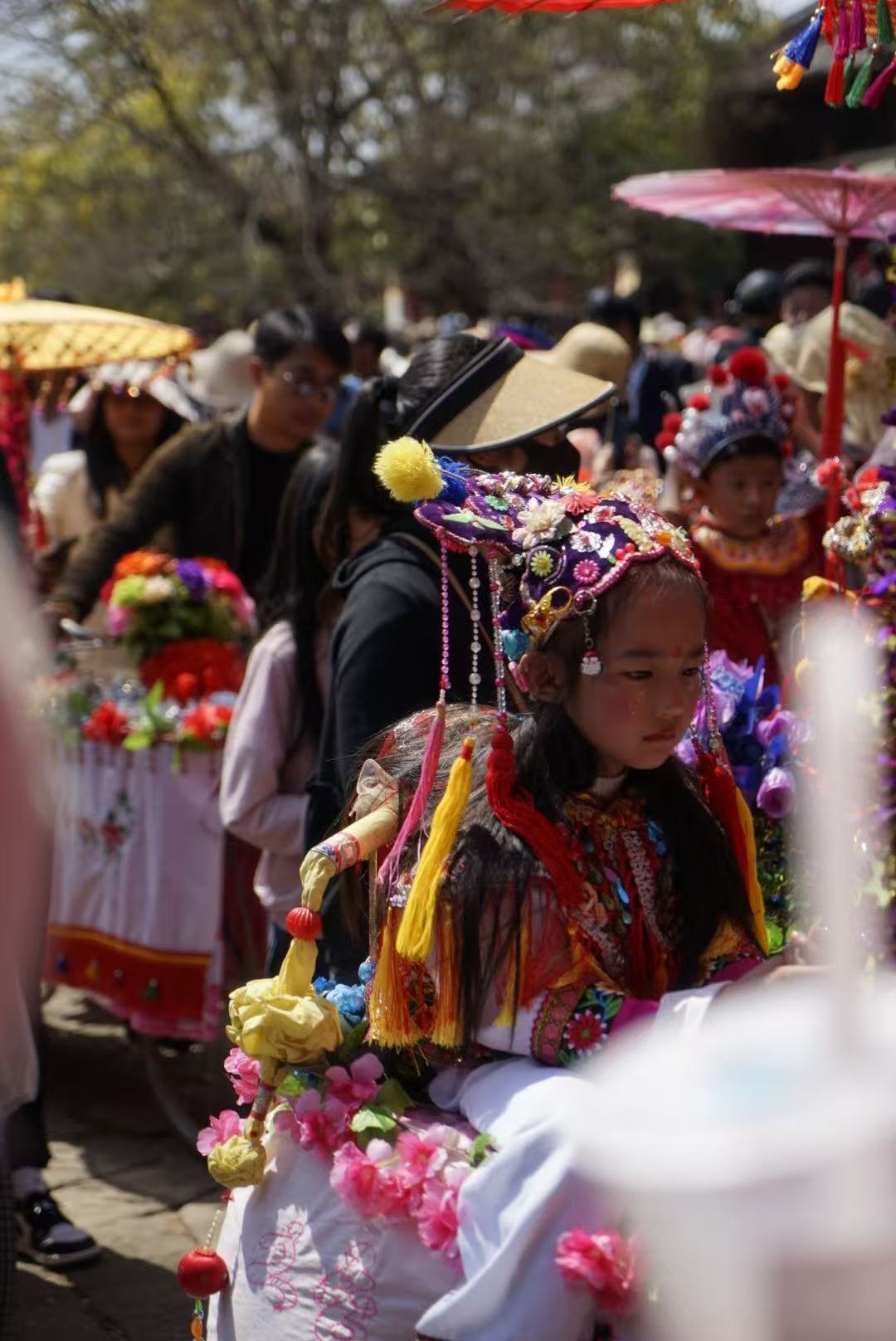
Many people, when they first arrive in Dali, are first moved by the scenery of the Cangshan Mountains and Erhai Lake, and only then become curious: why is this city so different from other ancient towns?
The answer lies in history. Dali was once the capital of an independent kingdom—Nanzhao and the Dali Kingdom established their states here for more than five hundred years. For a long period, it belonged neither to the Central Plains nor to Tubo, but was a "country" with its own king, its own Buddhism, and its own craft system. Once you understand this period of history, seeing the Three Pagodas of Chongsheng Temple, the Taihe City ruins, and the Bai grand residences of Xizhou will feel completely different.
And you will discover that the history of Dali is almost the history of Yunnan. The political center of this land has swung between two places for thousands of years: first Kunming by Dianchi Lake, then Dali by Erhai Lake, and finally back to Kunming. Each swing was a major turning point in history. And Dali was precisely the heart of Yunnan during that middle millennium. So by understanding Dali, you understand more than half of Yunnan.
Earlier stories: the Dian Kingdom, Zhuang Qiao, and the "Seal of the King of Dian"
Before Dali became a "royal capital," the protagonist on the Yunnan stage was by Dianchi Lake. In the 3rd century BCE, the Chu general Zhuang Qiao led troops all the way to the Dianchi region. According to the Records of the Grand Historian: Biographies of the Southwestern Barbarians, just as he was preparing to return to Chu, Qin captured Chu's Qianzhong region, cutting off his route home, so Zhuang Qiao had no choice but to declare himself king on the spot and adopt local customs; history calls this "Zhuang Qiao opening Dian." This was the starting point of the first large-scale entry of Central Plains power into Yunnan. From then on, the Dianchi region had the state name "Dian," and Zhuang Qiao became the first named "outside developer" in Yunnan history.
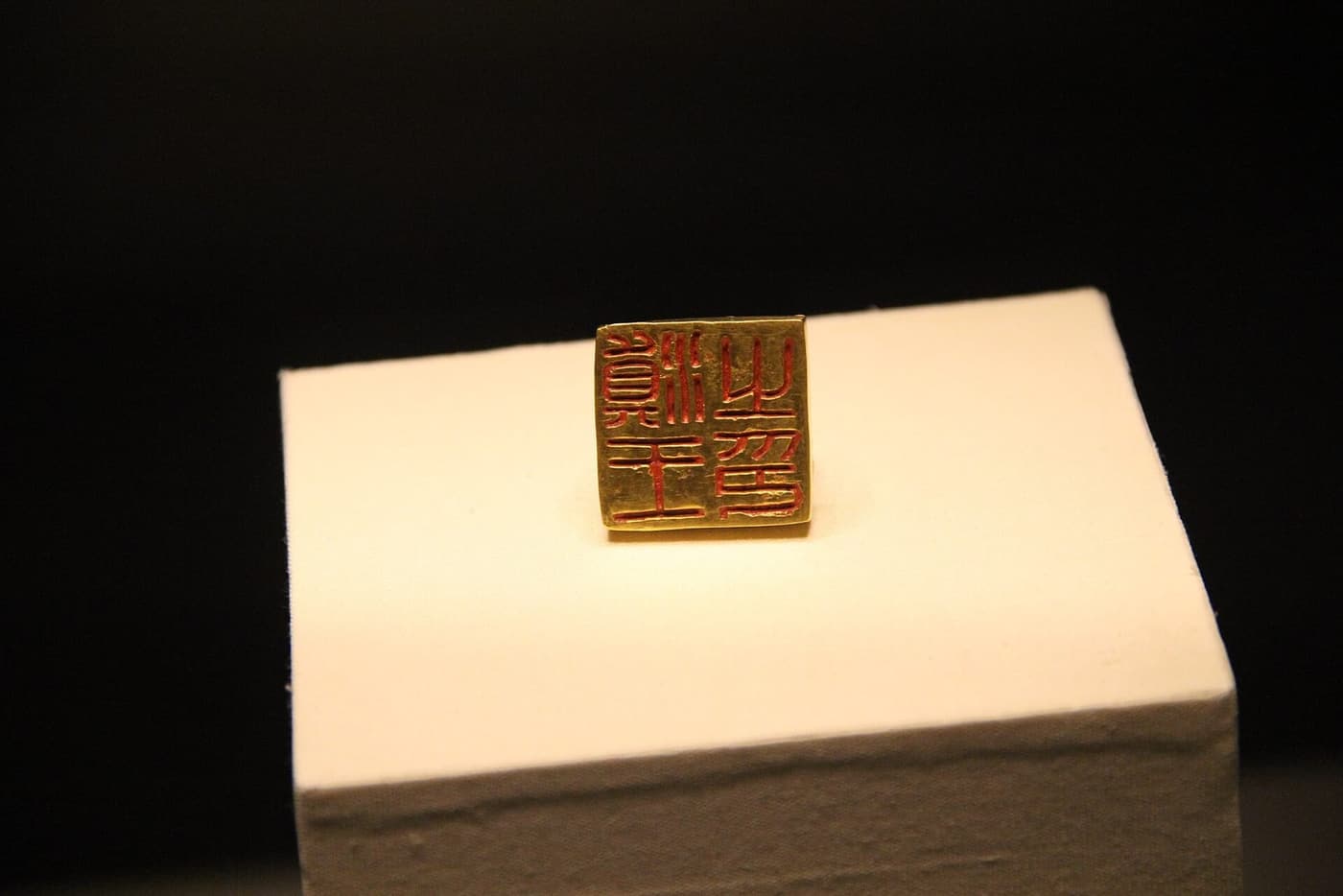
The gold seal "Seal of the King of Dian" from the Western Han. Image: Gary Todd / Wikimedia Commons, CC0
More than two hundred years later, during the reign of Emperor Wu of Han, the hand of the Central Plains dynasty reached here. In 109 BCE, the Han dynasty established Yizhou Commandery in the Dianchi region. The King of Dian requested to submit, and Emperor Wu granted him a gold seal. In 1956, archaeologists unearthed this "Seal of the King of Dian" at Shizhaishan in Jinning, and the inscription matched the Records of the Grand Historian exactly—if you go to the Yunnan Provincial Museum, you can still see it with your own eyes. This gold seal is important physical evidence that the Dianchi region was incorporated into the Han dynasty's commandery and county system.
Han management of Yunnan was not limited to Dianchi. In 69 CE, the Eastern Han established Yongchang Commandery in the Ailao region (around present-day Baoshan and Dehong), with territory extending west all the way to northern Myanmar today; it was one of the largest commanderies of the Eastern Han. Yunnan at that time was not a remote dead corner but a door—Shu brocade from the Central Plains went south along the "Shu-Shendu Road," passed through Yongchang, and reached India. This was the prototype of what later generations called the Southern Silk Road.
After the Eastern Han, the Central Plains fell into great chaos, and Yunnan's connection with the central dynasty was intermittent. From the Eastern Jin to the early Tang, the eastern Yunnan region was long ruled by a family called "Cuan." The Cuan were originally a great clan that had migrated from the interior, later became fully localized, and turned eastern Yunnan (around present-day Kunming and Qujing) into their own territory. The Cuan Baozi Stele and Cuan Longyan Stele they left behind still stand in Qujing today; they are called treasures of southern steles and are famous model works in the history of calligraphy. In the Cuan era, Yunnan's political center was in eastern Yunnan, while the Erhai area was still only scattered tribes—this left space for the later rise of Nanzhao.
Nanzhao: a kingdom rising between Tang and Tubo
In the 7th and 8th centuries CE, six zhao were scattered around Erhai. "Zhao" was the local term for a tribe or kingdom. The six zhao were: Mengshe Zhao, Yuexi Zhao, Langqiong Zhao, Shilang Zhao, Tengdan Zhao, and Mengxi Zhao. The southernmost, Mengshe Zhao, was called "Nanzhao" because it lay south of the six zhao.
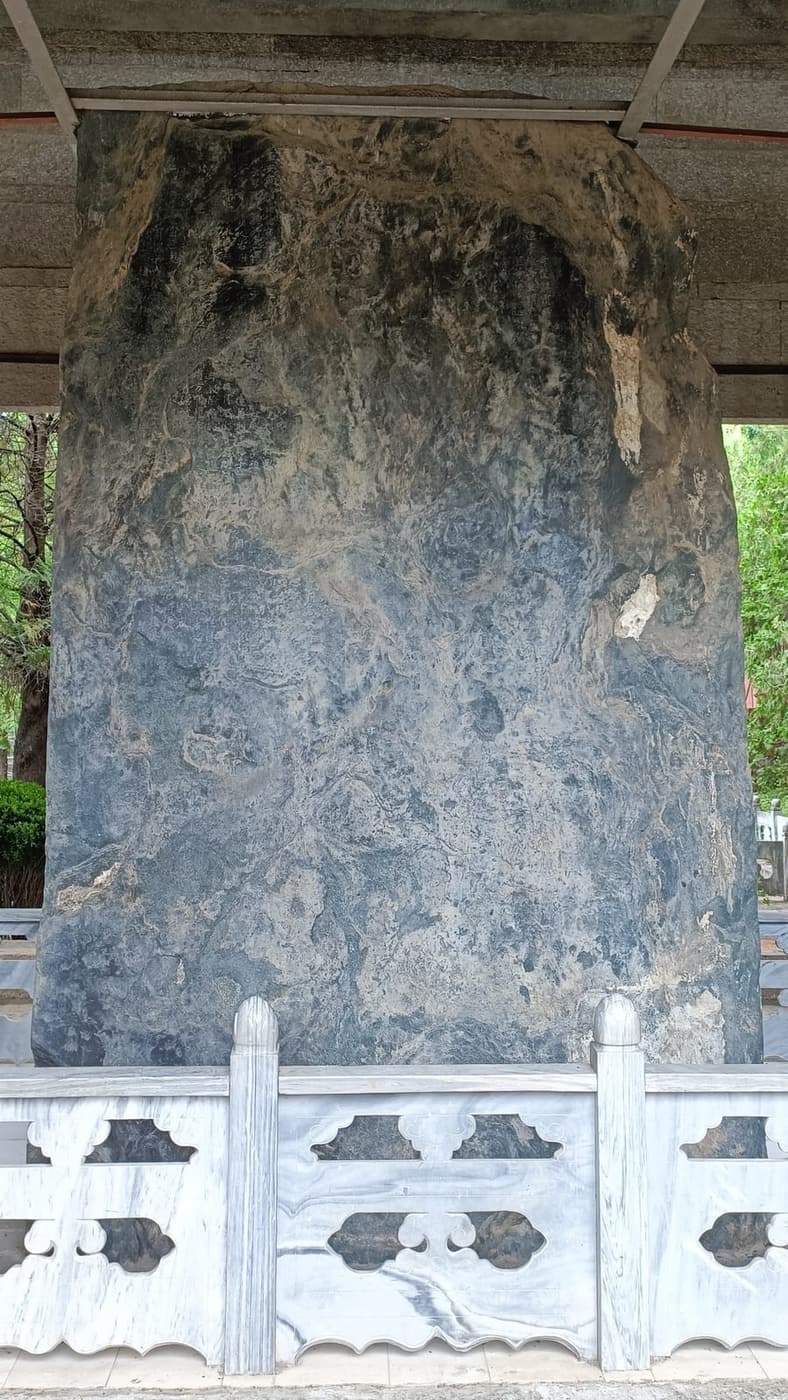
The Nanzhao Dehua Stele. Image: Kcx36 / Wikimedia Commons, CC BY-SA 4.0
The six zhao warred with one another, and none could suppress the others. At this time, the Tang dynasty needed someone in the Erhai region to check Tubo on its behalf, so it chose the most ambitious, Mengshe Zhao. With Tang support, the Mengshe Zhao leader Piluoge swallowed the other five zhao one by one, unified the six zhao in 738 CE, founded the state of Nanzhao, and set the capital at Taihe City in today's Dali area. The Tang court then enfeoffed Piluoge as "King of Yunnan"—from then on, the word "Yunnan" frequently appeared in Chinese historical records.
Nanzhao's rise depended on skillfully maneuvering between the two great powers of Tang and Tubo—sometimes allying with Tang, sometimes with Tubo, growing stronger step by step in the gap between them. Nanzhao used several generations to master this art of "surviving in the gap": it borrowed Tang power to unify the six zhao; later it fell out with Tang and relied on Tubo for support; still later it reconciled with Tang and joined forces to attack Tubo. Nanzhao's history, plainly put, is a history of walking a tightrope between two empires.
The most tragic episode was the "Tianbao War." In 751 and 754 CE, the Tang dynasty twice sent great armies to punish Nanzhao, and both times they were badly defeated at the foot of Cangshan. In the second campaign, the Tang general Li Mi led his army deep in; Nanzhao and Tubo joined forces, and the Tang army was almost completely destroyed. Li Mi himself died in battle at the foot of Cangshan. It is said the fallen soldiers were collected and buried in today's "Ten Thousand Men's Tomb"—in Tianbao Park in Xiaguan today, you can still see that great collective grave, with a tombstone inscribed "Tomb of the Tang Tianbao Soldiers." The poets Li Bai and Bai Juyi both wrote poems about this war. In Bai Juyi's "The New Feng Old Man with a Broken Arm," an old man who fled military service tremblingly recalls the war. A war on the southwestern frontier made poets in the Central Plains ten thousand li away sigh—showing how great a shock it caused at the time.
How did this war start? Tang established the Yaozhou Commandery office in western Yunnan to manage the frontier, but the frontier officials stationed there made endless difficulties and extorted Nanzhao. According to records, the Yaozhou commander Zhang Qiantuo repeatedly bullied Geluofeng, and Geluofeng, unable to bear it, raised troops, took Yaozhou, and killed Zhang Qiantuo. The Tang court was furious and first sent Xianyu Zhongtong with a great army to punish him; in 751 they were badly defeated by the Western Er River. Three years later Li Mi again led a great army, and that was the even more tragic total destruction. So the "we had no choice" repeated in the Dehua Stele is not entirely an excuse—the break between Nanzhao and Tang was forced step by step by frontier troubles, arrogant soldiers, and accumulated grievances.
When the war ended, the debts of gratitude and grievance still had to be written down. In 766 CE, Nanzhao erected a great stele at Taihe City—the Nanzhao Dehua Stele. Its inscription uses thousands of characters to describe in detail the causes and consequences of the falling-out with Tang, saying that Nanzhao had submitted to China for generations and only broke away because Tang frontier officials forced it to, and hoping that later Tang envoys would see this stele and understand Nanzhao's difficulties. The erectors' purpose was both to explain themselves to Tang and to account to their own descendants. Today, at the Taihe City ruins, you can still see this stele—it is Nanzhao's most complete first-hand archive, and a rare inscription in Chinese history in which "rebel officials" wrote their own defense.
More than twenty years after the Dehua Stele was erected, Nanzhao changed kings. In 779 CE, Yimouxun (Geluofeng's grandson) succeeded to the throne. Beside him was a key figure—Zheng Hui. Zheng Hui had originally been the magistrate of Xilu County in Tang; during the Tianbao War he was captured by Nanzhao. Geluofeng valued his learning, made him Qingpingguan (equivalent to chancellor), and had him teach the royal children. What Yimouxun learned from Zheng Hui was not only Confucian classics but also a judgment: following Tubo was becoming more and more disadvantageous, and returning to Tang was the long-term plan.
In the first month of 794 CE, the Tang envoy Cui Zuoshi arrived in Nanzhao and swore a blood oath with Yimouxun in the shrine on Diancang Mountain (Cangshan), known in history as the "Cangshan Alliance." After the oath, Nanzhao formally returned to Tang and immediately joined forces with the Tang army to crush Tubo at Shenchuan (around present-day Lijiang). For the following decades, Nanzhao and Tang were generally at peace. Today, when you stand at the foot of Cangshan and look up, those peaks in the clouds and mist are the backdrop of that oath.
After returning to Tang, Nanzhao entered its full prosperity. How large was Nanzhao at its height? To the east it reached western Guizhou, to the south it touched Annan (northern Vietnam today), to the west it bordered today's Myanmar—where the Pyu state was then—and farther west it also had dealings with Magadha in India; to the north it took the Dadu River as its boundary. A regime spanning today's southwestern China and northern Southeast Asia, dealing at the same time with Tang, Tubo, the Pyu state, and Annan, is almost hard to imagine: it had to submit to Tang, guard against Tubo, and control the small states to the south. Nanzhao's capital moved from Taihe City to Yangjumie City (around today's Dali Old Town); Dali City (today's Xizhou) was also an important royal capital, and the Erhai area was filled with its palaces and Buddhist temples.
Nanzhao's relationship with the Pyu state is also interesting. The Pyu state was a great power in the Myanmar region at the time. Around 802, the Pyu king sent a music and dance troupe to present music; they first came to Nanzhao, and through Nanzhao's recommendation went north all the way to Chang'an, where their performance at the Tang court caused a sensation. Bai Juyi wrote a poem especially for it, "Pyu Music." This was probably the first time Burmese music entered the Chinese court on a large scale—and the bridge was Nanzhao. You see, Nanzhao was not only a war-making regime; it was also a transfer station for cultural exchange between southwestern China and Southeast Asia at the time.
But decline after prosperity is the norm of history. In the late 9th century, several generations of Nanzhao kings exhausted their military power, repeatedly fought Tang, once attacked Chengdu and carried off craftsmen, and made war on neighboring small states year after year. War brought Nanzhao's territory to its greatest extent, but also rapidly drained its strength, and domestic contradictions piled up ever deeper. By the end of the 9th century, Nanzhao was beset by internal and external troubles, and the royal family had lost all prestige.
In 902 CE, the powerful minister Zheng Maisi (recorded as a descendant of Zheng Hui) launched a coup, killed the last king of Nanzhao, and Nanzhao perished; the Zheng family established the "Great Changhe Kingdom." But the Zheng family's rule was not secure either: in 928, Zhao Shanzheng replaced them and established the "Great Tianxing Kingdom," which lasted only a few months; in 929, Yang Ganzhen deposed Zhao Shanzheng and established the "Great Yining Kingdom." In these twenty-odd years, Yunnan's political arena changed masters like a revolving lantern, and no one could stabilize the scene, until 937, when a man named Duan Siping ended the chaos.
The Dali Kingdom: more than three hundred years of the Duan and Gao families
Who was Duan Siping? He came from the Duan clan, a great Bai family by Erhai Lake, and is recorded as having served as jiedushi of Tonghai—Tonghai is in southern Yunnan today and was an important military town in Yunnan at the time. After Yang Ganzhen established the Great Yining Kingdom, he suspected Duan Siping and repeatedly tried to harm him. Duan Siping was forced to flee; legend says he hid along the way and won the support of the thirty-seven tribes of eastern Yunnan (various Wuman tribes), and finally raised troops to counterattack. In 937, Duan Siping destroyed the Great Yining Kingdom and founded the Dali Kingdom, with its capital at Yangjumie City, around today's Dali Old Town. The Dali Kingdom's underlying character of "ruling the state by Buddhism" was set from the first day of its founding.
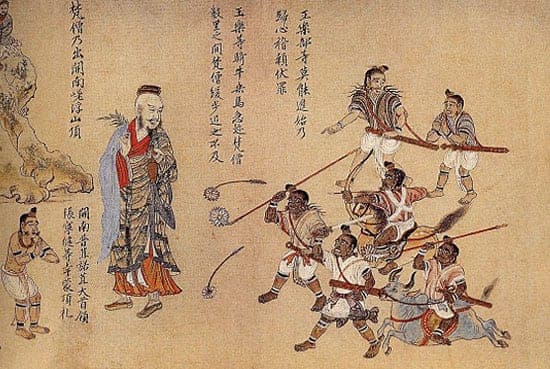
Detail of the Nanzhao Picture Scroll. Image: Wikimedia Commons, public domain
Dali Kingdom politics cannot avoid one surname: Gao. At the founding, the Gao were Duan Siping's most important allies; by the 11th century, the Gao had become the Dali Kingdom's de facto "shadow emperors." During Duan Silian's reign, Gao Zhisheng served as Buxie (equivalent to chancellor) and controlled the court; in 1080, a palace coup occurred in Dali and the king was murdered. Gao Zhisheng's son Gao Shengtais raised troops to put down the disorder, and from then on the Gao family held power over the court, deposing and installing kings as if it were child's play.
In 1094 CE, Gao Shengtais simply deposed the Duan king, ascended the throne himself, and changed the state name to "Great China." But this usurpation lasted only two years—in 1096, Gao Shengtais fell gravely ill and left a dying command: return the throne to the Duan. His son Gao Taiming obeyed and installed Duan Zhengchun as emperor, known in history as the "Later Li Kingdom." From that year on, the Duan sat on the throne again, but real power remained in Gao hands: Gao descendants served generation after generation as chancellor, and the Duan king was more like a symbol sitting on the throne.
If this history sounds a little familiar, it may be because you have read Jin Yong. The romantic and amorous Duan Zhengchun and the gentle and kind Duan Yu in the novels are modeled on the Dali Kingdom emperors Duan Zhengchun and Duan Zhengyan, father and son. In real history, Duan Zhengyan reigned for nearly forty years (1108–1147), one of the longest-reigning Duan emperors, but under his rule the Dali Kingdom was still administered by the Gao. It is said that in his later years Duan Zhengyan voluntarily abdicated and became a monk, passing the throne to his son—rather similar to Duan Yu's ending in Demi-Gods and Semi-Devils. By the way, the "Southern Emperor" Master Yideng in Jin Yong's The Legend of the Condor Heroes is named Duan Zhixing, and he too was a real emperor of the Dali Kingdom.
This brings us to the most distinctive tradition of the Dali Kingdom: kings becoming monks. According to the Nanzhao Yeshi and other records, among the more than twenty kings of the Dali Kingdom, nine in succession gave up the throne to become monks, known in history as the "nine emperors as monks." Why would kings give up the throne? There are many explanations: some say they sincerely believed in Buddhism and saw through the vanity of the world; some say they were sidelined by the Gao and had no choice; others say it was a political arrangement by which they abdicated to their sons and retired to temples while still holding power. Perhaps the truth is a mixture—Buddhism gave the kings a dignified way out, and the Gao gave them the pressure that made retreat unavoidable. In world history, it is almost impossible to find another example of a kingdom's monarchs collectively becoming monks so densely. The phrase "land of wondrous incense and Buddhism" is half Buddhist incense and half helplessness.
The status of Buddhism in the Dali Kingdom can be seen from Chongsheng Temple. Chongsheng Temple was the royal temple of Nanzhao and the Dali Kingdom, located below Yingyue Peak of Cangshan. It was first built in the late Nanzhao period, and successive Dali Kingdom kings kept expanding it. The three pagodas in front of the temple—the tallest central Qianxun Pagoda built in the Nanzhao period, and the two smaller pagodas built in the Dali Kingdom period—still stand at the foot of Cangshan today, having not fallen for more than a thousand years. They were the spiritual landmarks of the kingdom: traveling horse caravans and merchants crossing the lake, seeing the three pagodas from afar, knew they had reached Dali. When the three pagodas were repaired in 1978, people also found a large number of Buddhist statues, written sutras, and ritual objects from the Nanzhao and Dali Kingdom periods inside the pagodas—these are the physical remains the "land of wondrous incense and Buddhism" left to today.
Unfortunately, Chongsheng Temple, this thousand-year-old ancient temple, ultimately could not escape the fires of modern war—during the turmoil of the Xianfeng era of the Qing, the temple was destroyed, leaving only the three pagodas standing alone at the foot of Cangshan. The Chongsheng Temple you see behind the three pagodas today was rebuilt around 2003. Think about it: the three pagodas survived earthquakes, war, wind, and rain for more than a thousand years—that itself is a miracle.
If Buddhism was the Dali Kingdom's top-down faith, then "Benzhu" is Dali's bottom-up faith. Almost every Bai village has its own "Benzhu"—a guardian deity who can be a historical hero, a Buddhist figure, or even a Duan king. Walking into the Benzhu temple of any Bai village, you can see another telling of Dali's history: it is not on steles but in incense smoke.
The relationship between the Dali Kingdom and the Song dynasty is a very peculiar page in Chinese history. It coexisted with the Song for more than three hundred years but was never incorporated into the Song—not because the Song did not want to, but because the Dali Kingdom was separated by mountains and rivers and formed its own entity, and the Song was content to use enfeoffment in exchange for southwestern peace. Legend says that Song Taizu Zhao Kuangyin once drew a line along the Dadu River on a map with a jade axe and said, "Beyond this is not mine," and from then on the Song never again entertained the idea of conquering Dali—this is mostly a later legend, but it does convey the real distance between the two states.
However, political distance could not stop economic exchange—the two sides traded what they had through the "tea-horse market." The Song lacked warhorses, and the Dali Kingdom happened to have good horses. Dali horses were not large, but they had excellent endurance and were the best warhorses in the southwest at the time. In the Southern Song, the court opened a trading market at Hengshan Fort in Guangxi (around present-day Tiandong, Guangxi). Dali merchants drove horse caravans over mountains and ridges to trade, exchanging horses, medicinal materials, and ivory for Song brocade, books, and salt. The Southern Song writer Zhou Qufei recorded the bustle of this market in Lingwai Daida—Dali horses and Dali knives were hot commodities at the time. Besides the Song, the Dali Kingdom had dealings with Tubo, Pagan (today's Myanmar), and India; it was the hub connecting southwestern China with Southeast and South Asia at the time. Horse caravans carrying tea crossed the Wuliang Mountains and carried Dali's voice far away.
Between the Dali Kingdom and the Song, there was not only private trade. During the Zhenghe era (around 1117), Dali Kingdom king Duan Zhengyan sent envoys all the way to Bianjing to present horses, musk, and other goods to Emperor Huizong of Song, and Emperor Huizong enfeoffed Duan Zhengyan as "jiedushi of Yunnan and King of Dali"—this was a rare formal diplomatic moment in the history of relations between the two states, when Dali's envoys carrying tribute entered the Northern Song capital. The dignity between one "state" and another was maintained through these exchanges for more than three hundred years.
1253: Kublai Khan "crossing the river on leather bags," and the end of the Dali Kingdom
In the autumn of 1253, the Mongol army under Kublai Khan campaigned south against Dali. They came a long way south from the north and "crossed the river on leather bags" by the Jinsha River—sewing ox and sheep skins into air bags, inflating them, and tying them under rafts so that people and horses could cross the surging great river. Around present-day Lijiang, the story of "the Yuan crossing on leather bags" still circulates. After crossing the Jinsha River, the Mongol army split into three routes: one crossed behind Cangshan, one went straight for Longshou Pass, and one went south along the east bank of Erhai. Under the three-way encirclement, the Dali Kingdom's main resistance was crushed and the regime fell; Duan Xingzhi was subsequently captured by the Mongol army. The Dali Kingdom, which had stood for 316 years, thus came to an end.
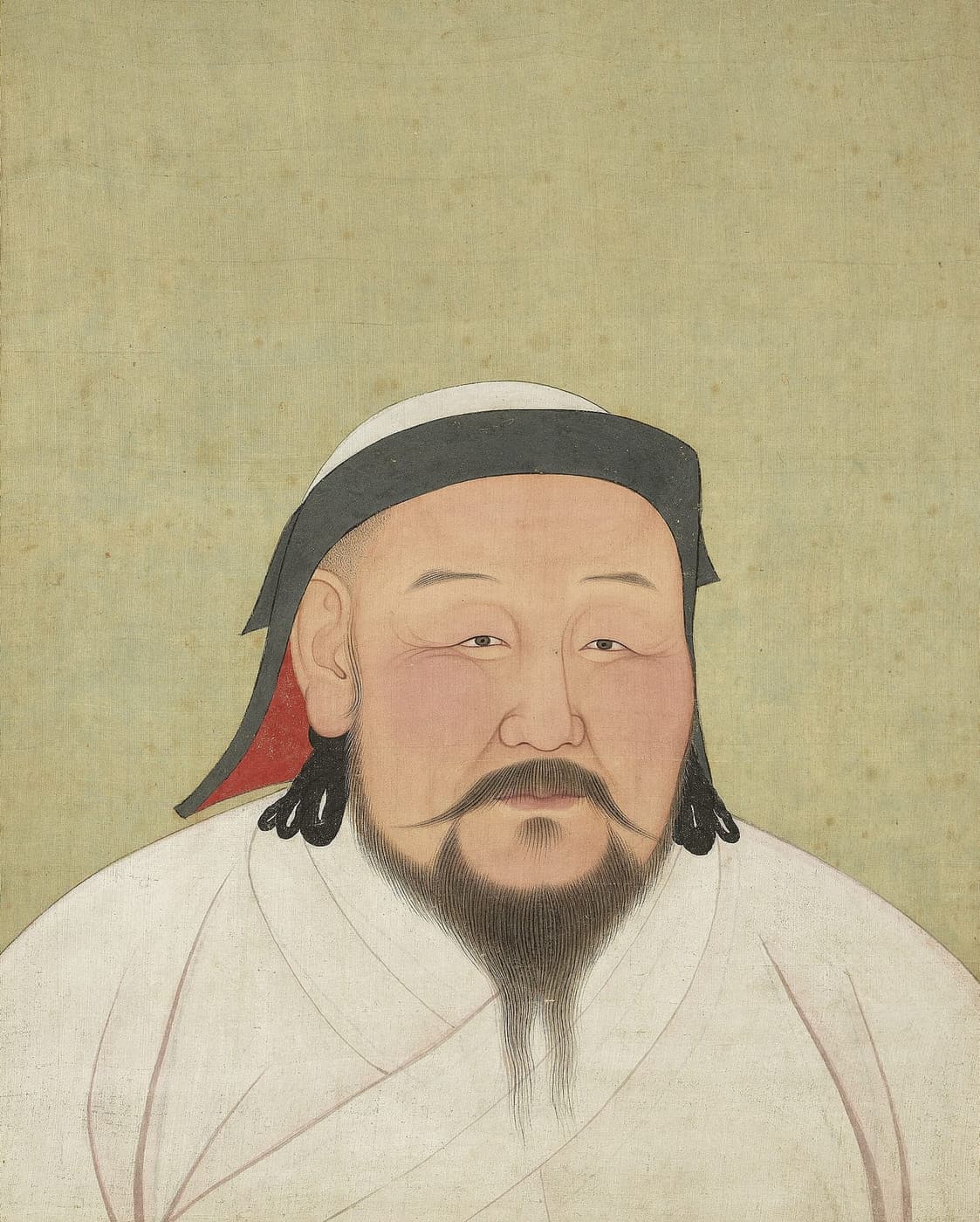
Portrait of Kublai Khan, Emperor Shizu of Yuan. Image: attributed to Anige / Wikimedia Commons, public domain
The Mongols did not erase Dali from the map, but from then on Yunnan's political center began to shift toward Kunming. In 1274, Sayyid Ajall Shams al-Din was appointed Pingzhang Zhengshi of Yunnan Province and, on the basis of the previously coexisting multiple systems, promoted unified provincial governance, with the provincial seat at Zhongqing (today's Kunming). He was a Hui politician who governed Yunnan in good order: repairing Dianchi's waterworks, building schools, establishing post stations, and pacifying all ethnic groups. It is said that during his tenure, Yunnan's taxes were lighter, roads were open, and there were far fewer armed clashes among ethnic groups. After Sayyid Ajall's death, the people of Yunnan built shrines to commemorate him, and traces of him remain in Kunming today. Dali changed from a "royal capital" to a prefectural city within the province, but its cultural foundation—Bai ethnicity, Buddhism, folk beliefs, and crafts—did not disappear; instead it settled into the daily life of Dali today.
Interestingly, the Dali Duan did not completely exit the stage of history in 1253. After Kublai Khan captured Duan Xingzhi, he did not kill him; instead he appointed the Duan to continue managing the Dali area as hereditary "Dali Governors," assisting the Mongols in governing western Yunnan. The Duan governors passed down for about ten generations and lasted into the early Ming. That is to say, the Duan's actual rule in Dali, counting from 937, continued intermittently for more than four hundred years—rare even in world family history. The surname "Duan" in Dali remains one of the major Bai surnames today.
From Ming and Qing to modern times: gaitu guiliu, merchant groups, and uprisings
After the Ming replaced the Yuan, Yunnan changed hands again. In 1381, Ming Taizu Zhu Yuanzhang sent a great army to campaign in Yunnan; in 1382, Mu Ying led troops to take Dali, and the last Dali Governor Duan Shi was captured—the Duan's more than four hundred years of rule truly came to an end here. Mu Ying was Zhu Yuanzhang's adopted son and highly decorated; afterward the Ming had the Mu family guard Yunnan hereditarily. The Mu family guarded it from the Hongwu era to the end of the Ming, nearly three hundred years, and various legends about the Mu family still circulate in Kunming today.
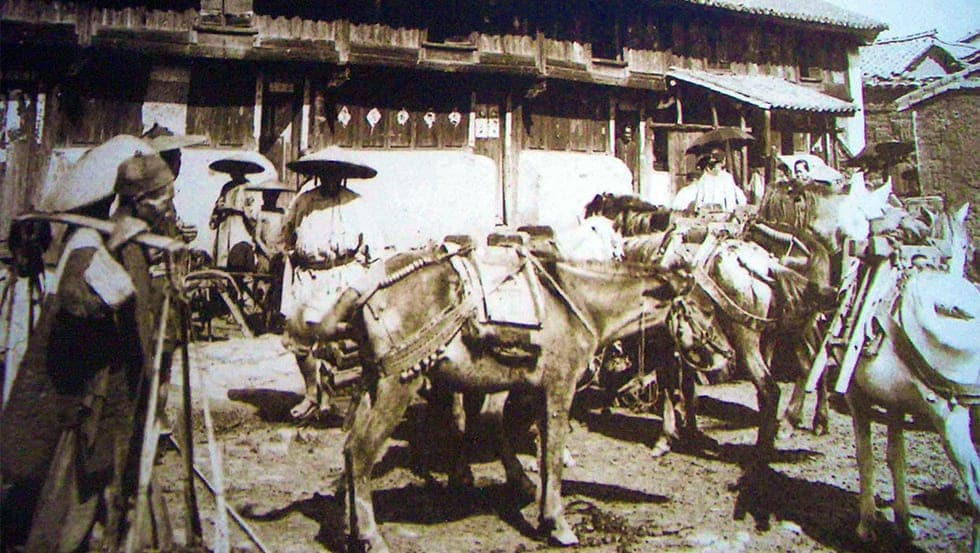
A mule and horse caravan in western Yunnan around 1905. Image: Wikimedia Commons, public domain
In the Ming and Qing dynasties, the core term of central governance in Yunnan was "gaitu guiliu": gradually replacing hereditary local regimes under native chieftains with officials sent by the court. This process lasted several hundred years and reached its climax during the Yongzheng era of the Qing, when large numbers of native chieftains were abolished and Yunnan's prefecture and county system basically took shape. Gaitu guiliu had a cruel side—many native chieftains were eliminated by force; it also had a positive side—from then on all parts of Yunnan were truly linked into one whole, and Dali's connection with the interior became closer than ever. The city walls and street layout of Dali Old Town today were fixed in the Ming: during the Hongwu era, the court built a new prefectural city on the old site of Yangjumie City, square and regular, with one central north-south axis and several main east-west streets—when you walk on Fuxing Road today, beneath your feet is the planning of six hundred years ago.
The heaviest page of modern Dali is the Du Wenxiu Uprising. In 1856, against the background of intensified Hui-Han conflict in western Yunnan, the Hui scholar Du Wenxiu gathered a force, took Dali, established a regime, and called himself "Grand Marshal President of the Army and Horses." Under his rule, Dali for a time had "Hui, Han, and Bai" co-governance, with people of different ethnic groups living and working together. This regime lasted sixteen years, until Qing forces recovered Dali in 1872 and Du Wenxiu died when the city fell. This history is heavy, and it also left a deep memory of Dali's diverse ethnic and religious coexistence—today in Dali, Hui communities, mosques, Bai Benzhu temples, and Buddhist temples stand side by side, precisely an echo of this history.
In the same period, another force quietly accumulated in Dali: merchant groups. Western Yunnan has had busy trade routes since ancient times, and in modern times Bai merchants from Xizhou seized the opportunity of Yunnan-Myanmar trade and built their businesses into something substantial. The Xizhou merchant group was one of the most famous merchant groups in modern western Yunnan, and its most famous figure was Yan Zizhen. He came from a poor family and started by driving horse caravans. It is generally believed that in 1902 he and partners founded the "Yongchangxiang" firm, specializing in tea, and created Xiaguan Tuocha—that bowl-shaped compressed tea that, because it was convenient for horse caravans to carry, quickly became a star product on the Tea Horse Road. Yongchangxiang's business expanded from Xiaguan to Kunming and Sichuan, and then to Myanmar and India; the silver earned built exquisite Bai grand residences one after another—the three-fang-one-screen-wall and four-heaven-five-courtyard houses you see in Xizhou today were mostly left from that era. The Yan family's Yan Grand Courtyard is still one of the most imposing residences in Xizhou.
The name Xiaguan Tuocha comes from the place where it was born: Xiaguan. Xiaguan is the transport throat of western Yunnan, with strong winds. The Tea Horse Road ran north from the tea mountains of southern Yunnan, gathered and distributed at Xiaguan, then crossed Lijiang and Zhongdian into Tibet to the north, and led to Myanmar and India to the west. Horse caravans were the protagonists on this road: hundreds and thousands of mules and horses traveled in groups, their bells echoing between Cangshan and Erhai. The Tea Horse Road was not only a trade route but also a road of cultural exchange—tea and salt from the Han lands, horses and furs from the Tibetan region, jade from Myanmar, and cloth from India all met in the markets of Xiaguan. The prosperity of modern Dali depended half on the scenery of Cangshan and Erhai and half on the horse caravans on this road.
Later, railways and highways changed Dali. In 1910, the Yunnan-Vietnam Railway built by the French opened, running from Kunming directly to Haiphong in Vietnam—this was Yunnan's first railway. Although it did not pass through Dali, it drew all of Yunnan into the modern world. In 1938, during the hardest period of the War of Resistance, the Yunnan-Burma Road opened, running from Kunming through Xiaguan and Baoshan to Myanmar, and became the lifeline by which China obtained international aid during the war; countless supplies and expeditionary soldiers passed along this road. Dali's Xiaguan was precisely an important node on the Yunnan-Burma Road. After the smoke of war cleared, the story of this road became part of Dali's modern memory.
Where can you see this history today?
If you want to walk through this history, the sites around Dali are enough to keep you busy for several days. Here are a few places recommended in chronological order:
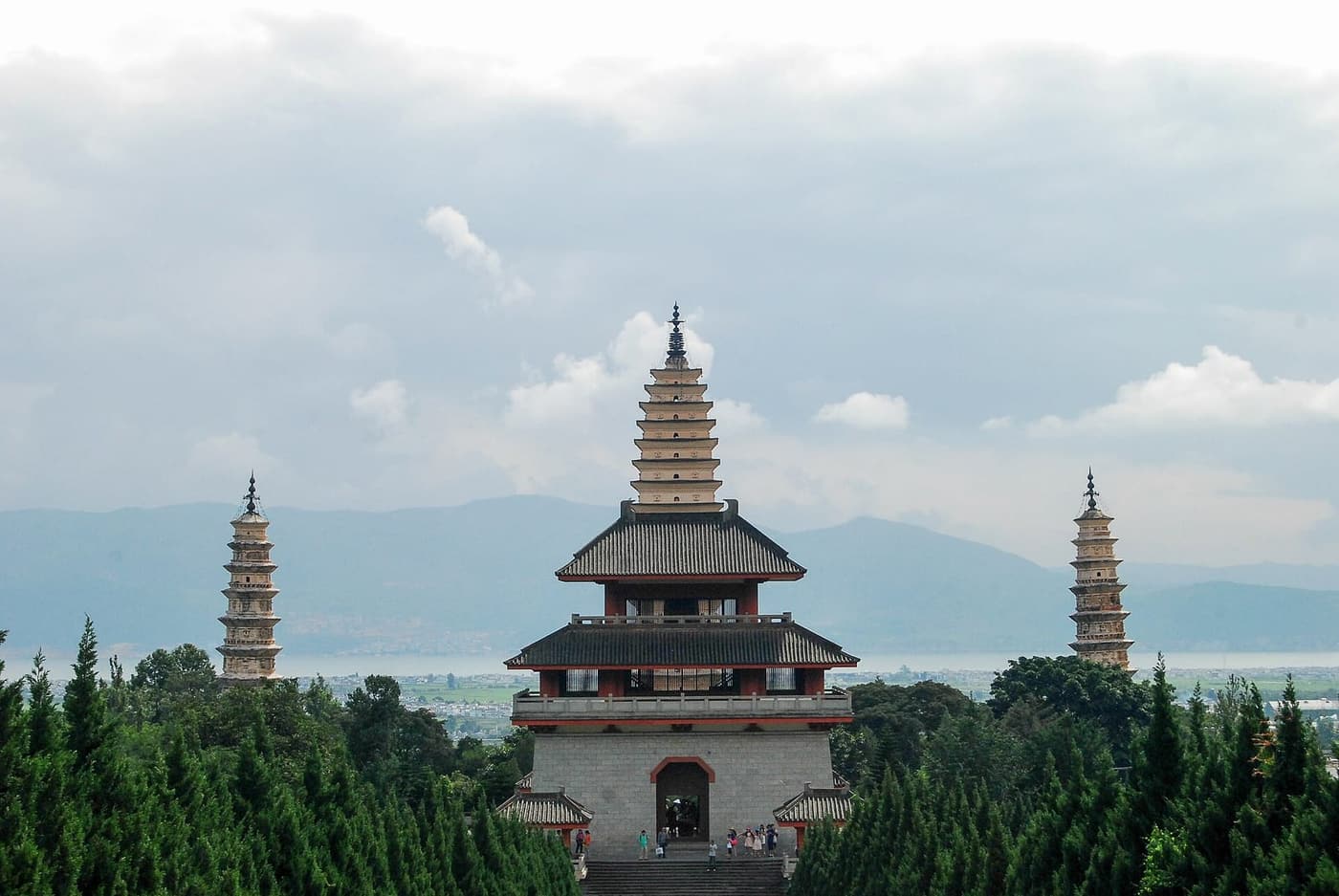
The Three Pagodas of Chongsheng Temple in Dali. Image: shizhao / Wikimedia Commons, CC BY-SA 2.0
• Taihe City ruins and the Nanzhao Dehua Stele: Nanzhao's earliest capital was in the area of today's Taihe Village in Dali City. The Dehua Stele stands on the ruins; the stone stele in the stele pavilion, more than 1,200 years old, is Nanzhao's first-hand archive and worth reading carefully.
• Longshou Pass (Shangguan) and Longwei Pass (Xiaguan): the northern and southern passes that guarded the two ends of Erhai during the Nanzhao and Dali Kingdom periods. Longwei Pass is in the area of today's Longwei Street in Xiaguan, where city walls and old streets can still be found; Longshou Pass is in Shangguan Town, guarding the northernmost end of Erhai.
• Three Pagodas of Chongsheng Temple: remains of the royal temple of Nanzhao and the Dali Kingdom, Dali's landmark, and the most direct physical evidence of the "land of wondrous incense and Buddhism." Many of the cultural relics unearthed during the 1978 repairs can be seen in museums.
• Hongsheng Temple Pagoda (One Pagoda): an ancient pagoda outside the south gate of Dali Old Town, said to have been built in the Nanzhao period; it faces the Three Pagodas from afar and is part of the old town's skyline.
• Fotu Pagoda (Snake Bone Pagoda): in the northern suburbs of Xiaguan, said to be connected with the Bai folk legend "Duan Chicheng Slays the Python"; its body is covered with small Buddha images and it is a good place to learn about Dali's folk beliefs.
• Xiaguan Tianbao Park (Ten Thousand Men's Tomb): the collective grave of Tang soldiers who died in the Tianbao War; the tombstone "Tomb of the Tang Tianbao Soldiers" is still there—the war in Bai Juyi's poem is buried here.
• Dali Old Town: although famous today for tourism, its walls and streets still preserve the layout of a Ming-Qing prefectural city; walking from the south gate to the north gate is six hundred years.
• Xizhou Ancient Town: the place where Bai merchant-group grand residences are most concentrated; the Yan Grand Courtyard and Dong Grand Courtyard are the most vivid examples of modern Dali.
• Weishan Ancient Town: the home of Mengshe Zhao, the birthplace of Nanzhao; quieter than Dali Old Town, with a more complete Ming-Qing layout. When you go to Weishan, remember to see the Confucian Temple and the old city tower.
Dali's beauty is half in its mountains and waters and half in its history. Next time you pass the Three Pagodas, think about this: they have stood here for more than a thousand years and have seen Nanzhao's campaigns, the Dali Kingdom's Buddhist incense, Kublai Khan's iron cavalry, and today's endless stream of tourists. They have witnessed the southward and northward shifts of Yunnan's political center, the bells of horse caravans, and the convoys on the Yunnan-Burma Road. Their story has only just begun to be heard by you.
References and notes
• Zhuang Qiao opening Dian and the Seal of the King of Dian: see Records of the Grand Historian: Biographies of the Southwestern Barbarians; the "Seal of the King of Dian" was unearthed in 1956 at Shizhaishan in Jinning, Yunnan, and is now in the Yunnan Provincial Museum.
• Yizhou Commandery and Yongchang Commandery: see the Book of Han: Biographies of the Southwestern Barbarians and the Book of the Later Han: Biographies of the Southwestern Barbarians; Yongchang Commandery was established in the twelfth year of Yongping of the Eastern Han (69 CE), and its territory included parts of today's western Yunnan and northern Myanmar.
• The Cuan family and the Cuan Baozi Stele and Cuan Longyan Stele: see the inscription of the Cuan Longyan Stele and Yunnan local history research; both steles are now in Qujing.
• Nanzhao's founding and the Tianbao War: synthesized from the New Book of Tang: Biography of Nanzhao and mainstream academic accounts; poems such as Bai Juyi's "The New Feng Old Man with a Broken Arm" mention the Yunnan war during the Tianbao era; the account of Li Mi's death in battle and the "Ten Thousand Men's Tomb" is found in the Nanzhao Dehua Stele and local historical literature; today's Tianbao Park in Xiaguan preserves the "Tomb of the Tang Tianbao Soldiers."
• Cangshan Alliance (794): see the New Book of Tang: Biography of Nanzhao; in the tenth year of Zhenyuan (794), the Tang envoy Cui Zuoshi and Yimouxun swore alliance at Diancang Mountain; Zheng Hui's capture by Tang and service as Nanzhao Qingpingguan are also found in the New Book of Tang: Biography of Nanzhao.
• Causes of the Tianbao War (the Yaozhou commander Zhang Qiantuo incident) and the two campaigns of Xianyu Zhongtong and Li Mi: see the New Book of Tang: Biography of Nanzhao and mainstream accounts.
• Pyu music presented to Tang via Nanzhao (around 802): see the New Book of Tang: Biography of Pyu and Bai Juyi's poem "Pyu Music."
• Nanzhao's territorial extent and its relations with the Pyu state and Magadha: see the New Book of Tang: Biography of Nanzhao, Fan Chuo's Manshu, and mainstream academic research on Nanzhao's territory.
• The succession Nanzhao—Great Changhe—Great Tianxing—Great Yining—Dali Kingdom: see Nanzhao Yeshi (compiled by Yang Shen of the Ming), the New History of the Five Dynasties, and Yunnan local history research.
• Duan Siping's founding and Gao family dominance (Gao Shengtais established "Great China" in 1094 and returned power to Duan Zhengchun in 1096): see the History of Song: Biography of the Dali Kingdom, Nanzhao Yeshi, and modern Yunnan local history research.
• The Dali Kingdom royal lineage, the name "land of wondrous incense and Buddhism," and the saying "nine emperors as monks": see Nanzhao Yeshi and modern Yunnan local history research; Duan Zhengyan and Duan Zhixing are real historical figures, see the History of Song: Biography of the Dali Kingdom.
• Jin Yong's Demi-Gods and Semi-Devils and the Dali Duan: Duan Zhengchun and Duan Zhengyan (the model for Duan Yu) were real emperors of the Dali Kingdom; the "Southern Emperor" Duan Zhixing in The Legend of the Condor Heroes was also a real king of the Dali Kingdom.
• Horse market trade between the Dali Kingdom and the Song: see the Southern Song Zhou Qufei's Lingwai Daida and relevant records in the History of Song; Hengshan Fort (around present-day Tiandong, Guangxi) was an important horse market town in the Southern Song, and "Dali knives" also appear in Lingwai Daida.
• During the Zhenghe era (around 1117), the Dali Kingdom sent envoys to present tribute, and Emperor Huizong of Song enfeoffed Duan Zhengyan as "jiedushi of Yunnan and King of Dali": see the History of Song: Biography of the Dali Kingdom.
• Chongsheng Temple destroyed in the wars of the Xianfeng era of the Qing and rebuilt around 2003, with only the Three Pagodas being original Nanzhao-Dali Kingdom objects: see cultural protection materials on the Three Pagodas of Chongsheng Temple and Dali local history research; for Bai "Benzhu" belief, see studies such as Bai Benzhu Culture.
• "The Yuan crossing on leather bags" and Kublai Khan's destruction of Dali (1253): see the History of Yuan: Annals of Shizu and relevant records in Rashid al-Din's Jami' al-Tawarikh; Sayyid Ajall Shams al-Din's governance of Yunnan: see the History of Yuan: Biography of Sayyid Ajall Shams al-Din; Yunnan Province was formally established in the thirteenth year of Zhiyuan (1276).
• The Duan family as Dali Governors: the Yuan granted the Duan hereditary office of Dali Governor, which ended in the fifteenth year of Hongwu of the Ming (1382) when Ming forces took Dali and the last governor Duan Shi was captured; see the History of Yuan and Yunnan local history research.
• Ming construction of Dali Prefectural City and the Mu family guarding Yunnan: see the History of Ming: Biography of Mu Ying and Yunnan local history; the layout of Dali Old Town originates from the prefectural city built during the Hongwu era of the Ming.
• Du Wenxiu Uprising: the uprising lasted from the sixth year of Xianfeng of the Qing (1856) to the eleventh year of Tongzhi (1872); Du Wenxiu was from Baoshan, Yunnan (older texts also say "Weishan"; mainstream historical sources follow the Baoshan account). See relevant historical materials on the Yunnan Hui Rebellion and Dali local history research.
• Xizhou merchant group and Xiaguan Tuocha: the Yongchangxiang firm is generally believed to have been founded in 1902; the creation of Xiaguan Tuocha is closely related to Yongchangxiang. See the Yunnan Provincial Institute of Nationalities, Xizhou local historical materials, and the Xiaguan Tuocha Gazetteer.
• Yunnan-Vietnam Railway (opened 1910) and Yunnan-Burma Road (opened 1938): see research in Modern History of Yunnan and local transport history materials.
Keep exploring Dali
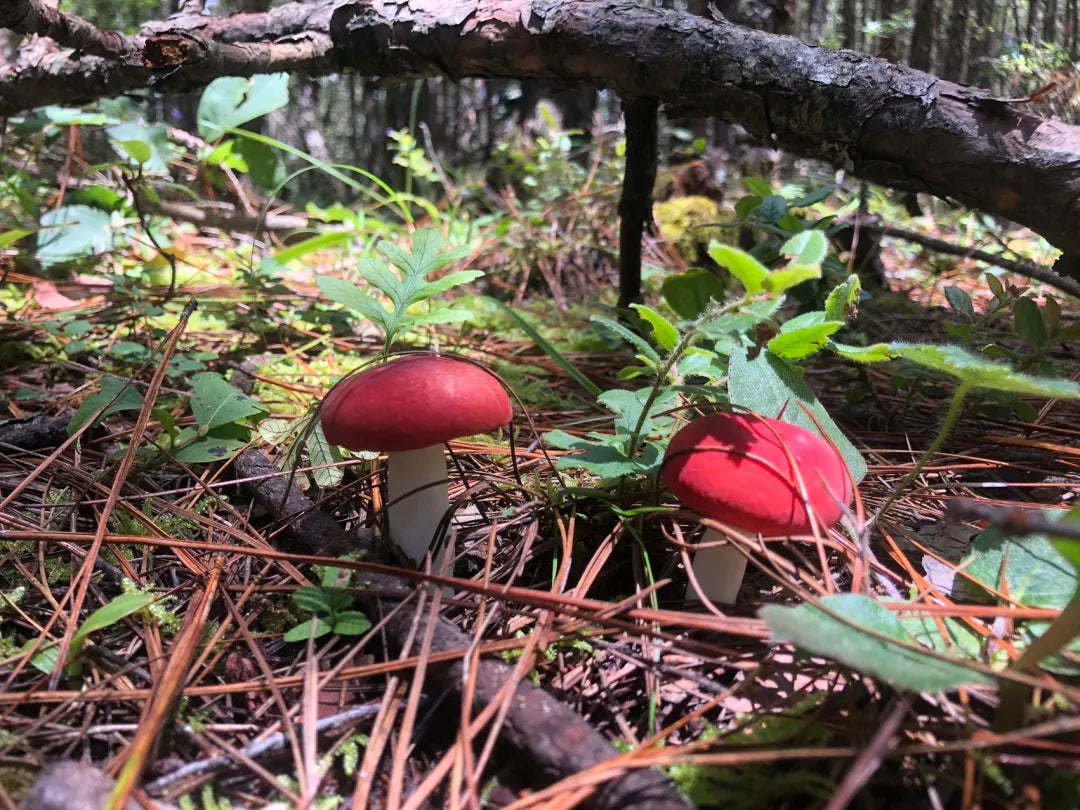 Dali Wild Mushrooms: Mushroom Season, Table Recipes, and Two Thousand Years of Mushroom-Eating HistoryEvery June, when the rainy season arrives in Yunnan, mushrooms start to pop up. Yunnan has 2,753 known wild mushroom species, accounting for more than half of China's total. This article covers the dried beef mushroom (ganba jun), termite mushroom (jizong), green-headed mushroom (qingtou jun), matsutake, and jianshouqing on Dali people's tables, how locals stir-fry them and preserve them in oil until next year, and also records from Zhuangzi, Bencao Gangmu, and Xu Xiake of Yunnan people eating mushrooms for over two thousand years—as well as the safety bottom line that must be upheld when foraging and eating mushrooms.→
 Scripts, Songs, and Wine in the Valleys: The Spread of Christianity in Yunnan's BorderlandsFrom James O. Fraser's early encounters with the Lisu people in Tengchong, explore the scripts, songs, churches, and wine of Yunnan's borderlands.→
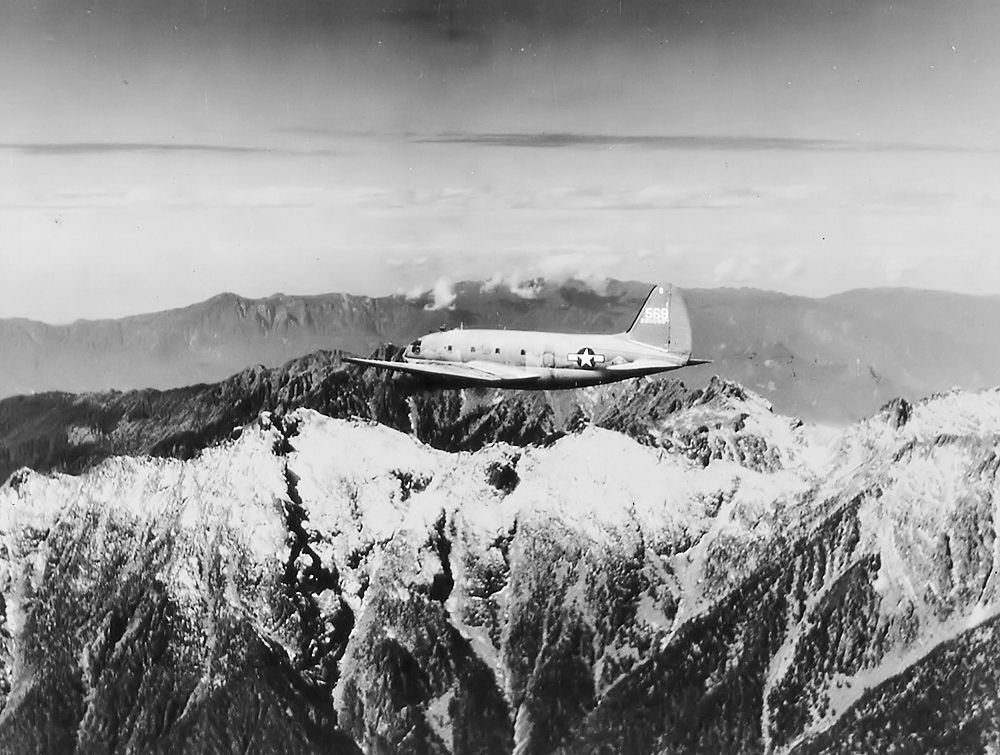 The Hump Route and the Burma Road: Two Lifelines of the War of Resistance Through YunnanOne leads through the mountains west of Xiaguan to Myanmar, the other flies over the mountains from Yunnanyi in Xiangyun. How did the Burma Road and the Hump Route maintain China's connection with the world during the most difficult phase of the War of Resistance? Why did Dali become an important node on both lifelines simultaneously?→
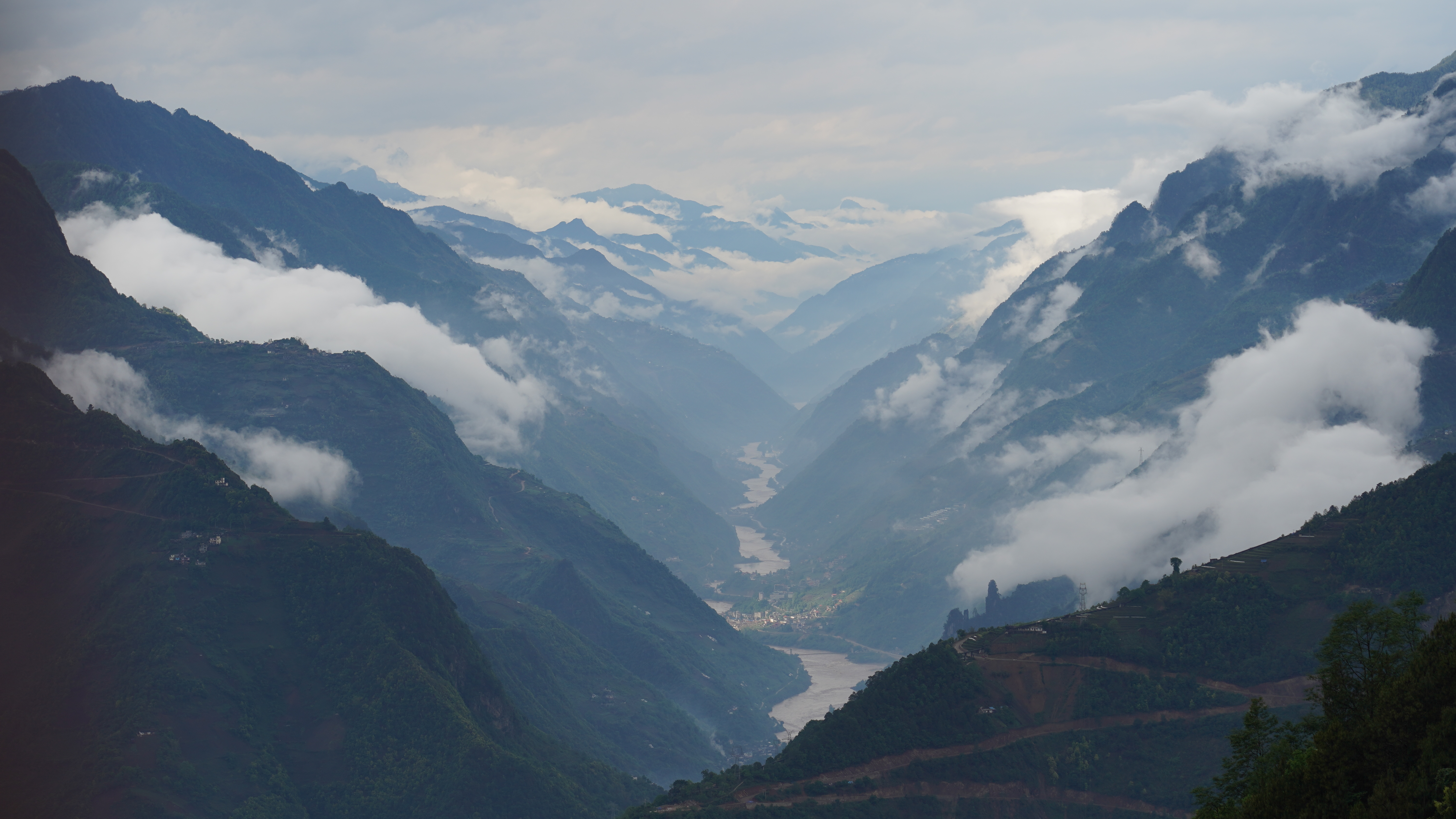
 The Nujiang, Lancang, and Jinsha Rivers: the unique nature and culture of the Three Parallel RiversStarting from Dali and heading north, crossing over the Cangshan Mountains, you will enter a massive fold split open by three great rivers. The Nujiang (Salween), Lancang (Mekong), and Jinsha (Yangtze) rivers—three great rivers originating from the Qinghai-Tibet Plateau—cut through the land of northwestern Yunnan from north to south like three parallel knives. They run so close together—at their nearest point, the straight-line distance is less than seventy kilometers; and they flow side by side for over one hundred seventy kilometers before each turns and heads toward a different destination. This is the "Three Parallel Rivers," inscribed as a UNESCO World Natural Heritage site in 2003, and it is also a key to understanding Yunnan. Many people think the beauty of Yunnan is simply the wind, flowers, snow, and moon by Erhai Lake→
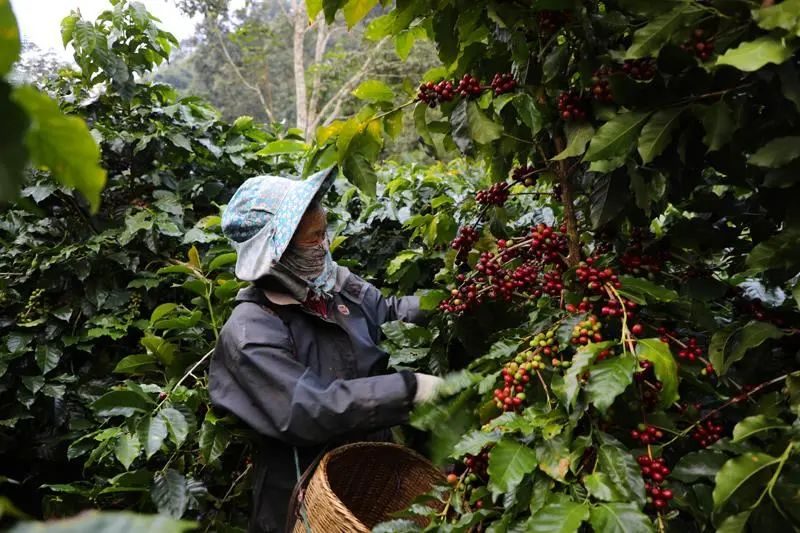 The history of Yunnan coffee: from Zhukula (a village in Yunnan) to a cup at the foot of Cangshan (a mountain in Yunnan)If you walk into the ancient town of Dali today, sit down at any café, and order a latte made with Yunnan beans, chances are you won't find it anything special. Coffee is far too common here—on Renmin Road there's one every few steps, the aroma of roasting drifts from the courtyards on Yeyu Road, and the terraces of the Chuangdancang Art District are full of people with their laptops. You might not realize that this ordinary cup of coffee is actually the end of a history spanning more than a century: its source lies in the mountains not far from the ancient town of Dali; its story begins with a French missionary and a small village almost completely cut off from the world. The story of Yunnan coffee is almost→
Comments
Comments
…