Life in Dali
Dali, Yunnan and the Ancient Tea Horse Road (Chama Gudao): A Thousand Years of One Road
Aug 15, 2026
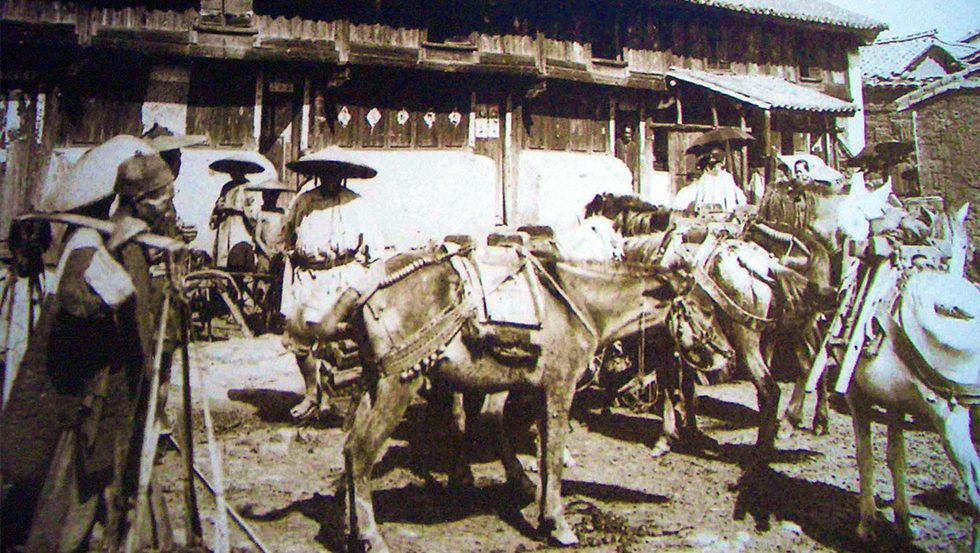
If you had to describe the Tea Horse Road in a single word, many people would blurt out "road." But those who have truly walked this route will tell you: it was never a single road. It was a network—a web spread across the folds of the Hengduan Mountains, linking the basins of Yunnan, the Sichuan Basin, the Tibetan Plateau, and the river valleys of Myanmar. For centuries, horse caravans carrying tea, salt, medicinal herbs, cloth, and silver traveled back and forth across this web, their bells ringing from Dali all the way to Lhasa, from Xiaguan all the way to Bhamo in Myanmar.
Like the Silk Road, the Tea Horse Road was not a route with a single starting point, endpoint, and fixed main trunk, but a network of trade routes formed in different periods and directions. The Tea Horse Road more prominently features the interlocking mountain transport systems of Yunnan, Sichuan, Tibet, and surrounding areas. It is the collective name for an entire transport system in the border region of Yunnan, Sichuan, Tibet, and Myanmar: mountain passes between great mountains, plank roads along river valleys, zip lines and skin rafts across rivers, horse inns and markets in the basins—countless small paths branched and converged in the Hengduan Mountains, spreading out like blood vessels. It is hard to draw "that one" Tea Horse Road on a map; you can only sketch its general direction. On some preserved old sections, the flagstones have been worn into deep grooves by the hooves of mules and horses over centuries—that was not a road built, but a road walked into being.
Imagine a dawn a hundred years ago: in the courtyard of a horse inn in Xiaguan, hands groped in the dark to feed horses and load packsaddles; the caravan leader checked the cargo list by oil lamp; mules snorted, and bells jingled in a cacophony. When daylight broke, a string of men and horses would follow the official road out of town, one after another disappearing toward the Cangshan range. Such dawns repeated on this road for a thousand years.
Of the goods on the network, tea was the star, but not the whole story. Salt, medicinal herbs, cloth, ironware, and silverware were all regulars of the caravans: many places in Yunnan did not produce salt, and salt from the salt wells had to be carried by horse caravans in all directions; cordyceps, musk, and hides came down from Tibetan areas, while tea, cloth, and ironware from Yunnan went up. Dali happened to be close to several sources of salt, tea, and medicine, and also guarded the gateways to Tibetan areas and Myanmar—naturally it was a major port on this web.
The most important thing carried on this road was tea. Life in Tibetan areas is inseparable from tea: vegetables are scarce on the plateau, meat and dairy are staples, and tea cuts greasiness and aids digestion. Butter tea is a daily necessity in every tent—brick tea boiled, butter and salt added, churned in a tea barrel, drunk hot, and a day's strength is there. But Tibetan areas do not produce tea; tea leaves had to be transported up from Sichuan and Yunnan. What did Tibetan areas have? Horses, hides, and medicinal herbs. Thus arose the "tea-horse trade": tea for horses, horses for tea. A simple exchange bound the plateau and the basins, Tibetans and Bai and Han Chinese, firmly onto the same road. Dali stood right at the hub of this exchange.
Today, when highways, railways, and airplanes compress distances into hours, we instead begin to miss this road walked into being by foot. It reminds us: some connections are made step by step; some civilizations are trampled out by the hooves of mules and horses.
The Formation of the Road: From the Shu-Shendu Road to the Tea-Horse Trade
The skeleton of the Tea Horse Road is far older than the two words "tea" and "horse." Over two thousand years ago, Emperor Wu of Han sent Zhang Qian on a mission to the Western Regions. In Daxia—today's Afghanistan area—Zhang Qian unexpectedly saw cloth from Shu and bamboo staffs from Qionglai Mountain. These items had not been transported from the Central Plains; locals said they were bought from Shendu (India). Zhang Qian deduced from this: Shu had long had a trade route leading through Yunnan and Myanmar to India. This route, later called the "Shu-Shendu Road," can be regarded as the older transport foundation on which some later Tea Horse Road sections relied. It predates the formal opening of the Silk Road and is a true "Southern Silk Road."
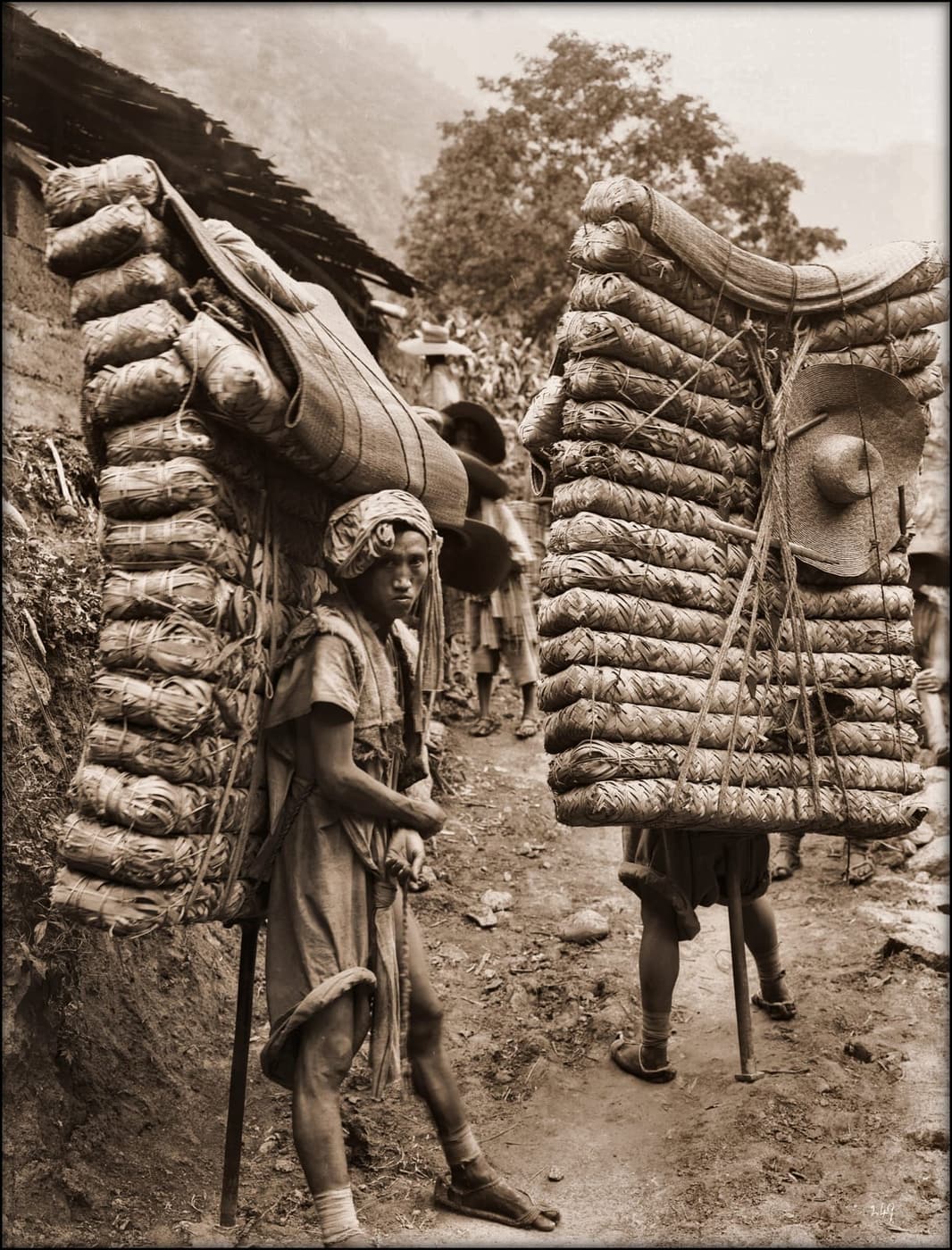
A tea porter in Sichuan, 1908. Image: Ernest H. Wilson; restorer ralph repo / Wikimedia Commons, CC BY 2.0
The Han dynasty specifically developed the southwest for this. The Qin dynasty had already cut the "Five-Foot Road" from Yibin in Sichuan to northeastern Yunnan; Emperor Wu of Han continued it southward and established Yizhou Commandery around Lake Dian; the Eastern Han established Yongchang Commandery in today's Baoshan area, extending the road farther west. In the Huayang Guozhi by Chang Qu of the Jin dynasty, a Han-era ballad is recorded: "Han virtue is vast, opening the unsubmissive; crossing Bonan, crossing Lanjin; crossing Lancang, for others." Bonan, Lanjin, and Lancang all refer to places west of Dali along the Lancang River—to build this road, people endured great hardship, but the beneficiaries were later travelers. This road, called the "Bonan Road" by Han people, is today counted as the oldest section of the Tea Horse Road.
What truly turned this road into the "Tea Horse Road" was the arrival of tea. Legend has it that when Princess Wencheng entered Tibet in the Tang dynasty, tea began to spread in Tubo; by the Song dynasty, an old saying circulated in Tibetan areas: "Better to go three days without grain than one day without tea"—tea had gone from a luxury condiment to a plateau necessity. It is generally believed that after the Tang dynasty, the tea-drinking habit gradually took hold in Tibetan areas, and the tea trade between Yunnan and Tibet rose accordingly; during the Nanzhao kingdom, Dali was already a link in this trade belt. By the Dali Kingdom, trade reached a peak: the Dali Kingdom traded with the Song dynasty through Guangxi; the Southern Song court opened a trading market at Hengshan Stockade (today's Tiandong area in Guangxi), and Dali caravans drove horses and carried medicinal herbs and ivory over mountains to exchange for Song brocades, books, and salt. The Southern Song writer Zhou Qufei recorded the bustle of this market in Lingwai Daida—Dali horses and Dali knives were hot commodities at the time. This "horse market" story is the most famous trade chapter between Yunnan and the Central Plains, but note: it is only one thread of this great web extending eastward. The main body of the web lies to the west and north—from Dali westward to Myanmar, northward to Tibet.
During the Ming and Qing dynasties, the tea-horse trade in the northwest and Sichuan-Tibet regions was managed by institutions such as the Tea Horse Office and tea licenses; Yunnan's Yunnan-Tibet trade relied both on official markets and, over the long term, on private merchants and horse caravans. Yunnan's Pu'er tea also emerged in this period: it is generally believed that Pu'er tea got its name from the establishment of Pu'er Prefecture in the Qing dynasty; tea from the Xishuangbanna area was gathered and distributed in Pu'er, then carried north by horse caravans—brick tea and compressed tea were pressed tightly and loaded pack by pack onto the road. By this time, the pattern of the Tea Horse Road was fully formed: with Dali as the central hub, west to Myanmar, north to Tibet, east to Kunming and the interior. Dali's history is Yunnan's history, and Yunnan's skeleton is precisely this Tea Horse Road.
Why Dali Was the Hub
Some say Dali's history is Yunnan's history; this is especially true on the Tea Horse Road—Yunnan's skeleton is this web. Open a map of Yunnan and you will find an interesting fact: most of Yunnan's major cities are not at the very center of mountain basins, but at the intersections of major transport routes. Dali is the most typical example. The Dali Basin is wedged between the Cangshan range and Erhai Lake, long and narrow north-south, one of the largest basins in western Yunnan. A basin means grain can be grown, people can be fed, and markets can gather; Cangshan and Erhai also give it natural protection. More critically is its position toward three directions: westward, over Cangshan, through Yongping, Baoshan, and Tengchong, all the way down to Myanmar; northward, along Erhai, through Jianchuan, Lijiang, and Zhongdian (today's Shangri-La), over snow mountains into Tibetan areas; eastward, through Chuxiong and Kunming, connecting to the official road to the interior. Three streams of people and goods converged at Dali, making it the largest distribution center in western Yunnan.
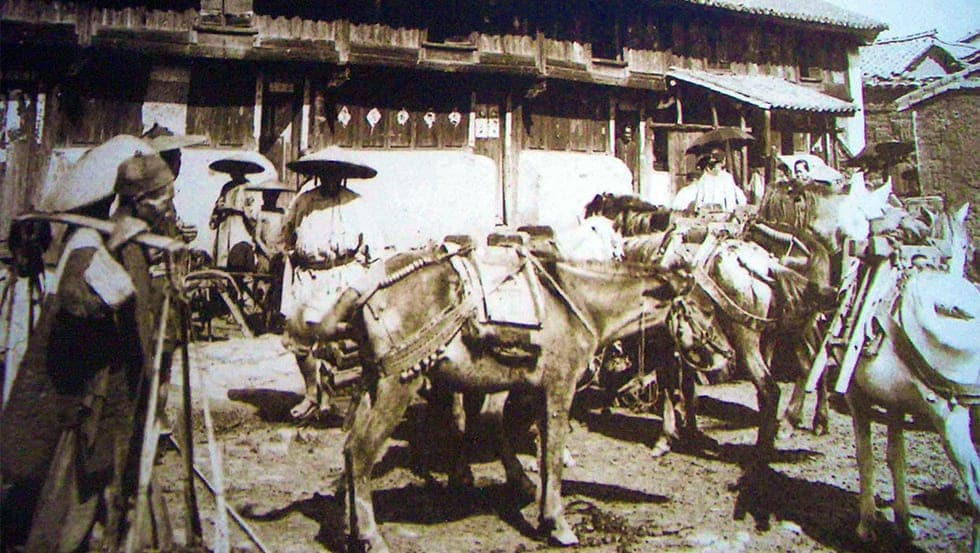
A mule caravan in western Yunnan, circa 1905. Image: Wikimedia Commons, public domain
The most concrete location of this crossroads is today's Xiaguan. Xiaguan is at the southern end of Erhai, where Cangshan and the Ailao Mountains almost close together, leaving only a wind gap—so Xiaguan has strong winds year-round, and locals call it the "Wind City." "Xiaguan wind, Shangguan flowers, Cangshan snow, Erhai moon"—wind ranks first. For horse caravans, wind was not a nuisance but a marker: seeing Xiaguan's wind meant arriving at the busiest commercial port in western Yunnan. In modern Xiaguan, shops stood side by side, and storage inns (warehouses for goods) were piled full of goods awaiting transport—at its peak, silver from western Yunnan, cotton from Myanmar, and hides from Tibet all had to pass through here, be repacked, and loaded onto horses' backs. The capitals of Nanzhao and the Dali Kingdom were both built on the shore of Erhai—not by chance; the capital was chosen here precisely because this was the throat of all western Yunnan.
The Dali Basin had another practical significance for caravans: it produced grain. A caravan covered only a few dozen li a day; people and animals both needed to eat. A basin that could sustainably supply grain, fodder, and lodging was a true transit station on a trade route. The Dali Basin could support passing caravans—this is the most plain reason it became the hub of western Yunnan. Erhai itself was also part of the road—Bai wooden boats plied the lake year-round, connecting villages on both shores. Every year in mid-lunar March, the Third Month Fair, said to originate from the legend of Guanyin preaching, filled with neighing horses and clamor, gathered mules and horses, medicinal herbs, and general goods—arguably the largest annual trade fair on the Tea Horse Road.
Dali's hub status also had a military dimension. At the north and south ends of Erhai, a pass guarded each: Longshou Pass (Shangguan) to the north locked the route to Lijiang and Tibetan areas; Longwei Pass (Xiaguan) to the south blocked the gateway to Baoshan and Myanmar—two passes, north and south, enclosed the Erhai basin into a fortress that could advance or retreat. During the Nanzhao and Dali Kingdom periods, these two passes were symbols of the national gate; in peacetime, they became tax stations and post stations on the trade route—caravans passing through had to have goods inspected, pay taxes, and rest. For travelers, Dali also had a lighthouse-like landmark—the Three Pagodas of Chongsheng Temple. When caravans came over the mountains from the north or crossed the river from the west and saw the silhouettes of the three pagodas in the distance, they knew Dali had arrived. This royal temple of the kingdom was also the most conspicuous signpost on the trade route.
Three Routes: Yunnan-Tibet, Yunnan-Myanmar, Yunnan-Sichuan
From Dali, the Tea Horse Road roughly divided into three main lines. The most important was the Yunnan-Tibet line, also called the "Dali–Lhasa line." Caravans set out from Xiaguan, went north along Erhai, through Jianchuan and Lijiang, crossed the Jinsha River at Shigu, then through Zhongdian, Benzilan, and Deqin, over Baima Snow Mountain, into Tibet's Mangkang and Qamdo, finally reaching Lhasa. This line was the veritable "tea-horse" main line: it carried mainly tea—compressed tea pressed into brick or heart shapes, sold mainly to Tibetan areas; on the return trip it carried Tibetan horses, hides, and medicinal herbs. The whole journey took two to three months, crossing several passes over 4,000 meters; at the passes, mani piles and prayer flags fluttered in the wind—prayers left by travelers. Today, if you drive the Yunnan-Tibet Highway (G214), most sections follow the route the caravans took. This line first hops from basin to basin: Jianchuan Basin, Lijiang Basin, Zhongdian Basin—each basin a resting point; beyond the basin are great mountains, and after crossing one, another lies ahead.
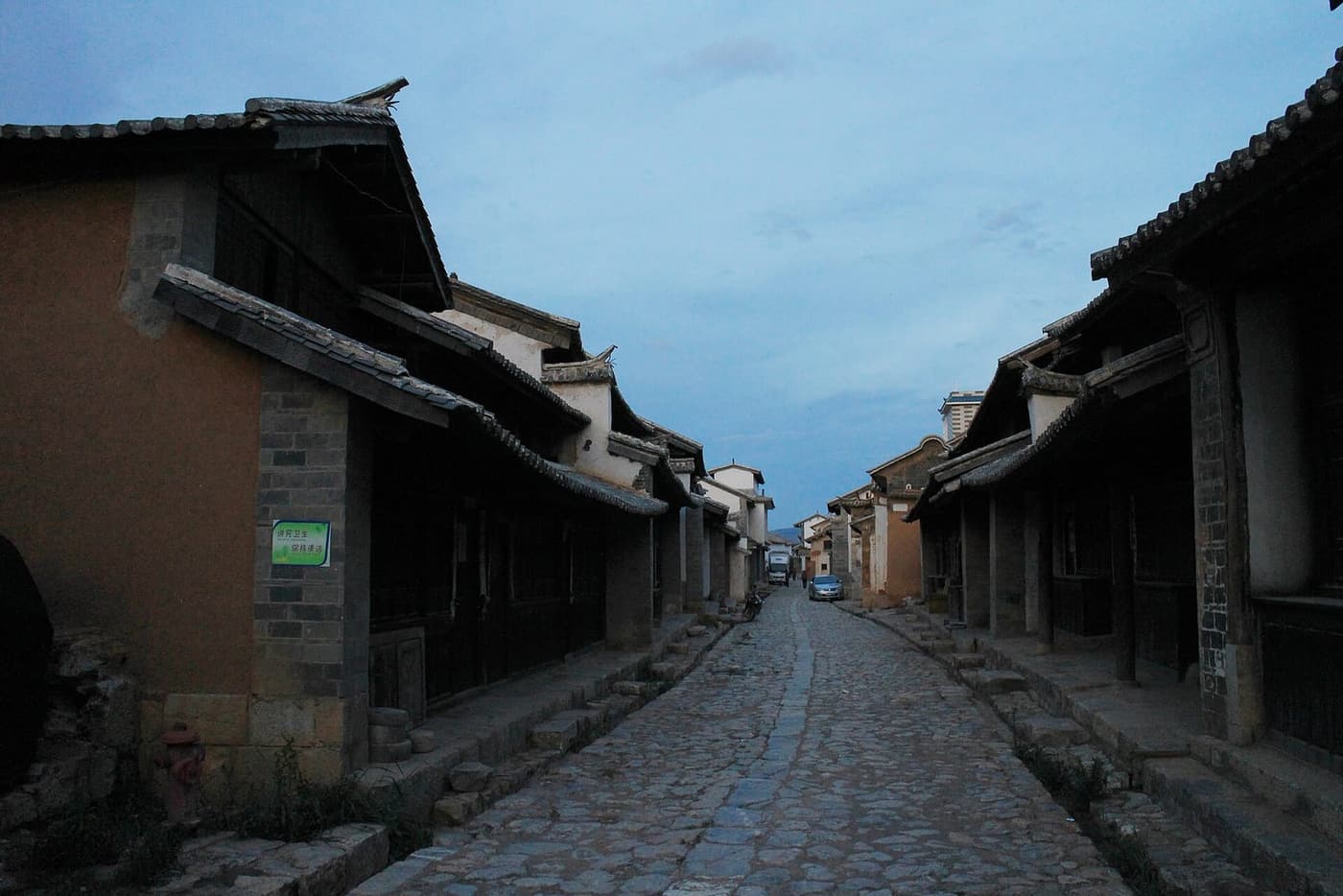
An ancient road in a Yunnan village. Image: Xin / Wikimedia Commons, CC BY-SA 4.0
The second was the Yunnan-Myanmar line, the westward extension of the Han dynasty "Bonan Road." From Xiaguan westward, through Yongping and Baoshan to Tengchong, crossing the border to Bhamo or Myitkyina in Myanmar, then south down the Irrawaddy River, or continuing west into India. This line carried more than tea—silk, salt, ironware, and silverware went out to Myanmar; cotton, jade, and ivory from Myanmar and spices from India came into Yunnan. Modern Tengchong thus became one of Yunnan's wealthiest border trade cities; the Bai merchants who "walked to the Yi lands" mostly took this line. Tengchong's Heshun Old Town is a hometown of overseas Chinese nurtured by this line—silver from caravans and overseas Chinese built the town's library and refined residences.
The third was the Yunnan-Sichuan line: from Dali through Chuxiong and Kunming eastward, or from Kunming north to Zhaotong and via Yibin into Sichuan—the direction in which the Qin dynasty "Five-Foot Road" was cut was the prototype of this line. This line connected Yunnan with the Central Plains: in the Ming and Qing dynasties, the court set up post stations and relay posts along this line; official documents, troop movements, and merchants all traveled this road, and many sections of the Tea Horse Road actually overlapped with the official road. Yunnan copper, Yunnan salt, and tea were transported to the interior along this road, and cloth and general goods from the interior were carried back to Yunnan. The three lines converged at Dali, so the old saying goes that Dali is the crossroads of western Yunnan—west to Myanmar, north to Tibet, east to Kunming and the Central Plains. Each line had its own important towns, its own products, its own stories.
The Tea Horse Road etched "tea" deeply into the lives of Dali's people. When Bai families receive guests, the most refined custom is the "Three-Course Tea": the first course is bitter tea, roasted fragrant in an earthenware pot over charcoal, brewed with water and drunk immediately—bitter on the tongue; the second is sweet tea, with brown sugar, rushan (fan-shaped cheese), and walnut kernels—a long, lingering sweetness; the third is aftertaste tea, with Sichuan pepper, ginger slices, and honey—numbing, spicy, and sweet all mixed together. One bitter, two sweet, three aftertastes—this describes both tea and life. This ritual is said to be a refinement that came off the ancient road: caravan men drank tea on the road to relieve fatigue, and back in the basin they steeped this "bitterness turning to sweetness" into the rules of hospitality. Today in Dali, Xizhou, Zhoucheng, and many Bai households still keep the Three-Course Tea etiquette, and many teahouses offer it as a signature experience; you sit in a courtyard and drink a course of bitter tea,
Horse Caravans and Caravan Men
Roads are made by people walking, and by horses treading. The main transport force on the Tea Horse Road was the horse caravan. A caravan was a strict organization: the leader was called the "guotou" or "ma guotou" (caravan boss), usually the most experienced person with the widest connections, responsible for taking goods, setting prices, deciding routes, and looking after the whole team; below him were the "huoji" (hands), who drove horses, fed them, tied packsaddles, and pitched tents, each with their own duties. A caravan might have as few as a dozen mules and horses or as many as a hundred, stretching out in a long line on mountain paths. Choosing mules and horses was particular: Dali horses were small but extremely hardy, and were hot commodities in Song dynasty horse markets; more often mules were used—mules were steadier than horses, tolerated coarse fodder, and were reliable on mountain paths and zip lines. A mule could carry over a hundred jin; a caravan of a hundred mules could transport over ten tons of goods at once—in an age without machinery, this was the most powerful transport force in the Hengduan Mountains. The bells on mules' necks were not just decoration: at mountain bends the bells arrived first, warning oncoming caravans to make way; at night in camp, the bells could also scare off wild animals.
The craft of the road lay entirely in details. Tying packsaddles was a skill: tea and salt were packed into sturdy loads, bound tight with palm rope, balanced left and right, and securely tied to the packsaddle frame—tied poorly, they would slip or overturn on mountain paths, and the whole caravan's reputation would suffer. Before setting out, the guotou had to check the goods and calculate the route; which section had bandits and required traveling together, which river was swollen and required a detour—all in his head. A caravan covered only a few dozen li a day; sleeping in the open was normal, and reaching a horse inn before dark was the best luck of the day.
The caravan men's life was half on the road, half in horse inns. Horse inns were post stations on the ancient road: spacious courtyards to tie horses, fodder, hot food and soup, some also serving as warehouses. Caravan men slept in communal bunks and followed rules—by old custom, words like "fan" (overturn) and "chen" (sink) were taboo on the road, shouting names randomly in the mountains was taboo, and when meeting an oncoming caravan one had to yield, first come first served. Caravans operated on credit: lost goods had to be compensated, broken roads had to be waited out; one word from the guotou and dozens of men followed. Relying on this transport network held together by credit and rules, in an age without telephones or highways, it somehow sustained centuries of material flow between Yunnan and Tibet. Caravan men's families stayed in the basins, tending fields and children year-round—in Bai families, women were often the real heads of household; the men staked their lives on the road, and the women held the home together in the basin.
Caravan men sang their days into songs. "Caravan tunes" exist all over Yunnan, and the Bai caravan tune is especially famous, singing of the morning of departure, loneliness in the mountains, longing for lovers, and also place names and road conditions along the way—a song was an oral map. The songs sang of hardship, and life was indeed hard: crossing snow mountains, wading ice rivers, dodging bandits, enduring miasma—some never returned. Bai people called going to Myanmar to make a living "walking to the Yi lands"; some made fortunes there, and some lost their lives there. Yan Zizhen of the Xizhou merchant group is said to have walked to the Yi lands in his youth, later founding the shop "Yongchangxiang," which built the Xiaguan tuocha—tea pressed into bowl shapes for easy long-distance transport—into a business reaching Kunming, Chengdu, and even Myanmar. He was the most successful of countless caravan men, but his starting point, like all caravan men, was a pair of straw sandals and a string of mules and horses.
The volume carried sounds modest, but calculated it is astonishing. A mule could carry over a hundred jin at a time; a caravan of dozens of mules carried several thousand jin per trip. A round trip on the Yunnan-Tibet line took at least two to three months, at most half a year; a guotou could make at most one or two trips a year, earning money exchanged for his life—but it was these loads, year after year, that built the foundations of cities like Dali, Lijiang, and Tengchong. Tea was the largest cargo: a load of compressed tea leaving Dali, crossing Baima Snow Mountain to Lhasa, could multiply several times in price; the tighter the tea brick was pressed, the more a load could hold, so most tea on the Yunnan-Tibet line was pressed into bowl-shaped tuocha or heart-shaped compressed tea—for easy packing and durable transport. Besides tea, salt was also hard currency: salt produced at western Yunnan's salt wells (such as Nuodeng in Yunlong and Misha in Jianchuan) was carried by caravans to salt-scarce mountain areas and Tibetan regions; a load of salt could often exchange for a load of hides. Long roads, heavy goods, few people—past Deqin heading north, the road became steeper and colder, and mules and horses gradually gave way to yaks—yaks tolerate cold and could carry tea packs over higher passes. Yunnan caravans delivered goods here, Tibetan yak caravans took over, and the two groups exchanged goods at post stations and also exchanged news: where the road was broken, where a new horse inn had opened, which market sold tea dear. That is how the road passed news near and far, station by station.
Towns on the Ancient Road
The Tea Horse Road was a thread stringing together a series of beads. Almost every town along the way prospered because of the road—their locations, their wealth, their crafts were all given by this road. Among these towns, some are still bustling county seats today, some have quieted down, but if you are attentive, their streets are still recognizable: the road changed course, but the towns remain.
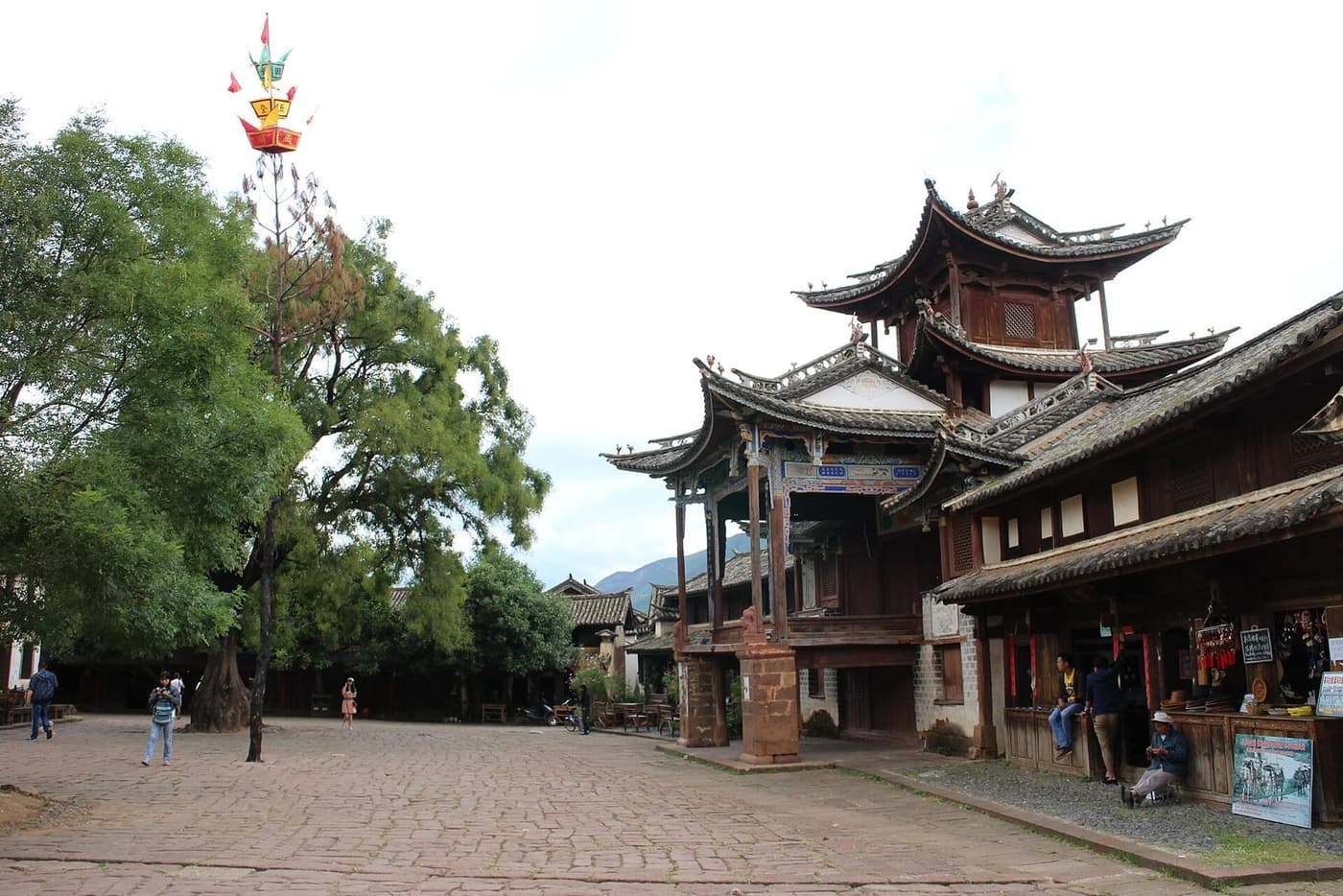
The ancient road and lanes of Sideng Street in Shaxi. Image: Xin / Wikimedia Commons, CC BY-SA 4.0
· Xiaguan: the largest commercial port in western Yunnan, with modern shops clustered and storage inns standing in rows, the common starting point of the three lines to Tibet, Myanmar, and Sichuan. Xiaguan tuocha was pressed into bowl shapes here for easy long-distance transport; today the Longwei Pass area of Xiaguan still retains the layout of old streets.
· Yunnanyi: an old post station in Xiangyun County, a famous old station on the western Yunnan highway; one of the earliest sources of the place name "Yunnan" is connected with this area.
· Xizhou: the headquarters of the Bai merchant group. Xizhou merchants traded along the ancient road, and the silver they earned built Bai mansions of "three workshops and one screen wall, four courtyards and five skylights." The grand courtyards you see today hold generations of accumulation from walking to the Yi lands.
· Shaxi Sideng Street: an ancient market in Shaxi Town, Jianchuan County, called the only completely preserved ancient market on the Tea Horse Road. Sifang Street, the old stage, the Ming-dynasty Xingjiao Temple, and the horse inns and shops along the street still look as they did centuries ago; Yujin Bridge at the town's edge spans the Heihui River, the passage by which caravans entered and left Sideng Street. In 2001, Sideng Street was listed by the World Monuments Fund in the "World Monuments Watch of Most Endangered Architectural Heritage," and subsequently Swiss partners cooperated with local authorities to restore it, saving it brick by brick.
· Jianchuan: an old city between Dali and Lijiang, with more mountains than fields; woodwork is the traditional livelihood. Jianchuan carpenters carried their toolboxes along the ancient road from village to village; many beams, columns, doors, and windows of temples and homes in western Yunnan came from their hands. Near the county seat, Shibao Mountain has grottoes from the Nanzhao and Dali Kingdom periods, and every year in late lunar July there is a grand Bai song festival.
· Heqing: silversmiths in Xinhua Village have hammered silverware for generations, said to have begun in the Nanzhao period. Silversmiths carried bellows and hammers far and wide—nearby to villages in western Yunnan, farther afield following caravans down to Myanmar. Today in Xinhua Village, the clanging of hammers still rings from morning to night.
· Lijiang: the domain of the Naxi Mu chieftains. In the Ming dynasty the Mu chieftains strongly supported the Karma Kagyu school of Tibetan Buddhism, making Lijiang an important religious and trade node between Yunnan and Tibet; when Xu Xiake visited Lijiang, he marveled that the Mu Mansion's "beauty of palaces rivaled that of kings." In 1997, Lijiang Old Town was inscribed on the World Cultural Heritage list; nearby Shuhe was also a bustling post station on the ancient road.
· Shigu: the Jinsha River makes a sharp bend here, known as the "First Bend of the Yangtze." Shigu is a famous ferry crossing; caravans crossing the river and armies fording it all passed here; in 1936, the Red Army on the Long March also crossed the Jinsha River here. The great stone drum by the river is a landmark where travelers rested.
· Benzilan: a small town on the banks of the Jinsha River, the last major post station on the Yunnan-Tibet line before crossing Baima Snow Mountain. Caravans rested and restocked here; farther north are Deqin and the snow mountain passes. The place name is said to mean "beautiful sandbank" in Tibetan.
· Nuodeng: a mountain village in Yunlong County, a famous salt well in western Yunnan during the Ming and Qing dynasties; caravans carried its salt in all directions. The ancient village is preserved to this day, and is now remembered again for its old salt wells and Nuodeng ham.
· Dali Old Town: the Fuxing Road and Renmin Road area was where shops and horse inns stood; strolling today, you can still imagine what it looked like a century ago.
The Ancient Road Was Also a Road of Culture
The Tea Horse Road carried not only goods but also faith, crafts, and people. It was a trade route, and more a road of culture. The clearest example is the southward spread of Tibetan Buddhism: Tibetan Buddhism entered northwestern Yunnan mainly along the Tea Horse Road. The Karma Kagyu school, supported by the Lijiang Mu chieftains, took root in northwestern Yunnan, and monasteries were built along the ancient road all the way to Lijiang; conversely, Bai and Naxi merchants went north along the same road, bringing Yunnan's incense into Tibetan areas. Religion followed the trade route—this was the most typical mode of transmission on the Tea Horse Road.
The Bai "benzhu" (local deity) faith is also inseparable from the road. The benzhu is the patron deity of each Bai village; before setting out on a long journey, caravan men went to the benzhu temple to burn incense and pray for safety on the road; benzhu temples and mountain god temples along the way were the caravan men's spiritual post stations. Some benzhu are said to have been generals who led troops to protect the road and were later enshrined in temples—the more important the road, the more revered the deities who protected it.
Song festivals also came with the road. The song festival at Shibao Mountain in Jianchuan and the Third Month Fair in Dali became lively precisely because people gathered along the road—people came with the road, songs went with the people, melodies spread through the valleys, singing out tunes that Bai, Naxi, and Tibetan could all understand.
Post stations and markets were the most vivid scenes of ethnic blending. Tibetan caravans stayed in Bai inns, Bai hands learned Tibetan from Tibetan guotou; at annual markets like the Third Month Fair, Tibetan hides, Bai tie-dye, Hui food, and Han general goods were displayed together—a market was an ethnic expo. On the road there were not only Bai caravans; Han, Hui, and Naxi caravans all ran on the same web, from Dali to Kunming, from Baoshan to Tengchong, all had their horse inns and shops. Crafts also flowed along this road: Jianchuan carpenters went to repair Tibetan monasteries, Heqing silversmiths brought jewelry into Myanmar's markets, and Dali cloth and Weishan pickles all circulated on this web. It can be said that half of Dali's multiculturalism today was nurtured by Cangshan and Erhai, and half was transported by this road.
In modern times, the travelers on this road changed identity. Missionaries walked the ancient road into western Yunnan and built churches in the style of Bai homes; plant hunters followed caravans over mountains and brought Cangshan rhododendrons back to Europe; during the War of Resistance, convoys on the Burma Road replaced horse caravans, and teachers and students of Southwest Associated University entered Yunnan along the Yunnan-Vietnam Railway and highways—old nodes on the ancient road like Dali and Kunming once again became gathering places for people coming and going. The road is still the same road, the travelers have changed, but "entering Yunnan along this road" itself has not changed for over a century. The outsiders you meet in Dali today are, in a sense, like the caravans, missionaries, and plant hunters of old,
The Decline and Legacy of the Road
Even the longest road has an end. In the 20th century, the arrival of mechanical transport began the countdown to the caravan era. In 1910, the Yunnan-Vietnam Railway opened, giving Yunnan its first railway; goods shifted to trains. In 1938, two hundred thousand Yunnan laborers rushed to build the Burma Road with the most primitive tools, and automobiles first drove into western Yunnan. These two new roads meant Yunnan for the first time had transport faster and more reliable than caravans; the Burma Road even became China's lifeline during the War of Resistance. After the Yunnan-Tibet Highway opened, pack horses gradually withdrew from long-distance transport. It is generally believed that by the 1960s, the caravan era had essentially ended. Bells of millennia gave way to the sound of engines.
But the road did not disappear; it changed identity. In 1997, Lijiang Old Town was inscribed as a World Cultural Heritage site; in 2001, Shaxi Sideng Street was listed in the World Monuments Watch of Most Endangered Architectural Heritage, and Swiss experts cooperated with local authorities to restore the ancient market, with restoration emphasizing "repairing the old as old," using local materials and traditional crafts as much as possible—the Tea Horse Road returned to public view for the first time as "heritage." It is generally believed that the name "Tea Horse Road" was proposed in the early 1990s by Yunnan scholars Mu Jihong, Chen Baoya, and others after field investigations in Yunnan, Tibet, and Sichuan. With a name came later research, protection, and storytelling; Shaxi, Shuhe, Benzilan—one ancient road town after another was rediscovered. In recent years, Yunnan, Sichuan, and Tibet have jointly promoted the Tea Horse Road's nomination for World Heritage status; this road is moving from the background of history to the foreground. The caravan past still lives in caravan tunes, place names, and local gazetteers, waiting to be heard.
Today, walking the Tea Horse Road has gone from livelihood to travel. To truly understand this road, it is best to walk a section on foot: the high trail at Tiger Leaping Gorge hugs Haba Snow Mountain, with the roar of the Jinsha River below; the pass at Baima Snow Mountain is over 4,000 meters, and snow can still fall in June and July. What caravans had to cross back then were exactly such mountains; today people hiking and cycling the Yunnan-Tibet line mostly follow the same ridges and river valley corridors. In Shaxi, most of the old horse inn buildings have been converted into guesthouses and teahouses, still the busiest business on the street. You sit in a café in Dali Old Town, watching tourists come and go—a hundred years ago, what walked this street were mules carrying compressed tea; the bells then, like the music today, were the everyday life of this street.
Where to Go Today
· Xiaguan, Dali: see the old street layout around Longwei Pass and learn about the history of Xiaguan tuocha and the old shops.
· Shaxi Sideng Street: the ancient market, Xingjiao Temple, old stage—the most complete ancient market on the Tea Horse Road; worth staying a night to see Sifang Street in the morning light.
· Xizhou Old Town: grand Bai merchant mansions, three workshops and one screen wall, four courtyards and five skylights; hear a story of walking to the Yi lands.
· Jianchuan: woodcarving and the Shibao Mountain grottoes, the Shibao Mountain song festival; can be arranged en route between the county seat and Shaxi.
· Xinhua Village, Heqing: hometown of silverware; watch craftsmen hammer silver, and you can take a piece home.
· Lijiang Old Town: World Cultural Heritage, the Mu Mansion and Naxi culture, a major town on the Yunnan-Tibet line.
· Shigu Town: the First Bend of the Yangtze; see where the Jinsha River turns.
· Yunnanyi: an old post station in Xiangyun County; see the remains of the post station on the western Yunnan highway.
· Tiger Leaping Gorge: hike a section of the high trail, walk the path caravans once crossed.
· Nuodeng Ancient Village: memories of old salt wells and the salt-horse ancient road, hidden in the mountains of Yunlong County.
A few practical reminders: Shaxi, Nuodeng, and Jianchuan are not in Dali city proper; it is best to drive yourself or hire a car, one to one and a half hours one way from Dali; Shigu and Tiger Leaping Gorge can be combined with a Dali–Lijiang itinerary; to see the old post road of the Yunnan-Tibet line at Benzilan and Deqin, allow two or three days and mind the altitude—guard against altitude sickness when crossing the Baima Snow Mountain pass. Market and festival days follow the lunar calendar; lodging is tight during the Third Month Fair and the Shibao Mountain song festival. Or you can plan nothing at all—just find an old teahouse in Dali Old Town, sit down, order a pot of Pu'er, and drink slowly. A hundred years ago, caravans rested here and probably drank the same tea. The road changes; the tea does not.
Epilogue: The Road Beneath Your Feet
Dali is what it is today half because of Cangshan and Erhai, half because of the Tea Horse Road. The landscape gave it scenery and products; the road gave it position and vision. Without this road, Dali might be just a quiet basin; with this road, it became the crossroads of western Yunnan, a place where merchants, craftsmen, monks, and travelers converged.
Walking in Dali now, you are actually walking on this thousand-year-old road. The flagstones you tread were trodden by caravan mules; the courtyard you stay in was lived in by shop hands; the Pu'er you drink was boiled in Tibetan tents too. The road connects past and present—you have come, and become another traveler on this road.
This road will continue. Perhaps one day highways and railways will squeeze the old sections narrower and narrower, but as long as someone still walks into Sifang Street in Shaxi, someone still stands at Shigu watching the Jinsha River turn, someone still is willing to sit down and order a pot of Pu'er to drink slowly, the Tea Horse Road will not truly disappear—it lives on in another way, beneath the feet of everyone who comes near Dali.
References and Notes
· The Shu-Shendu Road (Southern Silk Road) and Zhang Qian seeing Shu cloth and Qiong bamboo staffs in Daxia: see Shiji, "Dawan Liezhuan" and "Xinanyi Liezhuan"; the Han dynasty "Bonan Road" and the ballad "Han virtue is vast, opening the unsubmissive; crossing Bonan, crossing Lanjin; crossing Lancang, for others" see Huayang Guozhi, "Nanzhong Zhi" (Jin dynasty, Chang Qu).
· Five-Foot Road: the Qin dynasty transport line from Bodao (today's Yibin, Sichuan) to northeastern Yunnan; see Shiji, "Xinanyi Liezhuan" and research on Yunnan transport history.
· Horse market at Hengshan Stockade of the Dali Kingdom and Zhou Qufei's Lingwai Daida: common historical sources on Southern Song horse market trade; this piece touches on it only briefly—see the series article "The History of Dali" for details.
· Xiaguan tuocha and Yongchangxiang (Yan Zizhen): see research related to the "Xizhou Merchant Group," Dali city cultural and historical materials, and historical materials on Xiaguan tuocha; the shape of tuocha and "walking to the Yi lands" are common accounts in western Yunnan.
· The concept of the "Tea Horse Road": generally believed to have been proposed by Yunnan scholars Mu Jihong, Chen Baoya, and others in the early 1990s after field investigations in Yunnan, Tibet, and Sichuan; see "Cultural Exploration of the Yunnan-Tibet-Sichuan 'Great Triangle'" and subsequent Tea Horse Road research.
· Shaxi Sideng Street: listed in 2001 in the World Monuments Fund (WMF) "World Monuments Watch of Most Endangered Architectural Heritage," followed by restoration in cooperation with Swiss partners (the "Shaxi Restoration Project"); see public materials on the Shaxi Restoration Project.
· Lijiang Old Town World Cultural Heritage (inscribed 1997) and the Mu chieftains' support of Karma Kagyu: see Lijiang Old Town World Heritage nomination materials and Yunnan local history research; Xu Xiake's words are from Xu Xiake Youji, "Dianyou Riji."
· Yunnan-Vietnam Railway (opened 1910) and Burma Road (opened 1938): public transport history materials; see the series article "Yunnan's Place in Chinese History" for details.
· Caravan organization, caravan tunes, horse inns, and road rules: synthesized from common Yunnan ethnological and folkloristic accounts; accounts vary from place to place.
Keep exploring Dali
 Dali Wild Mushrooms: Mushroom Season, Table Recipes, and Two Thousand Years of Mushroom-Eating HistoryEvery June, when the rainy season arrives in Yunnan, mushrooms start to pop up. Yunnan has 2,753 known wild mushroom species, accounting for more than half of China's total. This article covers the dried beef mushroom (ganba jun), termite mushroom (jizong), green-headed mushroom (qingtou jun), matsutake, and jianshouqing on Dali people's tables, how locals stir-fry them and preserve them in oil until next year, and also records from Zhuangzi, Bencao Gangmu, and Xu Xiake of Yunnan people eating mushrooms for over two thousand years—as well as the safety bottom line that must be upheld when foraging and eating mushrooms.→
 Scripts, Songs, and Wine in the Valleys: The Spread of Christianity in Yunnan's BorderlandsFrom James O. Fraser's early encounters with the Lisu people in Tengchong, explore the scripts, songs, churches, and wine of Yunnan's borderlands.→
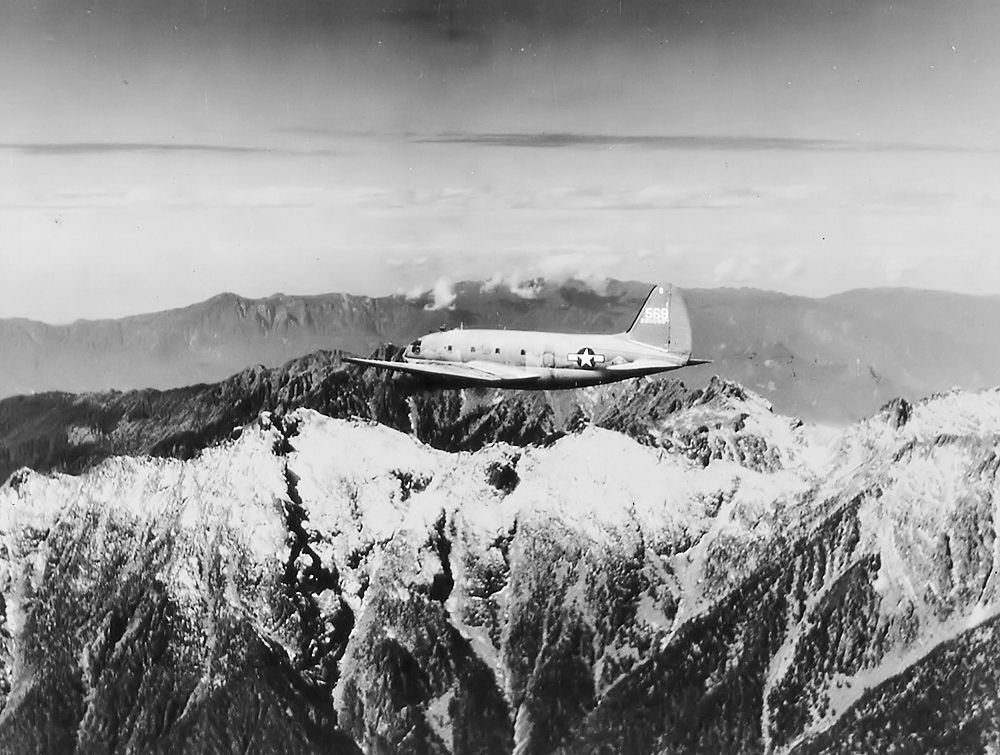 The Hump Route and the Burma Road: Two Lifelines of the War of Resistance Through YunnanOne leads through the mountains west of Xiaguan to Myanmar, the other flies over the mountains from Yunnanyi in Xiangyun. How did the Burma Road and the Hump Route maintain China's connection with the world during the most difficult phase of the War of Resistance? Why did Dali become an important node on both lifelines simultaneously?→
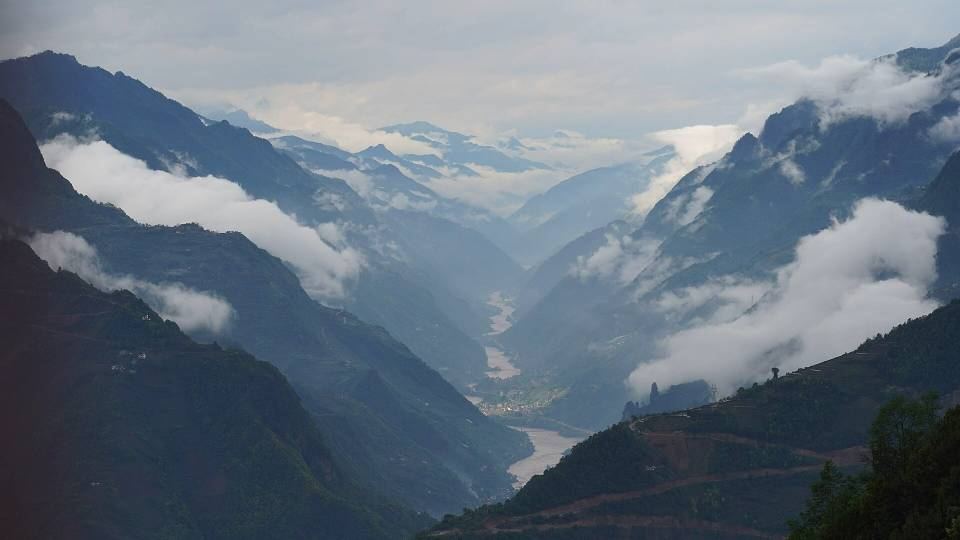 The Nujiang, Lancang, and Jinsha Rivers: the unique nature and culture of the Three Parallel RiversStarting from Dali and heading north, crossing over the Cangshan Mountains, you will enter a massive fold split open by three great rivers. The Nujiang (Salween), Lancang (Mekong), and Jinsha (Yangtze) rivers—three great rivers originating from the Qinghai-Tibet Plateau—cut through the land of northwestern Yunnan from north to south like three parallel knives. They run so close together—at their nearest point, the straight-line distance is less than seventy kilometers; and they flow side by side for over one hundred seventy kilometers before each turns and heads toward a different destination. This is the "Three Parallel Rivers," inscribed as a UNESCO World Natural Heritage site in 2003, and it is also a key to understanding Yunnan. Many people think the beauty of Yunnan is simply the wind, flowers, snow, and moon by Erhai Lake→
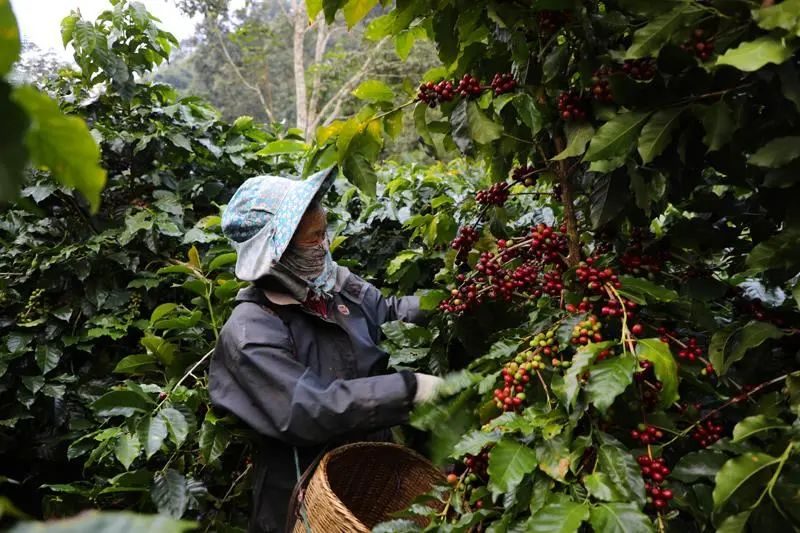 The history of Yunnan coffee: from Zhukula (a village in Yunnan) to a cup at the foot of Cangshan (a mountain in Yunnan)If you walk into the ancient town of Dali today, sit down at any café, and order a latte made with Yunnan beans, chances are you won't find it anything special. Coffee is far too common here—on Renmin Road there's one every few steps, the aroma of roasting drifts from the courtyards on Yeyu Road, and the terraces of the Chuangdancang Art District are full of people with their laptops. You might not realize that this ordinary cup of coffee is actually the end of a history spanning more than a century: its source lies in the mountains not far from the ancient town of Dali; its story begins with a French missionary and a small village almost completely cut off from the world. The story of Yunnan coffee is almost→
Comments
Comments
…