Life in Dali
Practical Entry Guide for Foreign Travelers
Jan 16, 2025

Reprinted from: China Daily
China has long been ready to expand high-level opening up, provide a series of thoughtful policies for foreign friends, and continuously improve the convenience for foreign nationals coming to and staying in China.
Welcome to share this life guide with foreign friends around you and online to help them live more conveniently in China. Welcome to China!
Image source: CCTV News. The same below.
I. Applying for a telecom card
Bring your passport or Foreign Permanent Resident ID Card to the service halls of telecom operators such as China Telecom, China Mobile, China Unicom, and China Broadnet to apply for a mobile SIM card and activate mobile communication services.
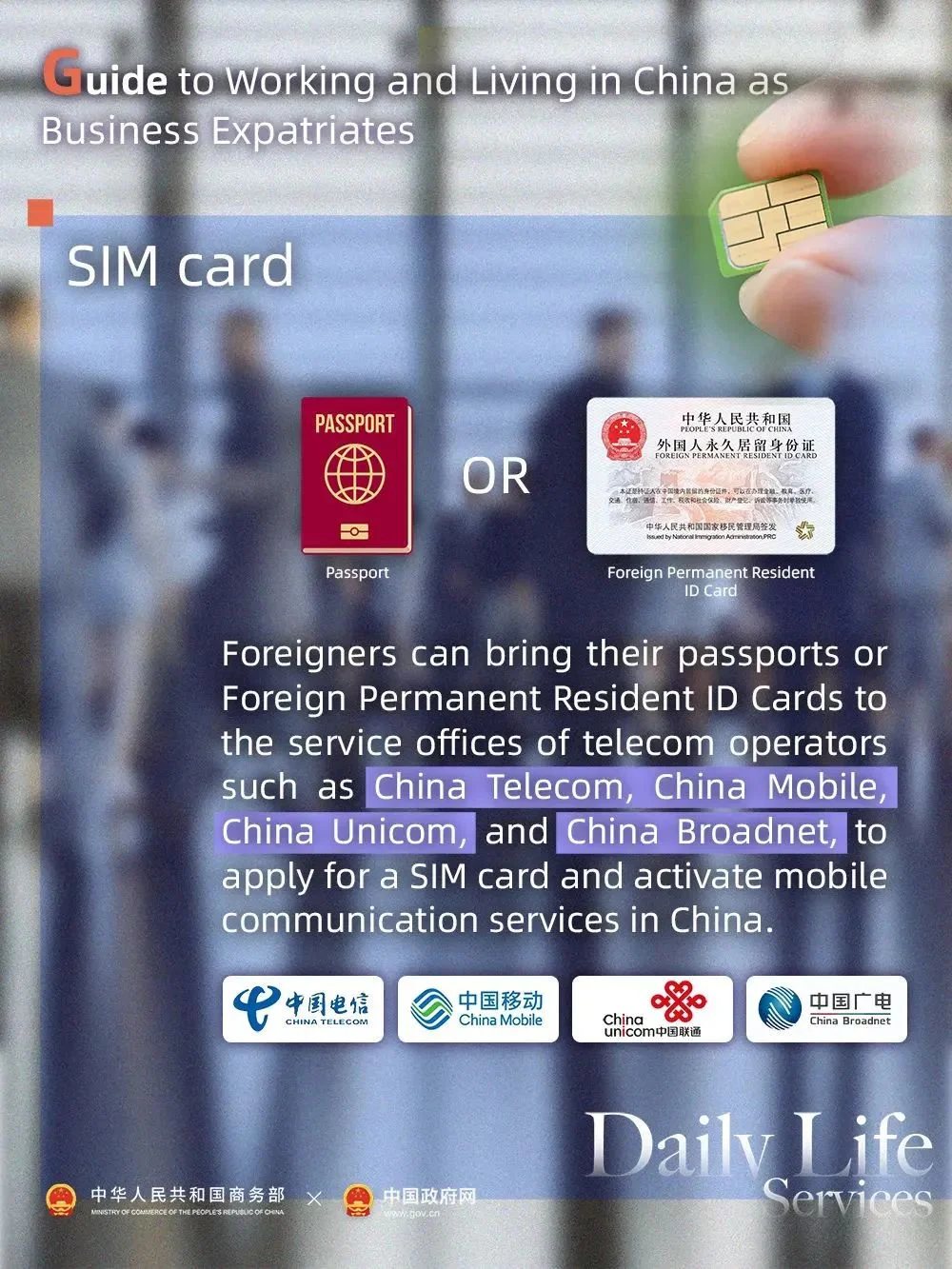 Foreigners can bring their passports or Foreign Permanent Resident ID Cards to the service offices of telecom operators such as China Telecom, China Mobile, China Unicom, and China Broadnet, to apply for a SIM card and activate mobile communication services in China.
II. Applying for a bank card
Bring your passport or Foreign Permanent Resident ID Card and a domestic mobile phone number to the business hall of a commercial bank to apply (specific requirements vary among commercial banks; consult the customer manager at the business hall for details).
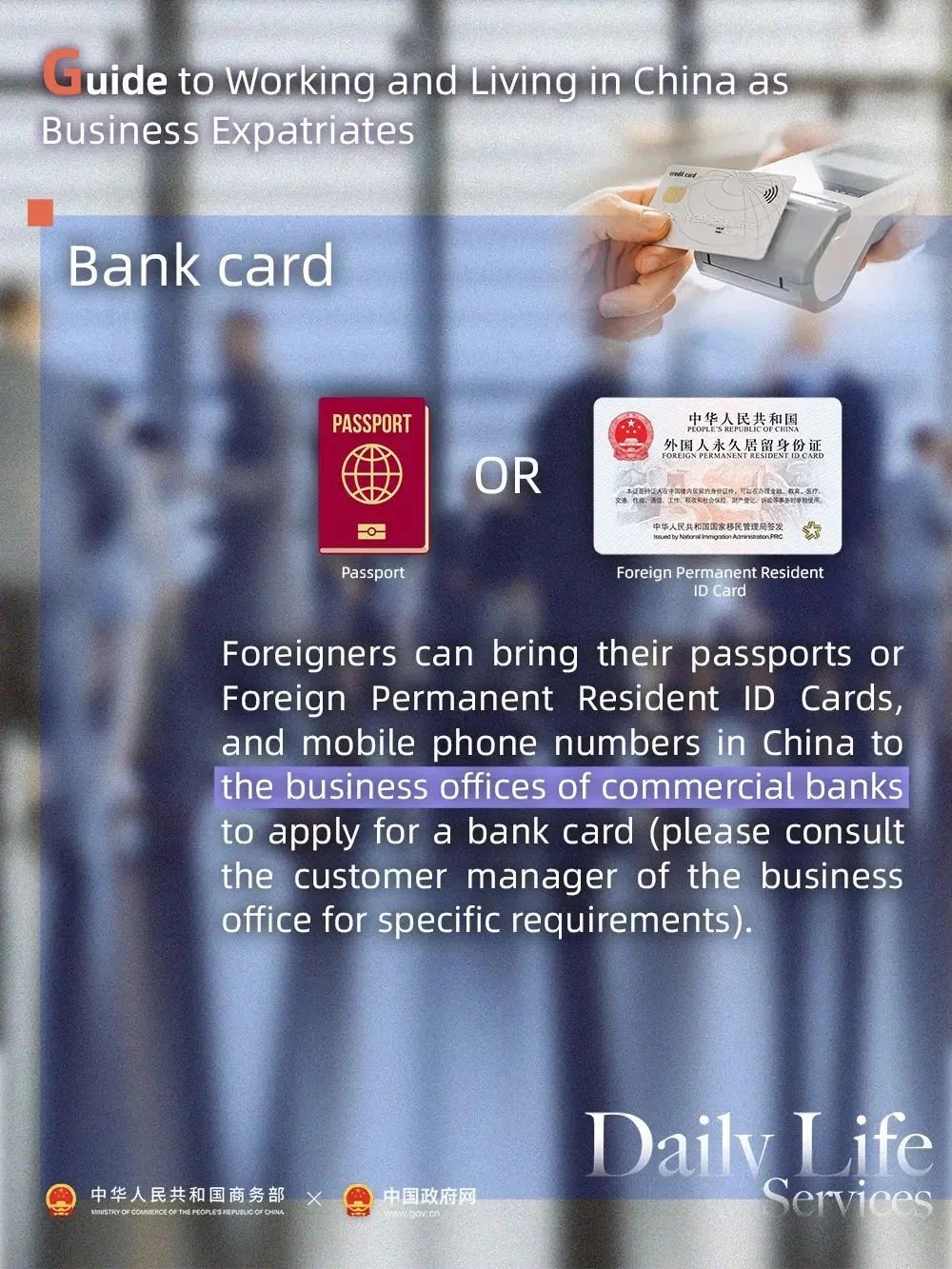 Foreigners can bring their passports or Foreign Permanent Resident ID Cards and mobile phone numbers in China to the business offices of commercial banks to apply for a bank card (please consult the customer manager of the business office for specific requirements).
III. Activating mobile payment
(1) Download and install the WeChat or Alipay APP on your phone, register according to the APP instructions, and enter information such as a foreign or domestic mobile phone number.
(2) Open the APP and link an international bank card bearing logos such as Mastercard, Visa, JCB, Diners Club, and Discover; or a domestic bank card bearing the UnionPay logo.
(3) When paying, open the APP, scan the merchant's payment QR code, or show the merchant your payment QR code.
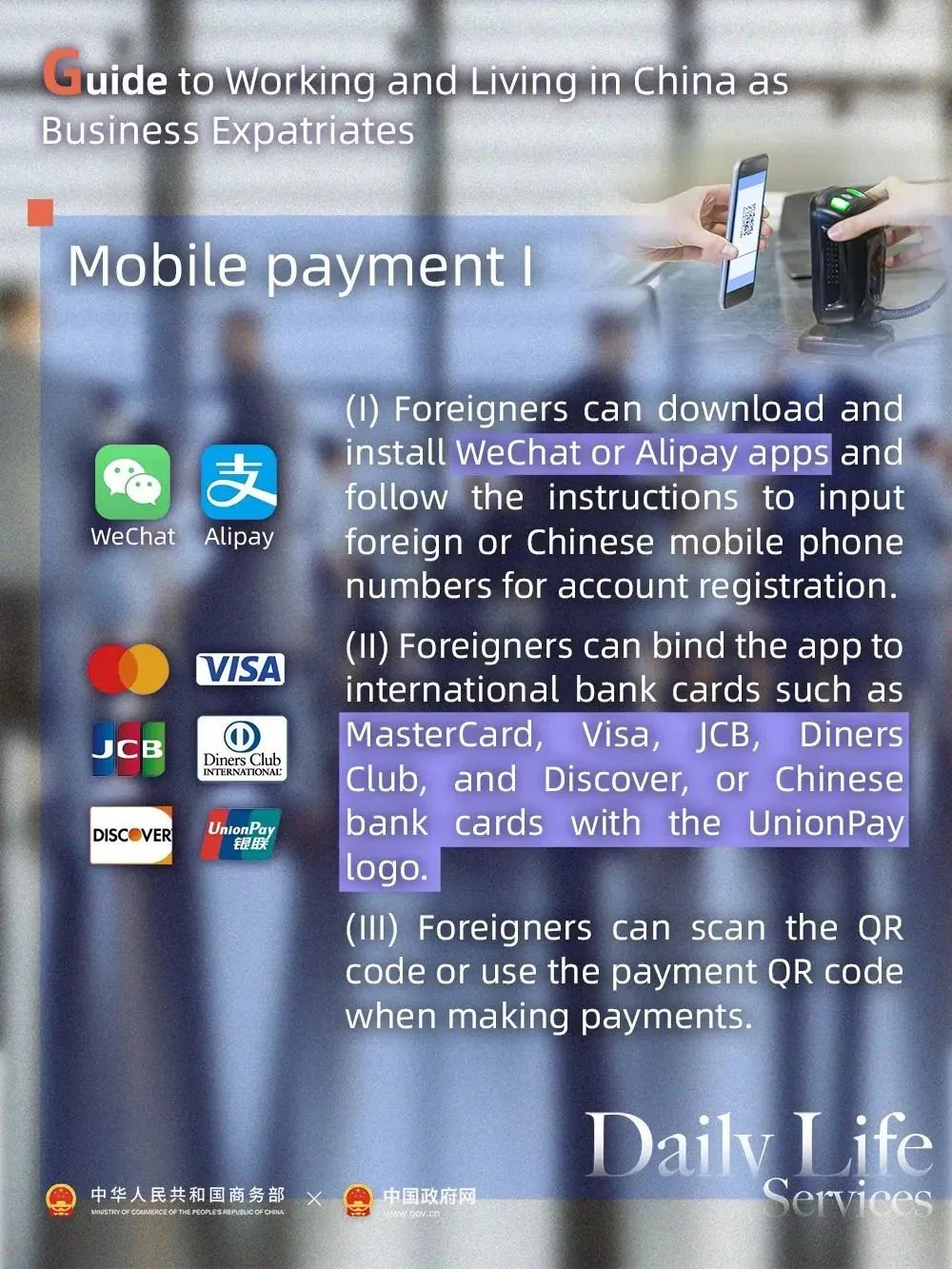 (I) Foreigners can download and install WeChat or Alipay apps and follow the instructions to input foreign or Chinese mobile phone numbers for account registration.
(II) Foreigners can bind the app to international bank cards such as MasterCard, Visa, JCB, Diners Club, and Discover, or Chinese bank cards with the UnionPay logo.
(III) Foreigners can scan the QR code or use the payment QR code when making payments.
Notes on linking international bank cards:
1. Using Alipay or WeChat to initiate a connection to an international bank card requires authorization and consent from the foreign issuing bank. Some issuing banks may reject the binding request because their systems cannot recognize the connection information. It is recommended to contact the issuing bank's customer service or use a domestic bank card instead.
2. When using Alipay or WeChat with a linked international bank card for QR code payments, if the single transaction amount does not exceed 200 yuan, the user does not need to pay an additional service fee; if the single transaction amount exceeds 200 yuan, the user needs to pay a service fee of 3% of the transaction amount.
3. The consumption limit of Alipay and WeChat for linked international bank cards is no more than 50,000 US dollars per year and no more than 5,000 US dollars per transaction. Users who link international bank cards are advised to use mobile payment according to the application scenario.
 Notes for binding international bank cards:
When binding an international bank card to Alipay or WeChat, it is necessary to obtain authorization from the foreign issuing bank. However, some issuing banks may reject the binding request due to their system's inability to recognize the connection information. In such cases, it is advisable to contact the issuing bank's customer service center or consider using a Chinese bank card instead.
When using Alipay or WeChat for QR code payments through the bound international bank card, users are not required to pay an additional service fee if the transaction amount does not exceed 200 yuan; or, users need to pay a service fee at 3% of the transaction amount if the amount exceeds 200 yuan.
Alipay and WeChat have set transaction limits for bound international bank cards, with an annual limit of 50,000 US dollars and a single transaction limit of 5,000 US dollars. It is recommended that users who have bound international bank cards to the APPs consider your specific use cases before using mobile payment.
4. Users of e-wallets AlipayHK, WeChat Pay HK (Hong Kong Special Administrative Region of China), mPay (Macao Special Administrative Region of China), Kakao Pay (Republic of Korea), Touch 'n Go eWallet (Malaysia), HiPay (Mongolia), Changi Pay (Singapore), OCBC (Singapore), Naver Pay (Republic of Korea), Toss Pay (Republic of Korea), and TrueMoney (Thailand) can use the above wallets to make direct QR code payments in the Chinese mainland.
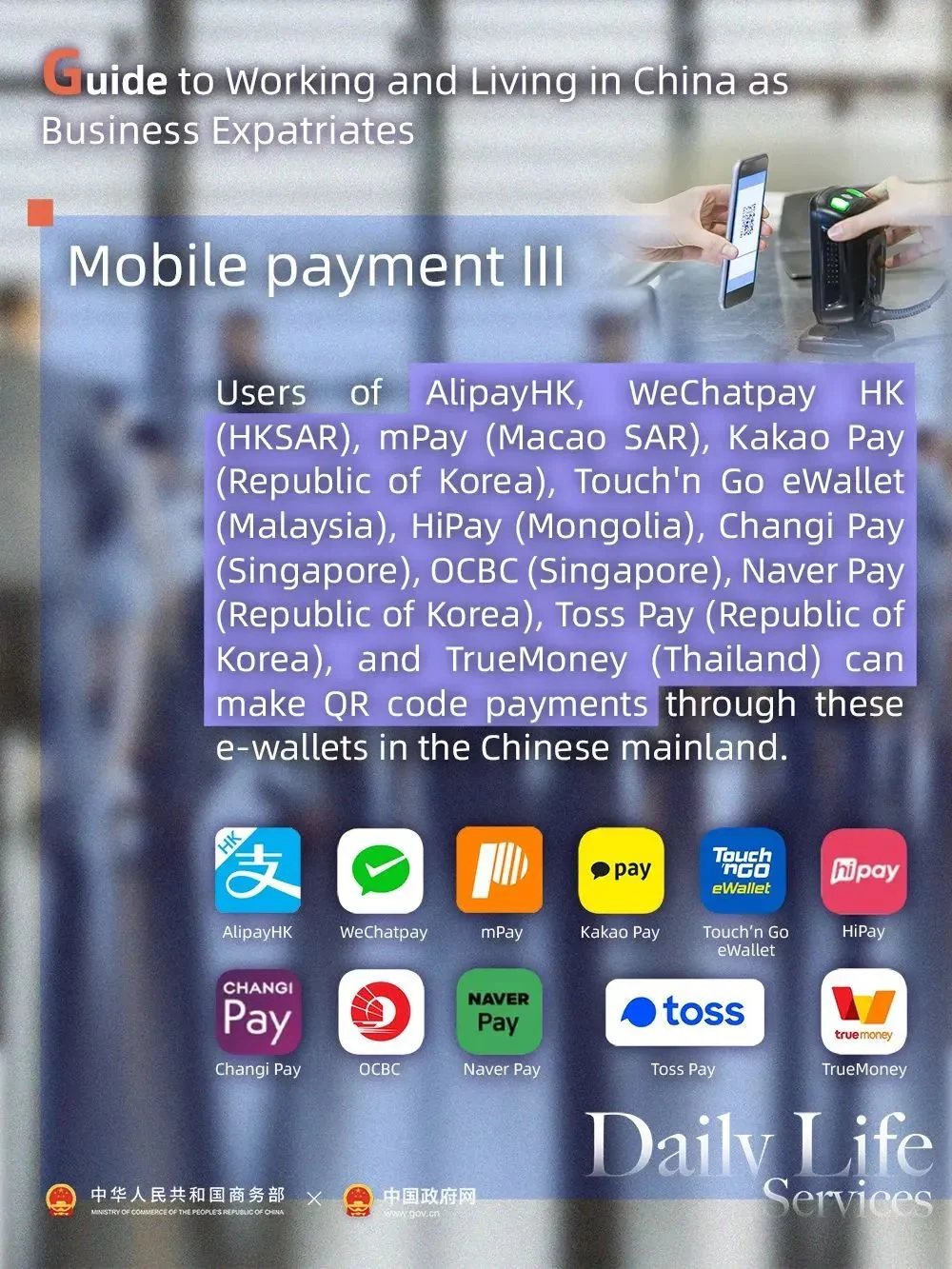 4. Users of AlipayHK, Wechatpay HK (HKSAR), mPay (Macao SAR), Kakao Pay (Republic of Korea), Touch'n Go eWallet (Malaysia), HiPay (Mongolia), Changi Pay (Singapore), OCBC (Singapore), Naver Pay (Republic of Korea), Toss Pay (Republic of Korea), and TrueMoney (Thailand) can make QR code payments through these e-wallets in the Chinese mainland.
IV. Foreign exchange
(1) Before entry, overseas visitors to China can exchange RMB cash in advance in the relevant country or region and bring it into China (the limit for each person carrying RMB in or out of the country is 20,000 yuan each time).
(2) After entry, exchange can be made at commercial bank counters, foreign currency exchange institutions, and self-service exchange machines at international airports, land ports, ports, and other entry ports, or RMB cash can be withdrawn using international bank cards at ATMs.
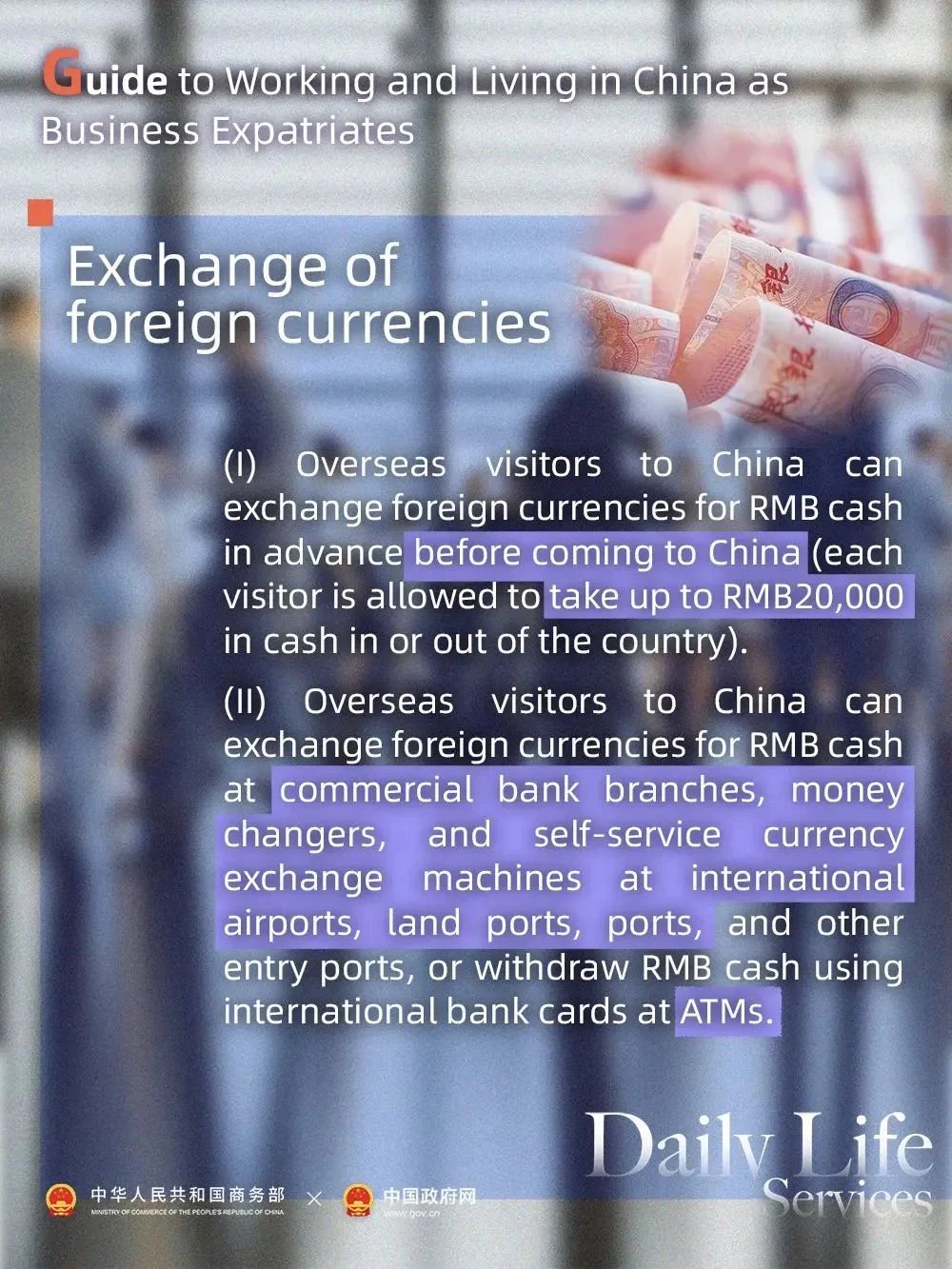 (I) Overseas visitors to China can exchange foreign currencies for RMB cash in advance in relevant countries or regions before bringing it into China (each visitor is allowed to take up to 20,000 yuan in cash in or out of the country).
(II) Overseas visitors to China can exchange foreign currencies for RMB cash at commercial bank branches, money changers, and self-service currency exchange machines at international airports, land ports, ports, and other entry ports, or withdraw RMB cash using international bank cards at ATMs.
V. Taking transportation
(1) Train
■ Ticket purchase
1. Documents to use. When foreign passengers purchase tickets or pay for supplementary tickets at station ticket windows, railway ticket agents' sales offices, or on trains, the valid identity documents that can be used include: Foreign Permanent Resident ID Card, foreigner's passport, foreigner's exit-entry permit, seafarer's certificate, receipt of acceptance of a foreigner's visa application issued by the exit-entry administration department of China's public security organs, passport loss report certificate, and temporary international travel documents issued by embassies and consulates of various countries in China (with a valid visa or stay permit issued by the exit-entry administration department of China's public security organs attached). When purchasing tickets through the 12306 website, 12306 APP, or booking phone line, the Foreign Permanent Resident ID Card and foreigner's passport can be used. When purchasing tickets through self-service ticket machines, the Foreign Permanent Resident ID Card can be used.
 (I) Train.
■ Ticket purchase
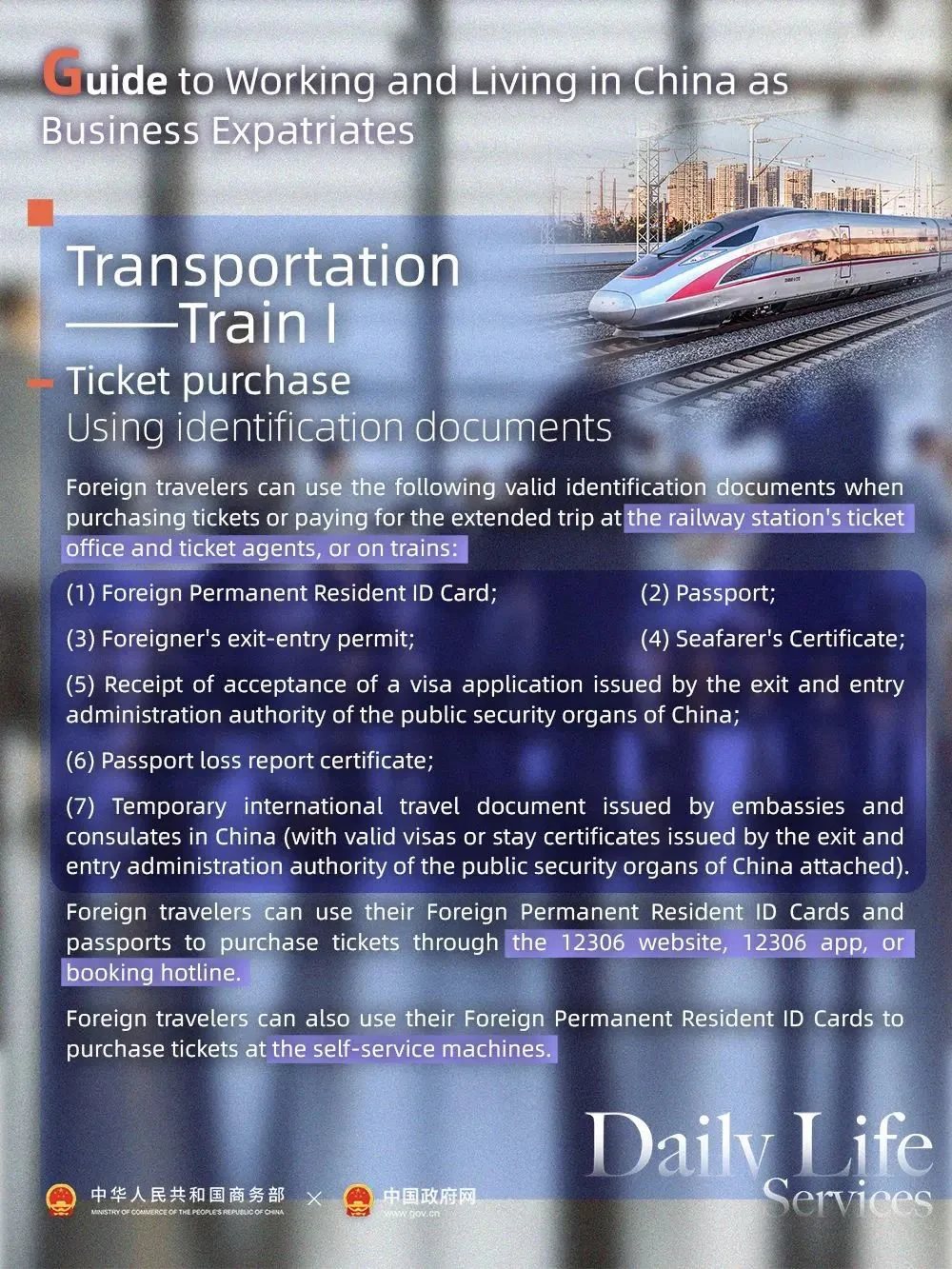
1. Using identification documents. Foreign travelers can use the following valid identification documents when purchasing tickets or paying for the extended trip at the railway station's ticket office and ticket agents, or on trains:
(1) Foreign Permanent Resident ID Card;
(2) Passport;
(3) Foreigner's exit-entry permit;
(4) Seafarer's Certificate;
(5) Receipt of acceptance of a visa application issued by the exit and entry administration authority of the public security organs of China;
(6) Passport loss report certificate;
(7) Temporary international travel document issued by embassies and consulates in China (with valid visas or stay certificates issued by the exit and entry administration authority of the public security organs of China attached).
Foreign travelers can use your Foreign Permanent Resident ID Cards and passports to purchase tickets through the 12306 website, 12306 APP, or booking hotline. Foreign travelers can also use your Foreign Permanent Resident ID Cards to purchase tickets at the self-service machines.
2. Identity verification. To ensure safe and orderly passenger transport, the railway operating company implements real-name ticket sales in accordance with relevant regulations, and foreign passengers need to complete identity verification before purchasing tickets. First, log in to the 12306 English-language website or 12306 APP, fill in information such as name, nationality, and document number according to system prompts, and the system will automatically complete identity verification. You can also choose to submit a photo of the passport information page online for manual verification in the background. Second, bring your valid passport to the railway station ticket window to complete identity verification.
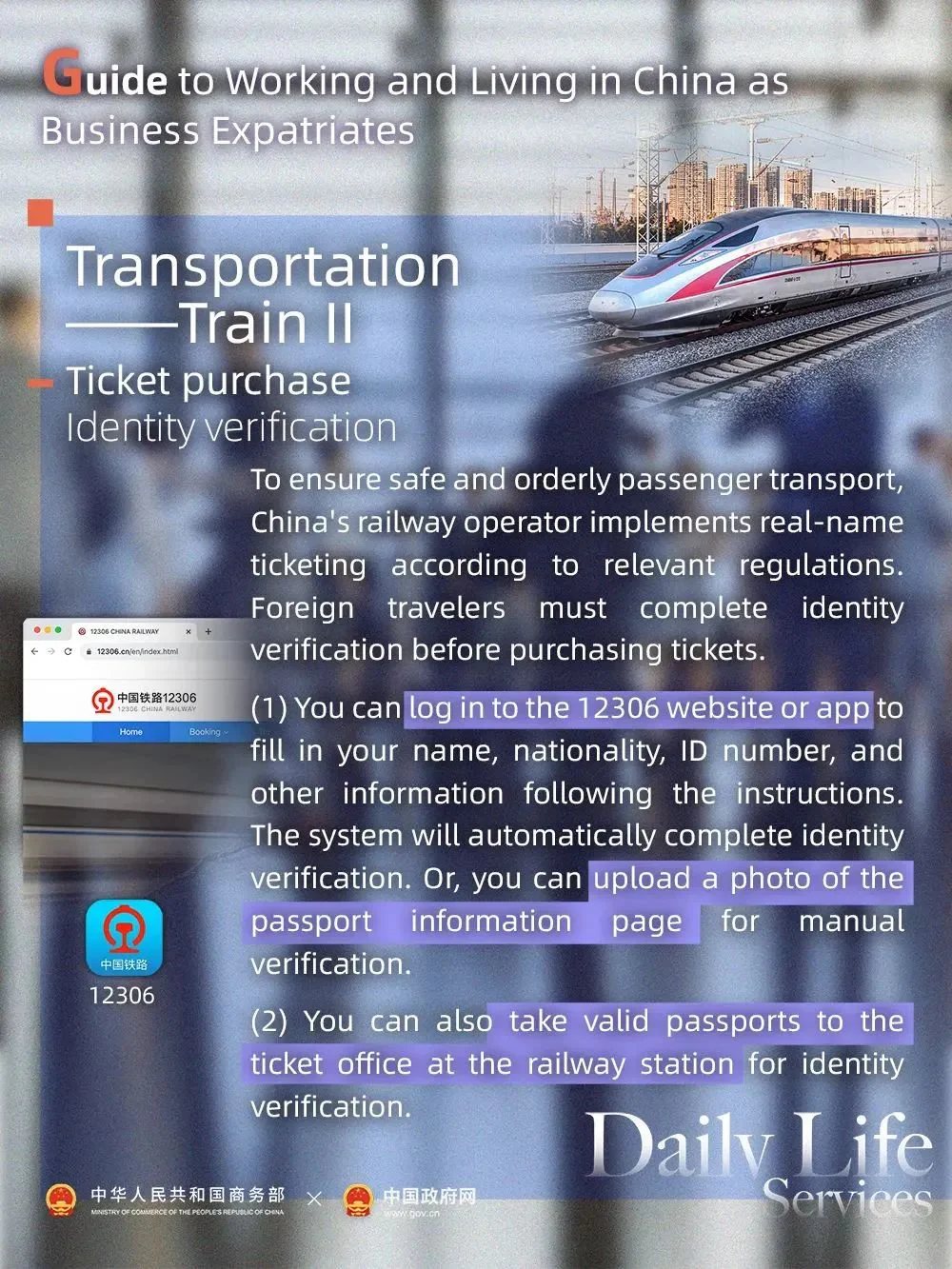 2. Identity verification
To ensure safe and orderly passenger transport, China's railway operator implements real-name ticketing according to relevant regulations. Foreign travelers must complete identity verification before purchasing tickets.
(1) You can log in to the 12306 website or app to fill in your name, nationality, ID number, and other information following the instructions. The system will automatically complete identity verification. Or, you can upload a photo of the passport information page for manual verification.
(2) You can also take valid passports to the ticket office at the railway station for identity verification.
3. Ticket purchase. After completing identity verification, foreign passengers can purchase tickets. First, purchase tickets online through the 12306 English-language website or 12306 APP, and pay the fare with Alipay, WeChat, or UnionPay bank cards. Second, purchase tickets at railway station ticket windows, and pay the fare in cash, Alipay, WeChat, or UnionPay bank cards. Some railway stations also allow ticket purchase through self-service ticket machines.
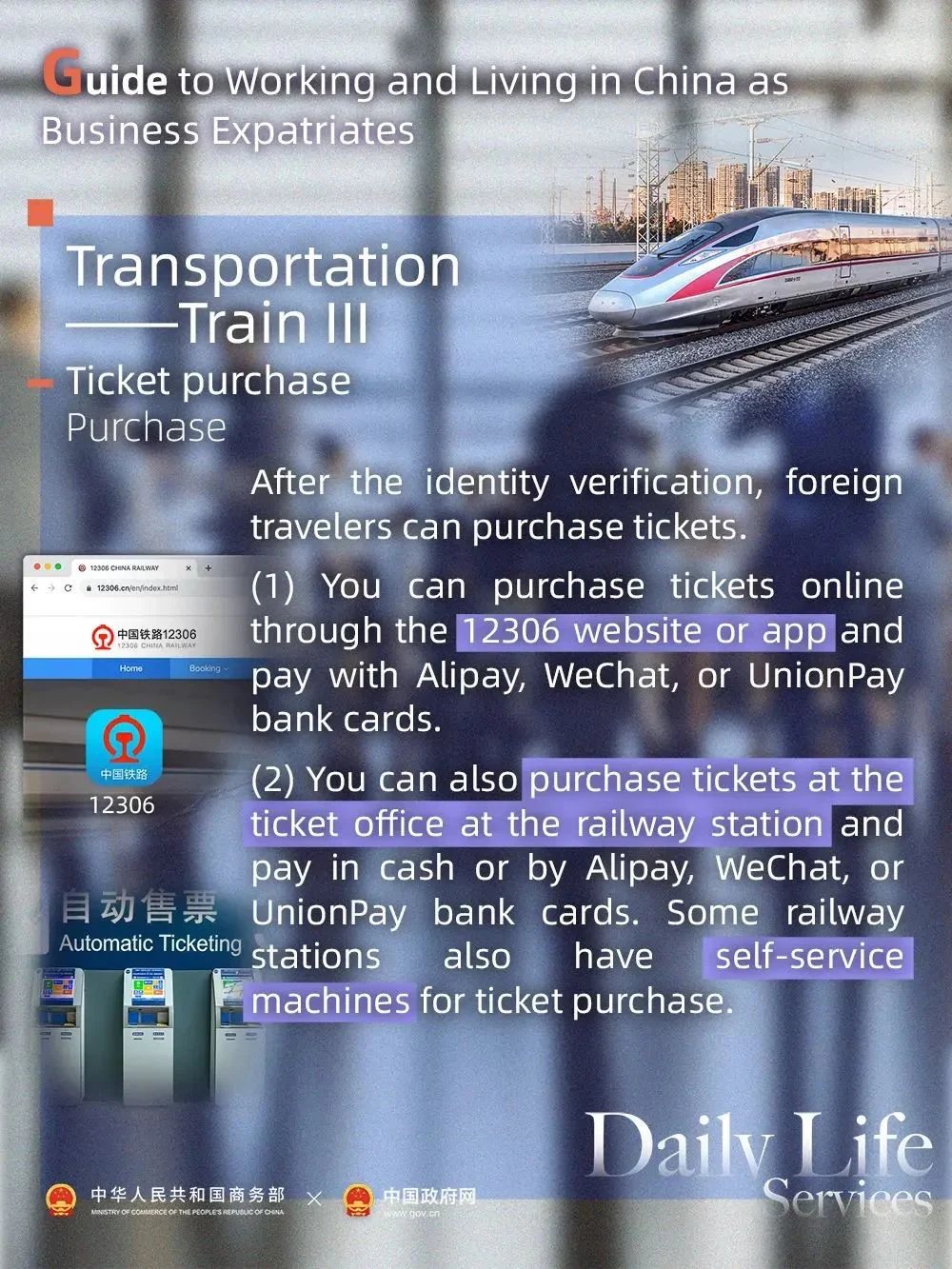 3. Purchase
After the identity verification, foreign travelers can purchase tickets.
(1) You can purchase tickets online through the 12306 website or app and pay with Alipay, WeChat, or UnionPay bank cards.
(2) You can also purchase tickets at the ticket office at the railway station and pay in cash or by Alipay, WeChat, or UnionPay bank cards. Some railway stations also have self-service machines for ticket purchase.
■ Ticket change
Foreign passengers can handle ticket changes through the 12306 English-language website, 12306 APP, or railway station ticket windows.
■ Ticket refund
Foreign passengers can handle ticket refunds through the 12306 English-language website, 12306 APP, or railway station ticket windows. A service fee may be incurred depending on the time of cancellation.
■ Station entry/exit and boarding
With the original valid identity document used when purchasing the ticket, enter and exit the station through automatic gates or staff-assisted channels, and cooperate to complete ticket verification during the journey.
For details, please log in to the China Railway 12306 website or China Railway 12306 mobile client to learn the relevant rules, or call the China Railway customer service hotline (12306) for consultation. 12306 website: https://www.12306.cn/en/index.html
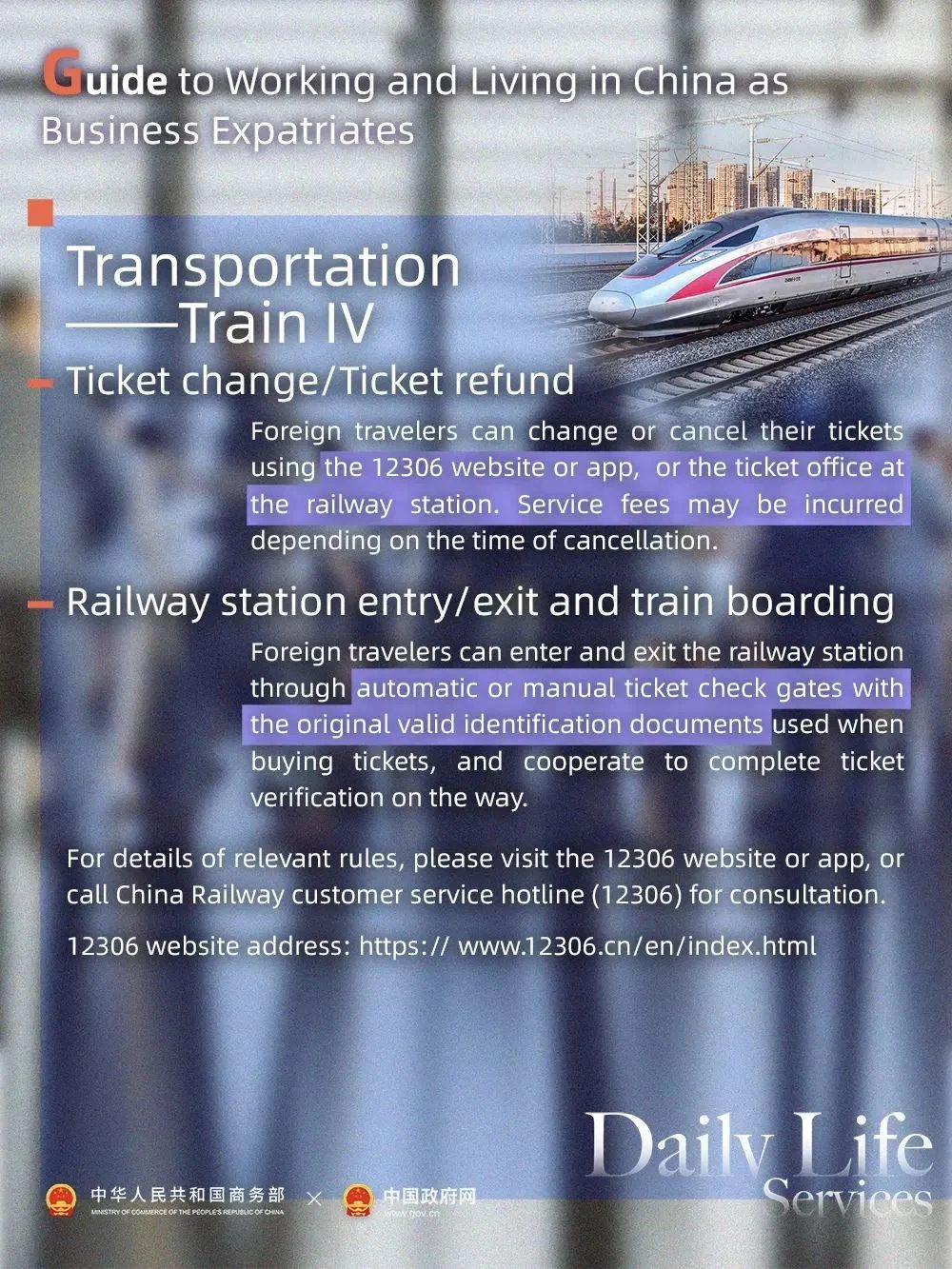
■ Ticket change
Foreign travelers can change your tickets at the 12306 website and APP, or the ticket office at the railway station.
■ Ticket refund
Foreign travelers can cancel your tickets at the 12306 website and APP, or the ticket office at the railway station. Service fees may be incurred depending on the time of cancellation.
■ Railway station entry/exit and train boarding
Foreign travelers can enter and exit the railway station through automatic or manual ticket check gates with the original valid identification documents used when buying tickets, and cooperate to complete ticket verification on the way.
For details of relevant rules, please visit the 12306 website or APP, or call China Railway customer service hotline (12306) for consultation. 12306 website address: https://www.12306.cn/en/index.html
(2) Airplane
Foreign passengers traveling by air within China can choose to book plane tickets online through airline official APPs, airline mini programs, and other ticketing platforms.
(II) Airplane.
Foreign travelers can book tickets online on the airline's official APP and WeChat mini program, or other ticketing platforms.
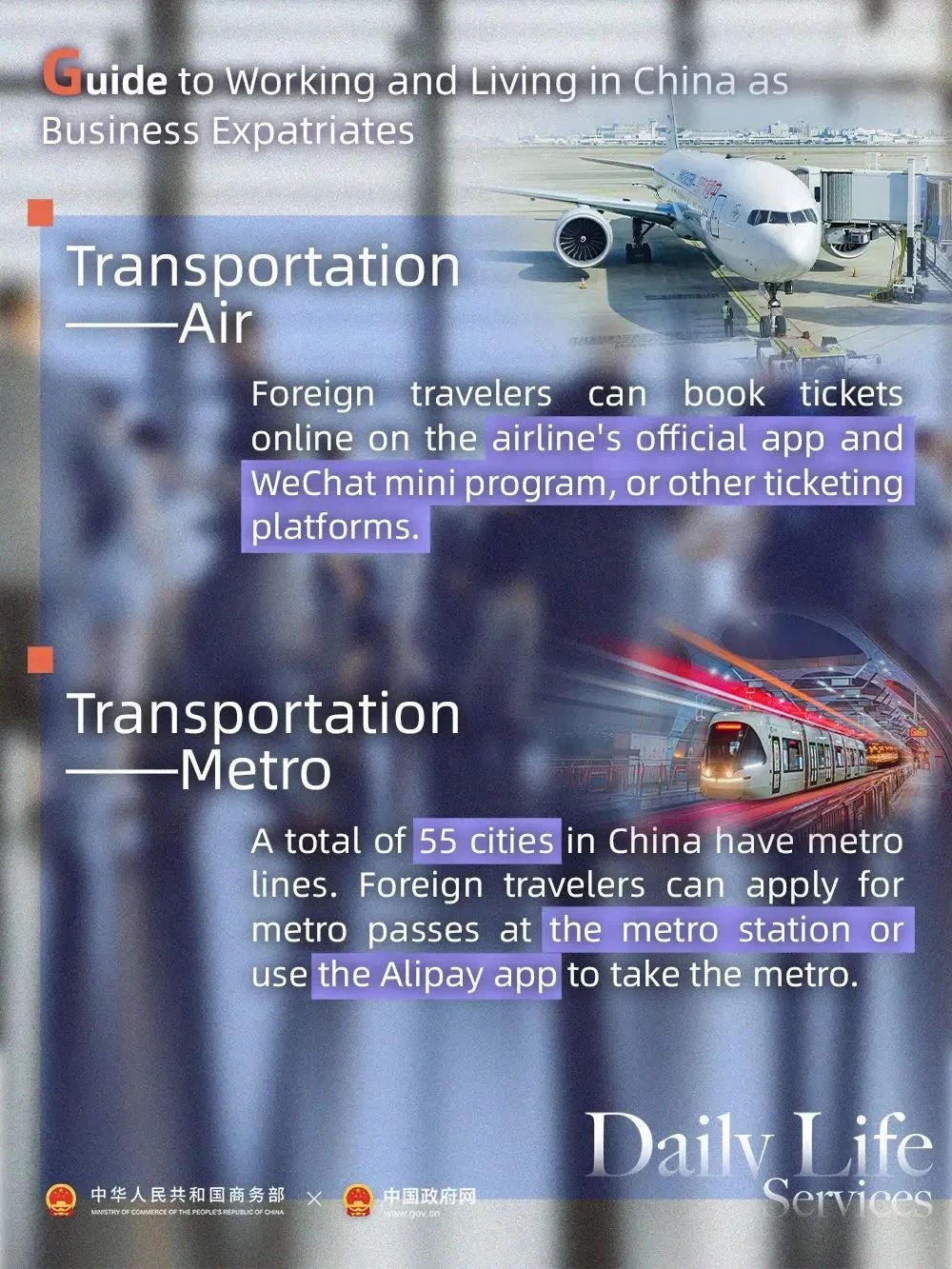
(3) Metro
At present, a total of 55 cities in China have opened metro services. Foreign passengers can apply for a ride card at metro stations or use the Alipay APP to take the metro.
(III) Metro.
A total of 55 cities in China have metro lines. Foreign travelers can apply for metro passes at the metro station or use the Alipay APP to take the metro.
(4) Bus
Foreign passengers can choose to pay in cash, apply for a bus card, or use the Alipay APP to take the bus.
1. Buses usually do not provide change, so passengers need to prepare small change in advance.
2. Bring your passport to the business outlets of the bus company to apply for a bus card; the card can be purchased with cash, WeChat, or Alipay.
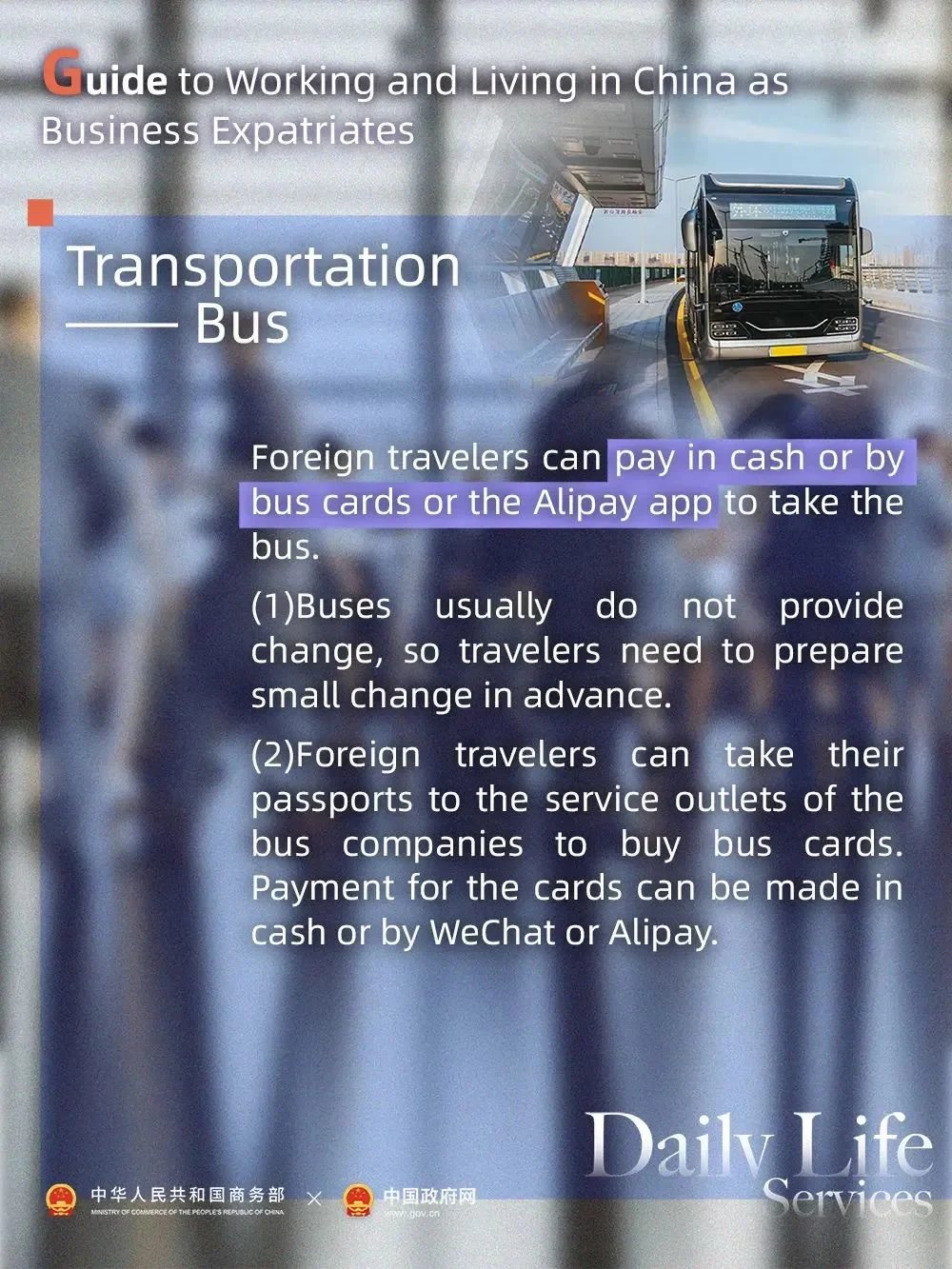 (IV) Bus.
Foreign travelers can pay in cash or by bus cards or the Alipay app to take the bus.
1. Buses usually do not provide change, so travelers need to prepare small change in advance.
2. Foreign travelers can take your passports to the service outlets of the bus companies to buy bus cards. Payment for the cards can be made in cash or by WeChat or Alipay.
(5) Online ride-hailing
Foreign passengers can use Alipay, WeChat, and the dedicated DiDi app to book online ride-hailing services.
(V) Online ride-hailing services.
Foreign travelers can use Alipay or WeChat to book online ride-hailing services.
(6) Car rental
For car rental, you can choose to rent on site at international airports or downtown rental outlets, or use a car rental APP or search for "car rental mini program" on Alipay or WeChat, register, and then reserve a car.
1. Foreign customers renting a car need to bring their passport or Foreign Permanent Resident ID Card, a valid Chinese driver's license, and an international/domestic credit card.
Note: For the first car rental, identity document information must be verified at least one working day in advance.
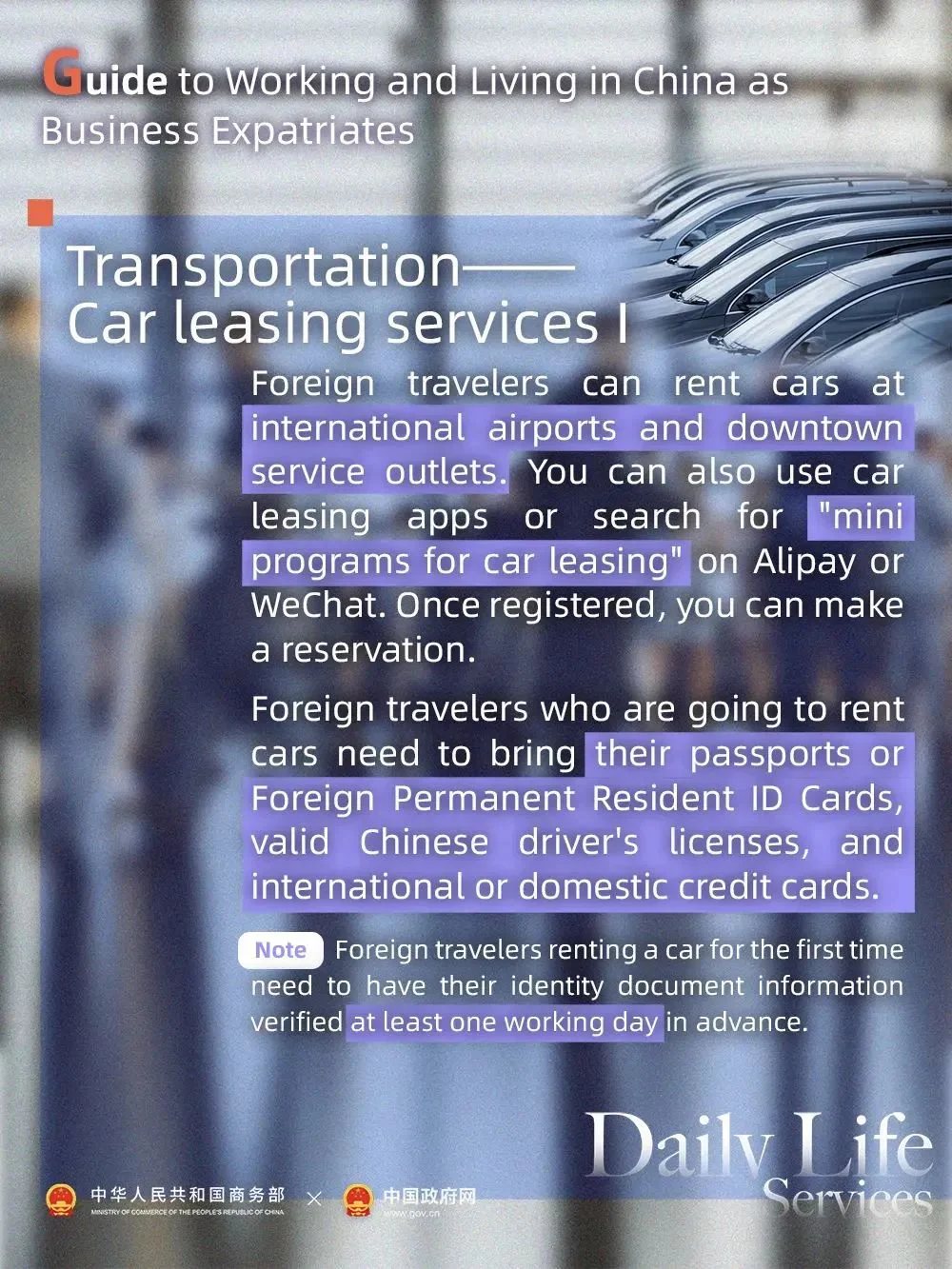
(VI) Car leasing services.
Foreign travelers can rent cars at international airports and downtown service outlets. You can also use car leasing APPs or search for "mini programs for car leasing" on Alipay or WeChat. Once registered, you can make a reservation for car leasing.
1. Foreign travelers who are going to rent cars need to bring your passports or Foreign Permanent Resident ID Cards, valid Chinese driver's licenses, and international or domestic credit cards.
Note: Foreign travelers renting a car for the first time need to have your identity document information verified at least one working day in advance.
2. Foreign customers applying for a Chinese driver's license need to bring materials such as their passport, overseas driver's license and its Chinese translation, and a recent one-inch color photo (half-length, bareheaded, full-faced, white background) to the public security traffic management service hall to apply for a temporary driving permit for small cars. For those entering China for a short-term stay, a temporary driving permit valid for 3 months can be applied for; for those staying longer than 3 months, the validity period can be extended to no more than 1 year. It can be used for multiple entries during the validity period without reapplication.
Note: At present, China has signed agreements on mutual recognition and exchange of driver's licenses with France, Serbia, Belgium, and the United Arab Emirates, allowing persons holding driver's licenses from the above countries to drive directly in China or exchange them for Chinese driver's licenses without taking a test.
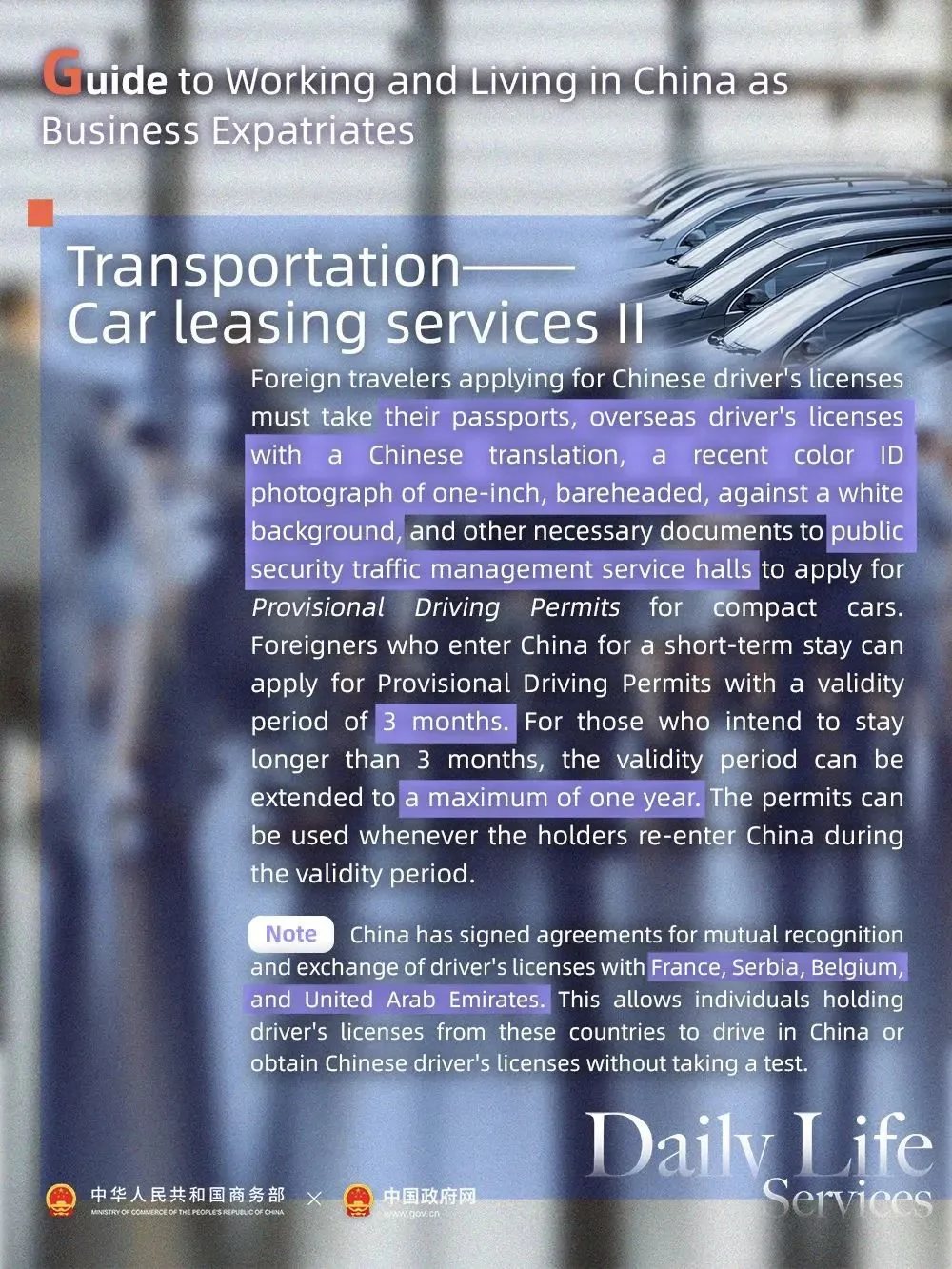
2. Foreign travelers applying for Chinese driver's licenses must take your passports, overseas driver's licenses with a Chinese translation, recent one-inch half-length, bareheaded, full-faced color photos against white background, and other necessary documents to public security traffic management service halls to apply for Provisional Driving Permits for compact cars. Foreigners who enter China for a short-term stay can apply for Provisional Driving Permits with a validity period of 3 months. For those who intend to stay longer than 3 months, the validity period can be extended to a maximum of one year. The permits can be used whenever the holders reenter China during the validity period without the need for reapplication.
Note: China has signed agreements for mutual recognition and exchange of driver's licenses with France, Serbia, Belgium, and the United Arab Emirates. This allows individuals holding driver's licenses from the aforementioned countries to drive in China or obtain Chinese driver's licenses without taking a test.
VI. Accommodation
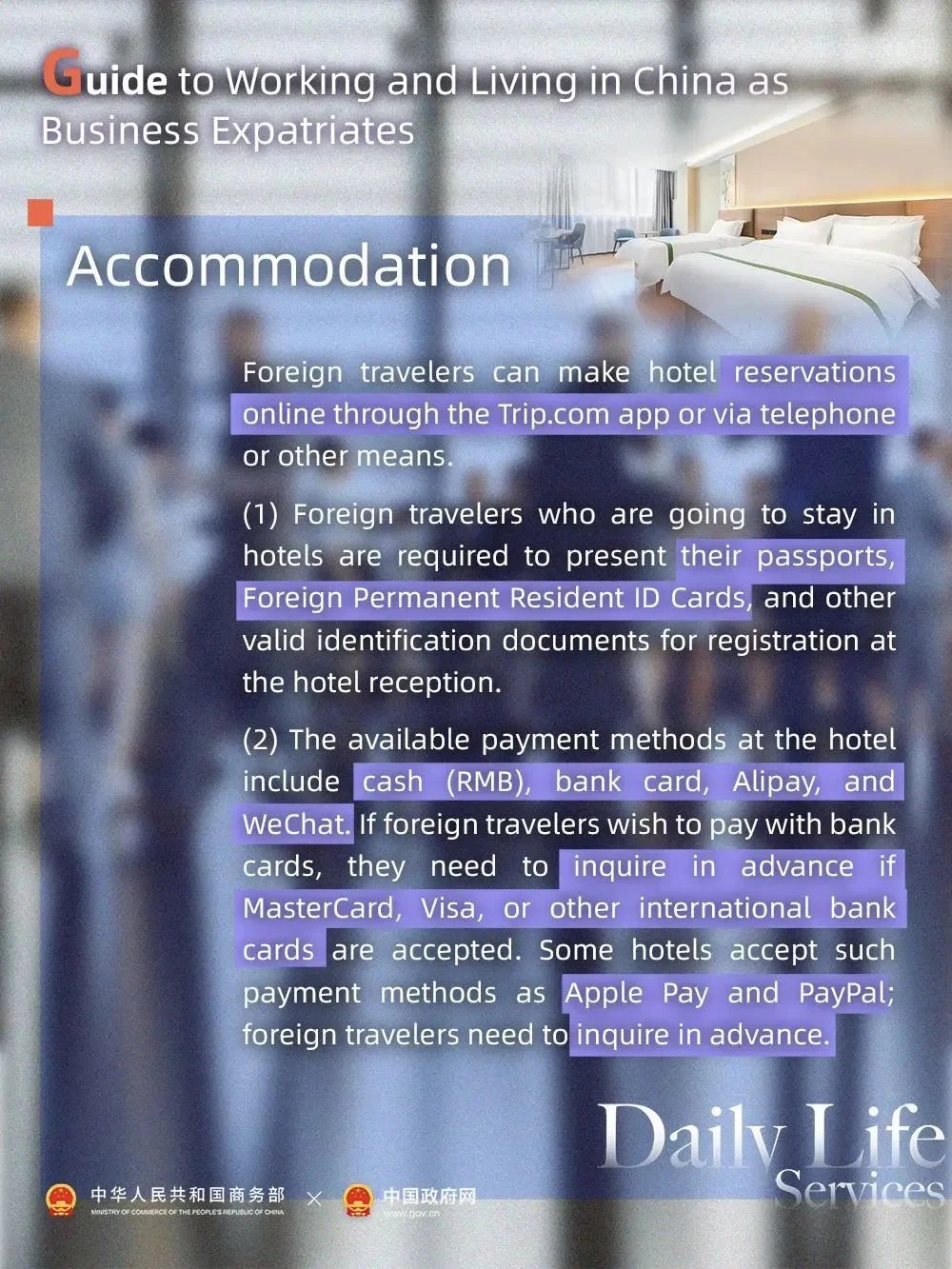
Foreign passengers can book hotels online through the Ctrip international version Trip.com APP or by phone or other means.
(1) To stay in a hotel, a passport, Foreign Permanent Resident ID Card, or other valid document must be provided for registration at the hotel front desk.
(2) Payment methods at the hotel can be cash (RMB), bank card, Alipay, or WeChat. If paying by bank card, please inquire in advance whether Mastercard, Visa, and other international bank cards are accepted. Some hotels support payment methods such as Apple Pay and PayPal; please inquire in advance before payment.
Foreign travelers can make hotel reservations online through the Trip.com APP or via telephone or other means.
(I) Foreign travelers who are going to stay in hotels are required to present your passports, Foreign Permanent Resident ID Cards, and other valid identification documents for registration at the hotel reception.
(II) The available payment methods at the hotel include cash (RMB), bank card, Alipay, and WeChat. If foreign travelers wish to pay with bank cards, you need to inquire in advance if Mastercard, Visa, or other international bank cards are accepted. Some hotels accept such payment methods as Apple Pay and PayPal; foreign travelers need to inquire in advance before making a payment.
Dali in depth
 Dali Wild Mushrooms: Mushroom Season, Table Recipes, and Two Thousand Years of Mushroom-Eating HistoryEvery June, when the rainy season arrives in Yunnan, mushrooms start to pop up. Yunnan has 2,753 known wild mushroom species, accounting for more than half of China's total. This article covers the dried beef mushroom (ganba jun), termite mushroom (jizong), green-headed mushroom (qingtou jun), matsutake, and jianshouqing on Dali people's tables, how locals stir-fry them and preserve them in oil until next year, and also records from Zhuangzi, Bencao Gangmu, and Xu Xiake of Yunnan people eating mushrooms for over two thousand years—as well as the safety bottom line that must be upheld when foraging and eating mushrooms.→
 Scripts, Songs, and Wine in the Valleys: The Spread of Christianity in Yunnan's BorderlandsFrom James O. Fraser's early encounters with the Lisu people in Tengchong, explore the scripts, songs, churches, and wine of Yunnan's borderlands.→
 The Hump Route and the Burma Road: Two Lifelines of the War of Resistance Through YunnanOne leads through the mountains west of Xiaguan to Myanmar, the other flies over the mountains from Yunnanyi in Xiangyun. How did the Burma Road and the Hump Route maintain China's connection with the world during the most difficult phase of the War of Resistance? Why did Dali become an important node on both lifelines simultaneously?→
 The Nujiang, Lancang, and Jinsha Rivers: the unique nature and culture of the Three Parallel RiversStarting from Dali and heading north, crossing over the Cangshan Mountains, you will enter a massive fold split open by three great rivers. The Nujiang (Salween), Lancang (Mekong), and Jinsha (Yangtze) rivers—three great rivers originating from the Qinghai-Tibet Plateau—cut through the land of northwestern Yunnan from north to south like three parallel knives. They run so close together—at their nearest point, the straight-line distance is less than seventy kilometers; and they flow side by side for over one hundred seventy kilometers before each turns and heads toward a different destination. This is the "Three Parallel Rivers," inscribed as a UNESCO World Natural Heritage site in 2003, and it is also a key to understanding Yunnan. Many people think the beauty of Yunnan is simply the wind, flowers, snow, and moon by Erhai Lake→
 The history of Yunnan coffee: from Zhukula (a village in Yunnan) to a cup at the foot of Cangshan (a mountain in Yunnan)If you walk into the ancient town of Dali today, sit down at any café, and order a latte made with Yunnan beans, chances are you won't find it anything special. Coffee is far too common here—on Renmin Road there's one every few steps, the aroma of roasting drifts from the courtyards on Yeyu Road, and the terraces of the Chuangdancang Art District are full of people with their laptops. You might not realize that this ordinary cup of coffee is actually the end of a history spanning more than a century: its source lies in the mountains not far from the ancient town of Dali; its story begins with a French missionary and a small village almost completely cut off from the world. The story of Yunnan coffee is almost→
Comments
Comments
…